
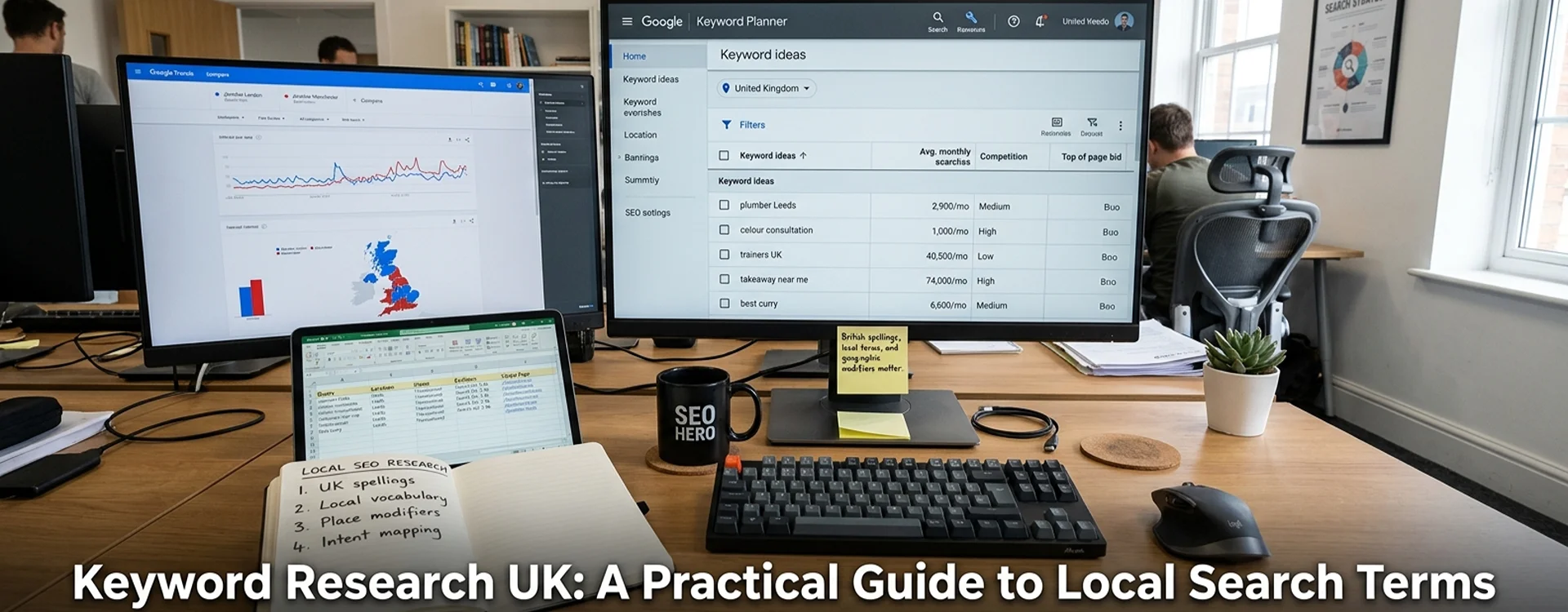
For UK businesses, keyword research begins with data that is filtered for the UK, customer language, and local intent. British spellings, alternative product names, and geographical modifiers are a worthwhile first sift through terms. Then you should sift by the job you want done. Make use of Keyword Planner, Google Trends, and Search Console together, and do not just depend on one volume search.
What makes UK search language different?
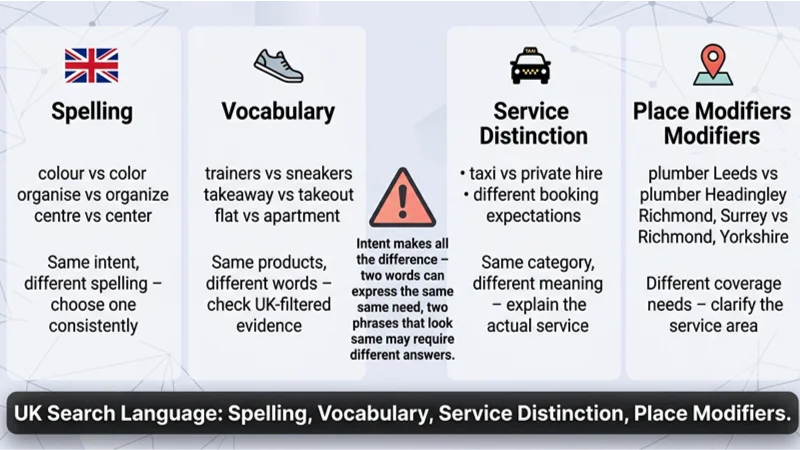
Separate spelling, vocabulary, and service meaning at the very beginning. “Color” and “colour” are spelling variations. Sneakers are also called trainers. Don’t automatically refer to a taxi as “private hire” or vice versa, as they can mean different things. Sorting these differences early is a core part of UK keyword research, because each variation can reflect a different audience or intent. According to the style guide, which is useful as house style, GOV.UK recommends UK English, including “organise” rather than “organize.” There is no evidence that it improves rankings.
Review the specific search results for each target phrase: are searchers finding transactional product pages, informational guides, directories, or local service providers? Only build a distinct page when you are providing a genuinely separate, valuable answer.
| Research dimension | Example terms | What to investigate | Recommended starting point |
|---|---|---|---|
| Spelling | color/color | Same intent and results? | One page using consistent spelling |
| Vocabulary | trainers/sneakers | Same products and audience? | Compare UK-filtered evidence. |
| Local wording | takeaway/takeout | Which wording customers use | Check inquiries and search queries. |
| Place modifier | plumber Leeds / plumber Headingley | Different coverage needs? | Explain genuine service availability. |
| Place ambiguity | Richmond, Surrey / Richmond, Yorkshire | Which location is intended? | Clarify the county or service area. |
| Service distinction | taxi / private hire | Different booking expectations? | Explain the actual service. |
Intent makes all the difference. Two words can express the same need; two phrases that look the same may require different answers.
Keyword research UK businesses can use. Here’s a 4-step implementation plan.
1. Create a seed list using consumer language
Gather phrases based on questions, category filters, sales conversations, and current website searches. Include variations for spelling, including product synonyms, town names, etc. in another column. Don’t create jargon to sound local: capture the language customers really use. It’s helpful to include original terms with your own preferences so that strange language isn’t mistakenly discarded.
2. Set location before comparing demand.
In Google Keyword Planner, choose United Kingdom, and then look at locations or cities. Every export will tag the location, date range, and network settings. Average monthly searches are for close variants. Competition is for ad share, not organic rank. Take the figures to be just estimates rather than actual counts of the individual spellings.
3. Check the validity of geography and seasonality.
When analyzing multiple alternatives, make sure to use the same geography and time frame in Google Trends. The trends demonstrate interest on a scale of zero to 100, rather than monthly search totals; equal regional scores don’t mean equal numbers of searches. Use Search Console to check visibility, queries, impressions, clicks, and position.
4. Map intent to useful pages
Check out the results for each phrase you are in the running for: are searchers finding products, guides, directories, or local providers? Collect terms when there is a single page for them. Advise a distinct page only when a distinct, worthy answer is being provided. Because several pages aimed at the same need can lead to keyword cannibalisation, Google has said to focus on content designed to help people, rather than attract traffic.
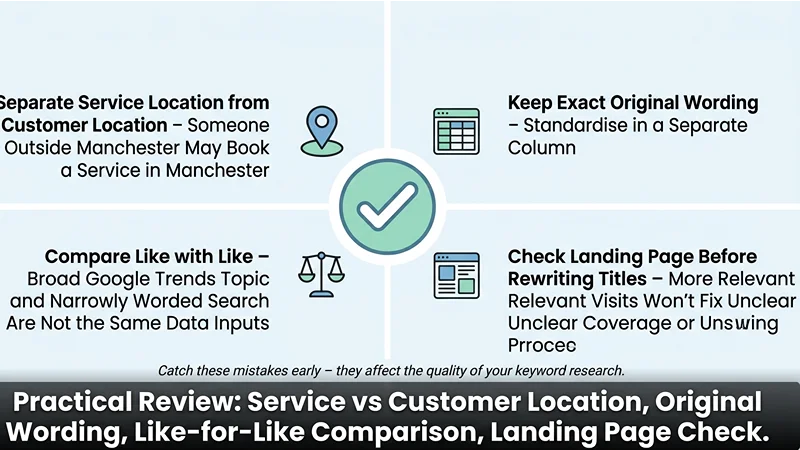
Practical review box: catch these mistakes early.
- Separate the service location from the customer location as somebody outside Manchester may book a service in Manchester.
- Keep your spreadsheet with the exact original wording; make it standardised in a separate column.
- Comparing like with like. A broad Google Trends topic and a narrowly worded search term are not the same data inputs.
- Check the landing page before rewriting titles. More relevant visits won’t fix unclear coverage or an unusable booking process.
FAQS
How do I perform keyword research for a UK business?
Begin by considering the questions your customers have regarding your service and products. Make a seed list, make use of the UK targeting in the Keyword Planner, and compare the relevant locations. After that, check the search results and assign an intent to a page. Write down your assumptions so that later inquiries and performance data can confirm or contest them.
What is the best tool for UK keyword research?
Begin using the Keyword Planner for estimated demand and geographical targeting, then move to Google Trends for a snapshot of the relative interest, and finally take a look at Search Console for your own visibility. No one tool can replace the others, as they answer different questions. Opt for extra software only when there is a defined research need those resources do not meet.
Does British spelling help SEO?
Use British spelling to keep UK-facing content consistent and appropriate for its audience. However, the cited guidance doesn’t establish a standalone ranking bonus for “colour” over “color”. Follow your house style, preserve official brand names and prioritise clear explanations over inserting every possible spelling variant into the copy.
How do I find regional keywords in the UK?
Once you filter the research by location, combine the customer language with the relevant towns, districts, and service areas. While Google Trends can show regional interest, that interest is relative. If we consider a regional expression as proof to be validated, that doesn’t mean we can label “popular in Yorkshire” as proof without proof.
Should I focus on both UK and US spellings?
When both spellings have the same need, start with one page. Before making another, set up what additional value it would provide. Because of Keyword Planner’s close-variant grouping, reported volumes may not cleanly separate the alternatives. Different content might be warranted for a country because of its specific requirements. Spelling alone is a weak reason for an editorial difference.
Does every town need its own landing page?
Nay. On different pages, answer distinct local queries about availability, delivery, amenities, or service conditions. If your page has been edited to add nothing except a new place name, think again. If somebody showed up directly on the results page, would they find useful information? That’s the practical test. It’s consistent with Google’s overall people-first guidance.
How do I rank for local keywords?
Get an idea of the page you could create based on relevance, service coverage, and likely inquiry value. Avoid dismissing a phrase only due to its low score. In the same vein, don’t take it for granted that it will convert well: record it as a test and assess actual enquiries alongside available search-performance evidence.
Your next actions
Create a worksheet with these columns: query, location, intent, evidence, target page, and next action. Research one service first, then expand the process. If you would like help turning that worksheet into a plan, Webranko can support your UK SEO.
Be the first to leave a comment below.