
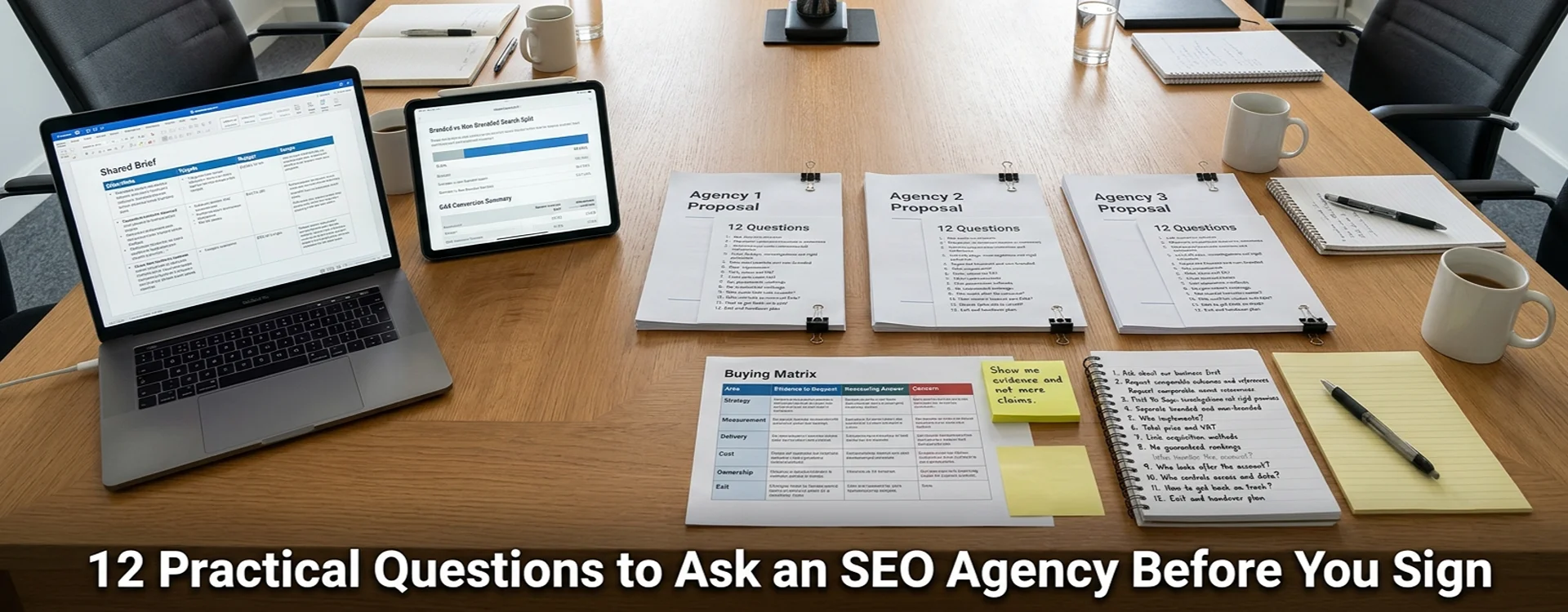
Asking the right questions of an SEO agency before signing a contract is invaluable to your ROI. You need a solid understanding of the agency’s methodology from the start, including the results they are working to achieve, their first-quarter priorities, and how they will measure and be held accountable for results.
In addition, you want to gain insight into the implementation process, including what the fees and contracts entail, their link-building practices, and who will own the account should you choose to leave. Ask for evidence, not just claims. When comparing proposals, make sure they align to the same business objective so that you can distinguish between pure persuasion and a workable partnership.
Questions to ask an SEO company: your interview checklist
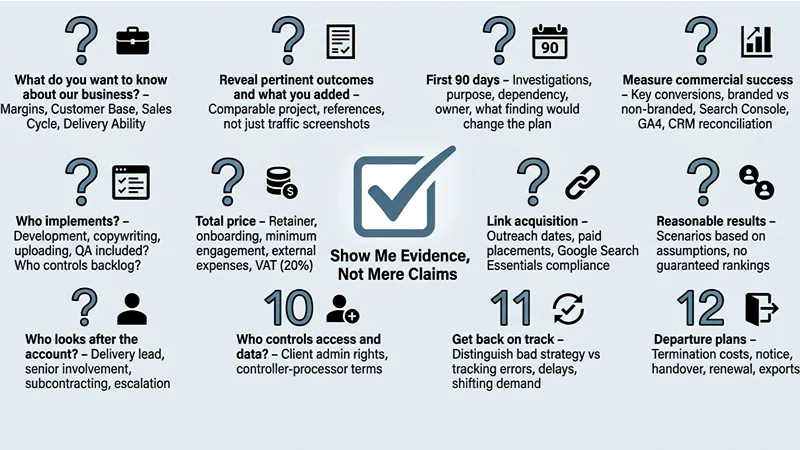
1. What do you want to know about our business?
Get ready for questions about your margins, customer base, sales cycle and delivery capacity. Whether you’re speaking to a local consultant or a national SEO agency in the UK, a good agency should take the time to understand your business. Google’s advice on hiring an SEO says they should ask what makes your business unique, who your competitors are and how your customers find you. Treat a proposal put together without that discovery work with caution.
2. Can you share relevant results and explain what you contributed?
Ask for a comparable project, its starting position, supporting documents and what the agency actually did. Ask what else changed during that period, such as a website relaunch, a pricing change or new advertising, that could have contributed. Speak to references, and don’t treat a traffic screenshot as commercial proof. Google recommends checking business references with past clients, and it’s worth asking about their experience in your industry and with UK businesses.
3. What will you focus on in the first 90 days?
Ask for a sequence of investigations and priorities rather than a rigid commitment to the same monthly output. Each proposed task should state its purpose, any dependency and an owner. Follow up with “What finding would change the plan?” Learn how to read an SEO audit report so you can judge those findings yourself.
4. How will you measure commercial success?
Ask them to identify the conversions that matter most to your business goals. Request that branded and non-branded search are reported separately wherever possible. Ask how Google Search Console, GA4 and CRM records will be reconciled, including attribution limits.
5. Who’s responsible for putting your suggestions into action?
Are development, copywriting, uploading and quality assurance included in the retainer? If not, you may end up paying for recommendations nobody can implement. Who makes the changes, controls the backlog and checks the work? An SEO agency with in-house WordPress development can implement fixes without handing them off to a separate developer.
6. What does the total price include?
Request details of the retainer, onboarding fee, minimum term, external costs and any extra charges. Check whether quotes include VAT. The UK standard rate of VAT is 20%, though only VAT-registered agencies charge it. When comparing proposals, make sure the scope is equivalent and check which fees are included.
7. How do you build links?
Ask how they find link opportunities, how outreach works, who writes or edits the content and where it gets published. Ask them to disclose any paid placements or proposed link schemes. Don’t accept “proprietary methods” as an answer; ask how their approach aligns with Google Search Essentials and its spam policies.
8. What results can we realistically expect?
Ask for scenarios based on stated assumptions and dependencies, not guaranteed positions. Google states that no one can guarantee a #1 ranking on Google. An agency should explain what it can influence and what is out of its control. If they offer AI search optimisation (sometimes sold as GEO or AEO), ask whether their advice aligns with Google’s guidance on generative AI features.
9. Who is going to look after our account?
Meet the delivery lead, not just the sales team. Ask them to confirm senior involvement, any subcontracting, quarterly reviews and escalation paths. What happens if your main contact leaves or the workload exceeds what was agreed?
10. Who controls access to our accounts and data?
Your business should keep administrative rights to important accounts. Agree in writing who owns the work produced and whether it can be reused. If the agency processes personal data on your behalf, UK GDPR requires a written contract with specific controller–processor terms, often called a data processing agreement. Confirm that relationship rather than assuming it.
11. How will you get things back on track if results stall?
Ask how the agency distinguishes a weak strategy from tracking errors, implementation delays or shifting demand. Look for a review process that identifies the evidence, revised priorities and accountable owners, rather than simply recommending more budget.
12. What happens if we leave?
Check the termination costs, notice period, handover responsibilities and renewal terms. Ask what you’ll receive on exit: account access, all completed work, a list of outstanding tasks and usable exports. A documented handover process is more useful than a simple promise that “a handover will take place.”
Compare evidence, not presentation quality
Use this buying matrix during agency interviews. The red-flag column shows answers that should prompt follow-up questions. It is a practical decision aid, not an industry accreditation.
| Area | Evidence to request | Reassuring answer | Red flag |
|---|---|---|---|
| Strategy | Prioritised sample plan | Dependencies explained | Fixed template |
| Measurement | Anonymised report | Defined commercial outcomes | Rankings alone |
| Delivery | Responsibility schedule | Named implementers | Unallocated tasks |
| Cost | Itemised proposal | Inclusions and exclusions | Unexplained extras |
| Ownership | Contract wording | Client-controlled access | Agency-only control |
| Exit | Handover schedule | Specified files and deadlines | Vague promises |
How to Choose an SEO Agency in Three Steps
Step one: Start with one shared brief
Make sure every agency is working to the same objectives, targets and budget. Ask each one to list its assumptions and exclusions. A lower-priced bid might simply involve less work. If proposals can’t be compared, ask each agency to restate its scope against your shared brief before discussing discounts.
Step two: Validate evidence safely
Check references and ask the proposed delivery lead to walk you through an anonymised report. If you commission an audit, grant read-only Search Console access only, as Google advises. Don’t grant access just to receive a proposal, and always ask why more access is needed.
Step three: Put the promises into the contract
The contract or statement of work must specify deliverables, responsibilities, reporting definitions and handover requirements. Check whether the sales offer contradicts the legal terms. If the wording is unclear or ambiguous, clarify it before you sign. Where the commitment or the data risk justifies it, get professional advice.
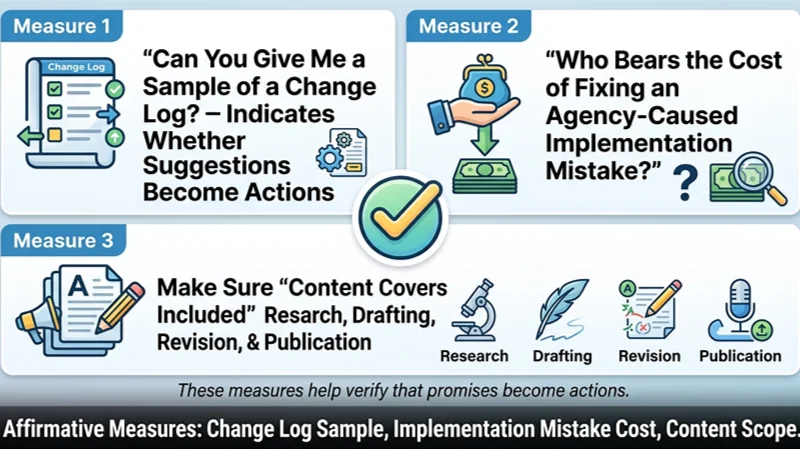
Three accountability checks
Ask for a sample change log; it shows whether recommendations actually get implemented. Ask who bears the cost of fixing an implementation mistake caused by the agency. And make sure “content included” covers research, drafting, revision and publication.
FAQs
How do I choose a UK-based SEO agency?
Assess relevant experience, understanding of your industry, ability to deliver and contract clarity. Ask every shortlisted agency for comparable evidence and give them all the same brief. Google suggests asking how an SEO measures success and what results to expect. Use the answers as claims to verify, not boxes ticked by confident-sounding sales responses.
How much should I pay an SEO agency?
Focus first on the scope of work, not a monthly average. Ask for a detailed breakdown of research, technical work, content, implementation and reporting. Examine the full commitment and exclusions, then confirm VAT treatment. A low retainer is not value for money if essential delivery sits outside it.
How long does SEO take to work?
Ask for a projection based on your starting position, competitors and ability to implement changes. Some factors, such as competitor activity and changes to search, are outside any agency’s control. Google recommends asking potential providers what results to expect and in what timeframe. A fixed deadline with no explanation is less useful than assumptions you can review.
Can an SEO agency guarantee rankings?
No. Google states that no one can guarantee a #1 ranking on Google. Don’t confuse that with an agency’s duty to perform specific work. An agency can commit to audits, agreed implementation and reporting without pretending to control search results or competitors.
What should an SEO contract include?
Include terms covering fees, responsibilities, approvals, reporting, ownership and exit. If the agency will process personal data for you, add data processing terms. ICO guidance explains the contractual protections UK GDPR requires between controllers and processors. This is a procurement checklist, not legal advice, so seek a review for complex or high-value agreements.
Who should control our SEO accounts?
Make administrative control of important business accounts a contractual requirement. Instead of sharing passwords, give agency staff their own individual access. Be clear about who owns what and how reports and other commissioned assets will be exported, because paying a retainer doesn’t on its own settle licensing and handover.
Can an agency work with our competitors?
Decide which conflicts of interest your business can accept. Ask about competing clients, confidentiality, shared staff and reuse of research. Exclusivity may affect price or availability, so define it carefully. You don’t necessarily need exclusivity, but ask for clear information barriers and disclosure arrangements.
Think before you sign
Send these questions to your shortlisted SEO agencies and ask for written replies. Read Google’s guidance on hiring an SEO, then build a side-by-side comparison of scope, evidence and exit terms. Resolve every outstanding question before you sign the contract.

Be the first to leave a comment below.