

Choosing between an SEO agency, a freelancer, and an in-house hire depends on your needs, budget, and scope. If SEO needs day-to-day ownership inside the business, an in-house SEO is usually the best fit. For coordinated, cross-discipline delivery, choose an agency. For focused specialist expertise, choose a freelancer. When comparing quotes, check the total cost of getting improvements live, not just the price being quoted.
SEO company, freelancer, or in-house: the decision table
Think of this as a buying framework, not a verdict on every supplier. Confirm each provider’s capabilities from their proposal, because a specialist freelancer may outperform a generalist team on a narrow brief.
| Decision factor | Freelancer | Agency | In-house |
|---|---|---|---|
| Best-fit brief | Defined specialist work | Coordinated workstreams | Continuous business integration |
| Main strength | Direct access to the specialist doing the work | Broad skills and capacity under one contract | Deep business knowledge and day-to-day availability |
| Main risk | Limited capacity and a single point of failure | Work handed to less senior staff than those who pitched | A narrow skill set that is slow to scale |
| Expertise to verify | Individual depth | Named delivery specialists | The hire’s skills and support needs |
| Implementation | Agree who makes changes | Check delivery inclusions | Depends on internal resources |
| Capacity cover | Request absence arrangements | Check team continuity | Plan holiday and vacancy cover |
| Cost comparison | Fees plus internal support | Retainer plus exclusions | Employment costs plus tools and support |
| Accountability | Named specialist | Named delivery lead | Internal manager and priorities |
A local service business with a web developer on hand may commission a freelancer’s audit and implementation support. A retailer needing technical fixes, product content, and outreach may prefer a multidisciplinary team. If you’re considering an integrated provider, explore Webranko’s SEO and web development team and compare its proposed responsibilities with your internal resources. Whichever model you choose, someone must have clear authority to approve changes.
Look at the total cost, not just the price
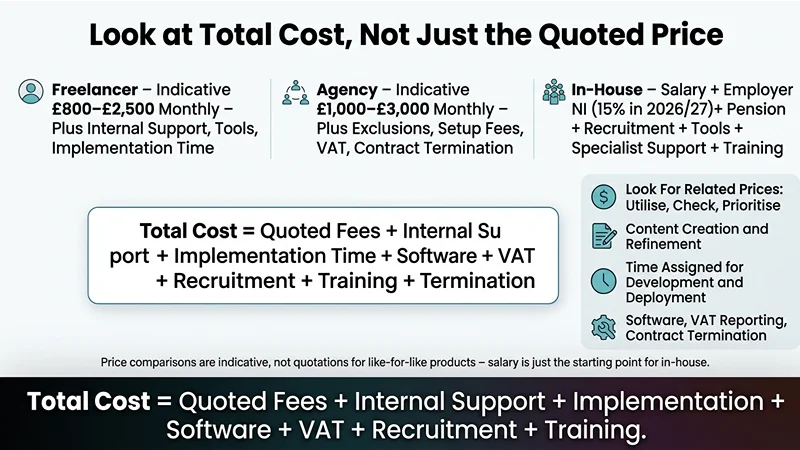
Before comparing monthly retainers or recruitment costs, establish what work your website actually needs. A professional SEO audit service can identify technical, on-page, and content issues, giving you a clearer starting point for comparing proposals.
Published UK price comparisons can provide some guidance, but they aren’t like-for-like quotations. Treat advertised ranges as indicative rather than independent market averages, and ask each provider to price the same scope of work. Check whether each quote covers:
- Related costs beyond the headline fee, such as set-up or onboarding
- Auditing, quality checks, and prioritisation
- Creating and refining content
- Developer time for implementation and deployment
- Software and tools, VAT, and contract exit or termination costs
VAT can change the comparison. A freelancer whose taxable turnover is below the £90,000 VAT registration threshold doesn’t have to register for VAT, while an established agency will usually add VAT at 20%. That difference matters if your business can’t reclaim VAT. If a freelancer works through their own limited company, also check whether the off-payroll working rules (IR35) apply: medium and large clients must decide the worker’s employment status for tax, while for small clients the contractor’s own company decides. The rules don’t apply to freelancers who work as self-employed sole traders.
When budgeting for in-house SEO vs an agency, the salary is just the starting point. Make sure to consider employer National Insurance, workplace pension contributions, recruitment, tools, and specialist support. HMRC’s rates and thresholds for employers 2026 to 2027 set the standard employer National Insurance rate at 15% on earnings above £5,000 a year. Exceptions apply: employers pay 0% on earnings up to £50,270 for employees under 21, apprentices under 25, and eligible veterans, and eligible employers can claim the Employment Allowance, which is £10,500 for 2026/27.
A 3-step implementation plan for picking your SEO delivery model
1. Start with a clearly scoped diagnostic
Before committing to a long retainer or permanent hire, commission a clearly scoped audit. Ask for prioritised findings, supporting evidence, implementation estimates, and business relevance. If you’re unsure how to assess the findings, read our guide on how to read an SEO audit report before comparing recommendations. The aim is to understand what needs fixing, who will do it, and how completion will be checked. During the audit, give the provider read-only access to Google Search Console; Google’s guidance on hiring an SEO advises against granting write access at this stage.
2. Give every recommendation an owner
Add the key findings and resulting actions to your delivery backlog. Assign each action to a named person, with an effort estimate, dependencies, and acceptance criteria. If a freelancer recommends template changes, name the developer who will apply and test them. Price any development work excluded from the proposal as a separate item. And don’t commission a second audit when the real bottleneck is delivery capacity.
3. Set up a regular review process
Before signing, agree on reporting, approvals, account access, and handover requirements. Set a baseline in GA4 and Google Search Console, and check that tracking is accurate before trusting any reported conversion impact. Then review enquiries or sales alongside relevant search trends. If progress stalls, work out whether implementation delays or weak recommendations are the cause before replacing your provider.
How to evaluate an SEO provider before you buy
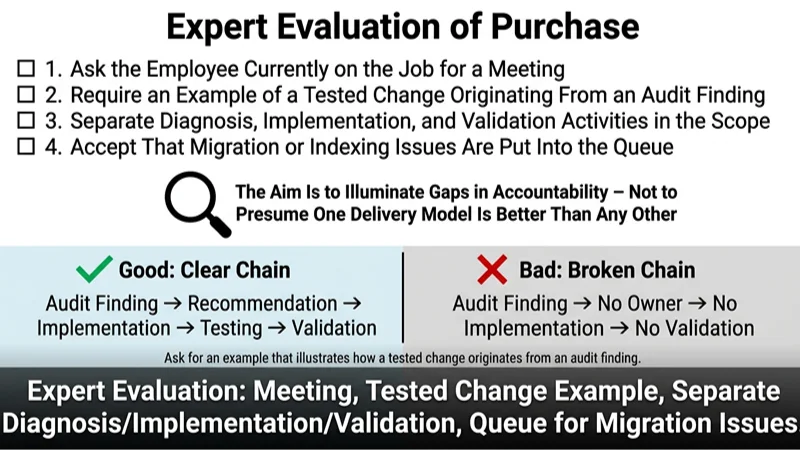
Ask to meet the person who will actually do the work, not just the person who pitches it. Request an example showing how an audit finding became a tested, live change. Check that the statement of work separates diagnosis, implementation, and validation, with the scope of each defined. Ask how urgent issues, such as migration or indexing problems, will be prioritised in the queue. These checks are designed to expose gaps in accountability; they don’t assume one delivery model is better than another.
Red flags when hiring an SEO
- Guaranteed rankings. Google says no one can guarantee a number-one position in its search results.
- Claims of special access. Treat talk of a special relationship with Google or “priority submission” as a warning sign.
- Unsupported recommendations. Ask whether advice is backed by official Google documentation and evidence from your own site.
- AI search promises. Advice sold as “AEO” or “GEO” should be consistent with Google’s guidance on generative AI features in Search.
- Locked-in accounts. Be wary of any provider that wants to own your domain, analytics, or Search Console property.
Frequently asked questions
Is an SEO freelancer better than an agency?
Neither is better by default. A freelancer suits you if you want a specialist and can manage the supporting work internally. An agency makes more sense when you want multiple disciplines managed together. Rather than assuming either structure guarantees competence or better results, review the proposed individuals’ past work and availability.
How much does SEO cost in the UK?
It depends on scope, so any price only makes sense alongside what it covers. A technical audit, an ongoing content programme, and a website migration are completely different purchases. Ask your shortlisted providers to quote against the same brief, with set-up, ongoing work, implementation, and exclusions listed separately. Check VAT treatment consistently, and ask what happens to unused hours or work delayed by your own approvals.
When should you hire an in-house SEO?
Consider hiring when organic search creates ongoing work that needs close contact with product, development, sales, and leadership teams. First, check that there is enough suitable work, and enough support, for the role. A single hire shouldn’t be expected to provide senior technical expertise, write all the content, and manage outreach on their own.
What is the difference between an SEO consultant and an agency?
Compare statements of work rather than job titles. A consultant typically diagnoses problems, sets strategy, and guides your team through delivery. An agency can do the same and also manage delivery itself. Whichever you choose, identify who approves, makes, accepts, and checks each change, because either model can be set up both ways.
How long does it take to see results from an SEO provider?
There is no fixed timeline, so set review points around the agreed work rather than accepting a ranking deadline. Start with diagnosis and prioritisation, move to implementation once fixes are verified, and finally review performance against your baseline. In line with Google’s advice to interview potential SEOs, ask each candidate what results they expect, in what time frame, how they will measure success, and what could delay it.
Can an agency work alongside an in-house team?
Yes. A hybrid SEO model can work well when your team can set priorities but needs specialist support, for example keeping business knowledge in-house while outsourcing technical SEO reviews. Record who makes final decisions and owns the backlog, especially if more than one supplier works on the same site. This prevents conflicting instructions and duplicated effort.
Who should own SEO accounts and data?
Your business should. Make controlled access a contract term: keep ownership of your domain, analytics, Search Console, and website, and grant providers only the permissions they need. Agree that documents, research, changelogs, and other commissioned assets will be handed over. Put this in writing before onboarding, rather than discovering at exit that a provider holds material you can’t do without.
Your next move
Write a short brief covering your business objectives, your existing in-house capability, and your constraints. Share the same brief with every shortlisted freelancer, agency, or candidate, then use Google’s guidance on hiring an SEO to structure your interviews and reference checks.


Be the first to leave a comment below.