

In-Depth Guide
The Complete Guide to Cyber Security
Our team has written a comprehensive guide covering technical specs, best practices, and the exact approaches we use on every project.
The Problem With Most Website Security in the UK
Most UK small and medium businesses believe their website is reasonably secure. They have an SSL certificate. Their hosting company runs server-level security. They installed a security plugin. And they have not had any visible problems so far.
Here is the thing. Visible problems are the last stage of a security incident, not the first sign one is coming. By the time a site shows a malware warning, redirects visitors, or displays defaced content, the attacker has already been inside the system for days, weeks, or, in sophisticated cases, months. The goal of a professional website security audit UK businesses actually need is to identify the vulnerabilities that enable initial access before anyone exploits them.
Webranko’s security audit is conducted by a CEH-certified professional with EC-Council accreditation. It covers your full attack surface methodically, produces a prioritized findings report, and comes with a remediation plan because identifying a vulnerability without a clear path to fixing it is only half of what a security audit should deliver.
What a Professional Website Security Audit Actually Covers
The Difference Between Automated Scanning and a Real Security Audit
Automated vulnerability scanners are useful tools, and they are part of every professional security audit process. But they are not a security audit on their own any more than a spell checker is a legal review. Automated tools identify known vulnerability signatures against a database of CVEs and common misconfigurations. They cannot identify logical access control flaws, business logic vulnerabilities, authentication bypass issues that do not match a known signature or the specific combination of lower-severity findings that together create a high-impact attack path.
A professional web application security audit uses automated tooling as a starting point and then applies manual investigation to every area where automated tools have known blind spots. That manual layer is where the most significant vulnerabilities are consistently found on UK client sites because it is also the layer that most basic security checks never reach.
What We Assess in a Webranko Security Audit
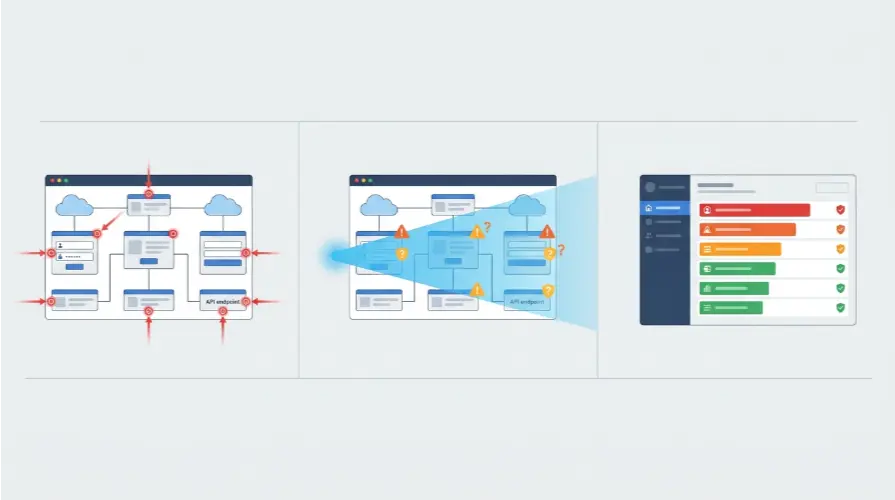
Every Webranko website security audit UK engagement covers the following assessment areas systematically.
Authentication and Access Controls
How users and administrators authenticate to your site and what level of access each role is granted. We assess password policy enforcement; multi-factor authentication availability and implementation; session management, including token expiry and invalidation; and the granularity of role-based access controls. Weak or misconfigured authentication is one of the most consistently exploited vulnerability classes on UK business websites and one of the most straightforward to address once identified.
Input Validation and Injection Vulnerabilities
Every point where your site accepts user input is a potential injection vector. We test for SQL injection, cross-site scripting, command injection and other input-based attack classes across forms, search functions, URL parameters and API endpoints. These vulnerability types remain among the most commonly exploited on web applications globally because they are easy to miss during development and reliably present on sites that have not been specifically assessed for them.
Software Components and Known Vulnerabilities
Your site depends on a stack of third-party components. WordPress core, plugins, themes, PHP version, web server software, JavaScript libraries. Every one of those components has a version history, and that version history has known vulnerabilities associated with specific releases. We audit your full dependency stack against current CVE databases and identify every component running a version with a publicly disclosed vulnerability, categorised by the severity and exploitability of that vulnerability in your specific environment.
Configuration and Infrastructure Security
How your server, hosting environment and application are configured matters as much as the code running on them. We assess HTTP security header implementation, SSL and TLS configuration, server information disclosure, directory browsing exposure, backup file exposure and a range of configuration weaknesses that are frequently present on UK business sites running shared or managed hosting. Many of these findings are low effort to remediate and have a meaningful impact on your overall security posture.
File System and Permission Security
Incorrect file and directory permission settings create opportunities for attacks that bypass application-level security entirely. We review your file system permission structure for overly permissive settings on sensitive files and directories, world-readable configuration files that expose credentials and upload directory configurations that allow executable file storage.
WordPress-Specific Security Assessment
For WordPress sites the audit extends to platform-specific vulnerabilities, including plugin and theme version assessment, XML-RPC exposure, user enumeration via the author archive, REST API authentication gaps, default prefix exposure and the full range of WordPress-specific attack vectors that automated scanners frequently underweight in their severity assessment.
Why CEH Certification Matters for a Security Audit
What CEH Means and Why It Is Relevant to Your Business
The Certified Ethical Hacker certification issued by EC-Council is one of the most widely recognised professional credentials in offensive security. It validates that the holder understands attack methodologies, penetration testing frameworks and vulnerability assessment techniques to a standardised professional level.
For a UK business commissioning a website security audit, CEH certification from the auditor matters for two reasons. It means the methodology applied is based on a recognised professional framework rather than an ad hoc process that varies between engagements. And it means the person conducting the audit understands how attackers think and operate, which is what allows a security assessment to identify the vulnerabilities that matter commercially rather than producing a list of theoretical weaknesses ordered by CVSS score.
Webranko holds CEH certification from EC-Council and operates as a registered UK company under SIC code 62020. When you commission a security audit from Webranko, you are engaging a credentialed professional service, not a freelance developer running a plugin scan.
Web Application Security Audit UK — What We Look For
OWASP Top 10 as the Assessment Framework
The OWASP Top 10 is the industry-standard reference for the most critical web application security risks. Every Webranko web application security audit UK engagement covers the full OWASP Top 10 as its core assessment framework because these are the vulnerability classes that are most commonly exploited and most commercially damaging when they exist in a production environment.
| OWASP Category | What We Test |
|---|---|
| Broken Access Control | Role permission boundaries, forced browsing, horizontal and vertical privilege escalation |
| Cryptographic Failures | Data encryption in transit and at rest, weak cipher usage, sensitive data exposure |
| Injection | SQL, command, LDAP and other injection vectors across all user input points |
| Insecure Design | Business logic flaws, missing security controls at the design level |
| Security Misconfiguration | HTTP headers, server configuration, default credentials, unnecessary features enabled |
| Vulnerable Components | Outdated plugins, libraries, frameworks with known CVEs |
| Authentication Failures | Session management, credential policies, MFA implementation, password reset flows |
| Software and Data Integrity | Update mechanisms, CI/CD pipeline security, unsigned updates |
| Logging and Monitoring Failures | Security event logging, alerting capability, incident detection readiness |
| Server-Side Request Forgery | SSRF vulnerability across URL input and remote resource fetch functions |
Beyond the OWASP Top 10, we assess WordPress-specific vulnerabilities and configuration issues that fall outside the generic framework but are highly relevant to the specific threat landscape facing UK WordPress sites in 2026.
What a High-Severity Finding Actually Means
Security audit reports are often written in technical language that does not communicate business risk clearly. We write our findings in plain English with explicit business impact statements because a business owner making decisions about remediation priority needs to understand what a vulnerability means commercially, not just technically.
A SQL injection vulnerability in your contact form is not just a technical flaw. It is potential access to every record in your customer database and a direct path to a UK GDPR data breach notification to the ICO with the financial and reputational consequences that brings. A cross-site scripting vulnerability in your checkout process is not just a code issue. It is a mechanism for stealing payment information from your customers that your business could be held liable for.
Connecting technical findings to business consequences is what makes a security audit actionable for the people who actually run the business. That is the approach we take in every report we produce.
WordPress Security Audit UK
Why WordPress Sites Have a Specific Threat Profile
WordPress is the most targeted web platform in the world by a significant margin. That is not a reason to avoid it, but it is a reason to take platform-specific security assessments seriously. The WordPress threat landscape in 2026 is predominantly automated. Bots continuously scan for WordPress installations and probe known plugin and theme vulnerabilities within hours of a CVE disclosure. A site running a vulnerable plugin version that was released three weeks ago is already being actively targeted.
The WordPress-specific elements of our security audit cover areas that generic web application testing frameworks do not adequately address. User enumeration through the author archive, which reveals valid admin usernames to brute force tools. XML-RPC endpoint exposure, which is exploited for credential stuffing and DDoS amplification attacks. REST API authentication gaps that expose user data and allow unauthenticated content modification in some configurations. Nulled plugin and theme detection, which are among the most reliable indicators of a backdoor present in the codebase.
Plugin and Theme Vulnerability Assessment
Plugin and theme vulnerabilities are the primary attack vector on UK WordPress sites. We assess every active plugin and theme against current CVE databases and the WordPress Vulnerability Database, identifying every component running a version with a known vulnerability. We categorise each finding by exploitability, severity and remediation complexity so you have a clear picture of what needs updating immediately, what can be scheduled and what represents a risk serious enough to warrant replacing the component entirely if a patched version is not available.
We also assess inactive plugins and themes because they are a frequently overlooked attack surface. An inactive plugin with a file inclusion vulnerability is still exploitable even if it is not activated, as long as its files are present in the file system.
Cyber Security Audit UK — Scope and Methodology
What Our Audit Scope Covers
A Webranko cybersecurity audit UK engagement is scoped to your specific environment at the start of the engagement. We confirm the URLs, subdomains, API endpoints and administrative interfaces included in the assessment scope and agree to the testing methodology, including whether the assessment is conducted as a black box test simulating an external attacker with no prior knowledge, a grey box test with limited credential access simulating a compromised account scenario or a white box test with full access for the most thorough technical review.
For most UK SMB engagements a grey-box assessment provides the most commercially useful findings because it covers both the external attack surface and the internal privilege escalation and access control vulnerabilities that a fully external test cannot reach without first compromising an account.
Testing Without Impacting Your Live Site
A security audit on a live production site carries inherent risk of service disruption if active exploitation testing is conducted carelessly. We do not conduct active exploitation testing on live production environments without explicit agreement and a clear rollback plan in place.
For clients with a staging environment available, we conduct the more intrusive elements of the assessment there. For clients without one, we scope the testing methodology to avoid techniques that carry disruption risk on live systems while still covering the full vulnerability assessment. We discuss this explicitly during the scoping conversation before any testing begins because it affects the findings’ completeness, and you should understand that trade-off before committing to an engagement scope.
The Remediation Plan — What Makes Our Audit Different
Most Security Auditors Report and Walk Away
This is the commercial differentiator that is genuinely absent from most UK security audit services and worth addressing directly.
The standard security audit engagement model is assessment, report, and handover. The auditor finds vulnerabilities, documents them in a report categorised by severity and delivers it to the client. What the client does next is entirely their problem. If their internal team does not have the technical capability to remediate the findings, or if their development agency does not understand the security context of what needs changing, the vulnerabilities identified in the report remain in place.
Webranko audits and remediates. The findings report comes with a prioritised remediation plan written in sufficient technical detail that it can be implemented by any competent developer. And if you want Webranko to implement the fixes directly, we scope that as a follow-on engagement drawn from the audit findings.
This matters practically because security vulnerabilities that are known but unpatched are in some ways worse than vulnerabilities that are unknown. If a report documenting your critical vulnerabilities is sitting on a shared drive and the issues are not being fixed, that document itself becomes a risk.
CEH-Backed Remediation Guidance
Remediation guidance written by someone without a security background tends to focus on the surface symptom rather than the underlying cause. Updating a plugin version addresses the known CVE but does not address whether the same class of vulnerability exists in other plugins or in custom code. Disabling a feature to remove an attack vector does not address whether the same feature implemented differently elsewhere creates equivalent exposure.
Our remediation guidance is written from the same CEH-certified methodology that underpins the assessment itself. Each recommendation addresses the root cause of the finding, explains the correct fix approach and identifies whether the same vulnerability pattern appears elsewhere in scope that should be addressed at the same time.
What Our Website Security Audit Report Includes
Report Structure and Findings Format
Every Webranko website security audit UK report follows a consistent structure that serves both technical and non-technical readers.
The executive summary presents the overall security posture assessment, the total number of findings by severity category and the top three priority actions in plain English. This section is written for business owners and senior stakeholders who need the commercial context without the technical detail.
The technical findings section presents each vulnerability with a consistent format covering the vulnerability name and class, the specific location within the assessed scope, the severity rating with business impact context, the evidence observed during testing, the remediation recommendation and the estimated remediation complexity. Each finding is self-contained, so a developer implementing the fixes does not need to cross-reference other documents to understand what needs changing and why.
The remediation roadmap presents all findings prioritised by the combination of severity and remediation effort to produce a recommended implementation sequence. Critical findings that are also low effort to fix appear first. High-effort structural changes that address fundamental design weaknesses appear with longer-term scheduling guidance.
Website Security Check Service UK — Ongoing vs One-Off
When a One-Off Audit Is the Right Choice
A one-off website security audit makes sense in several specific situations. You are about to launch a new site or significant new feature and want independent validation of its security posture before it goes live. You have never had a formal security assessment conducted and want a baseline picture of your current vulnerability landscape. You have recently experienced a security incident and want an independent assessment of your current exposure after remediation. Or your business has a compliance requirement or a client contractual requirement that necessitates a formal security audit report.
For all of these, a single point-in-time engagement produces a complete, actionable findings report that serves the purpose.
When Ongoing Security Monitoring Makes More Sense
The vulnerability landscape changes continuously. New CVEs are disclosed daily. New plugins are installed that introduce a new attack surface. Configuration drift occurs as sites are updated and modified. A point-in-time audit reflects your security posture on the day it was conducted, not six months later.
For UK businesses where the site is a primary revenue channel, where customer data is processed or where a security incident would have significant business consequences, an annual or bi-annual security audit combined with ongoing monitoring of your component versions against new CVE disclosures is a more appropriate posture than a one-off assessment.
Webranko offers both. We are transparent about which is more appropriate for your specific situation during the initial scoping conversation rather than recommending the higher-value option regardless of your actual needs.
What Our Security Audit Service Covers
| Audit Component | What It Assesses |
|---|---|
| Authentication and access controls | Login security, session management, role permissions, MFA |
| Input validation and injection testing | SQL, XSS, command injection across all user input vectors |
| Software component assessment | Plugin, theme and library CVE audit against current databases |
| Configuration security review | HTTP headers, SSL configuration, server information disclosure |
| File system and permission review | Permission settings, sensitive file exposure, upload directory security |
| WordPress-specific assessment | User enumeration, XML-RPC, REST API, nulled software detection |
| OWASP Top 10 coverage | Full assessment against current OWASP risk framework |
| Prioritised findings report | Plain English findings with business impact context and severity ratings |
| Remediation roadmap | Prioritised fix plan with implementation guidance and effort estimates |
FAQ
What is a website security audit, and what does it cover?
A website security audit is a systematic assessment of your site’s vulnerabilities, access controls, software components and configuration security conducted by a certified professional. It identifies weaknesses attackers could exploit before they are discovered and used against you. A professional audit covers authentication security, injection vulnerabilities, outdated components with known CVEs, configuration weaknesses and platform-specific issues relevant to your CMS.
How is a website security audit different from a malware scan?
A malware scan identifies infections that are already present. A security audit identifies vulnerabilities that could allow an attacker to install malware or compromise your site in the first place. The two are complementary but distinct services. If your site is already infected, malware removal is the immediate priority. If your site is clean and you want to keep it that way, a security audit finds the weaknesses before they are exploited.
How much does a website security audit cost in the UK?
Professional website security audits in the UK typically range from £500 to £3,000 or more depending on the scope of the assessment, the complexity of the site, the testing methodology and whether a remediation engagement is included. Webranko scopes every audit individually and provides a clear cost before any work begins. We do not apply a single price to engagements with very different scopes and complexities.
Do you fix the vulnerabilities found in the audit or just report them?
Both options are available. The audit report comes with a prioritised remediation plan written in sufficient technical detail to be implemented by any competent developer independently. If you want Webranko to implement the fixes directly, we scope that as a follow-on engagement from the audit findings. Most clients find it more efficient to have the same team that found the vulnerabilities also fix them because the technical context carries over without needing to be re-explained.
Is a website security audit the same as penetration testing?
They overlap significantly but are not identical. Penetration testing typically involves actively attempting to exploit discovered vulnerabilities to demonstrate real-world impact and is usually scoped to a specific system or application. A website security audit assesses the full vulnerability landscape and produces a comprehensive risk-prioritised findings report with remediation guidance. Webranko’s audit includes elements of both, with the testing methodology and exploitation scope agreed during scoping to match your environment and risk tolerance.
How long does a website security audit take?
Most website security audits take five to ten working days from access confirmation to report delivery depending on scope and site complexity. Larger sites with custom application code, multiple subdomains or API integrations take longer. We agree a delivery timeline during the scoping conversation before any work begins so you know exactly when to expect the report.
Your site currently has vulnerabilities you are not aware of. That is not a criticism. It is a statistical certainty that any website that has never been professionally assessed will fail. The question is whether you find them in a controlled audit or whether someone else finds them first in a way that costs you significantly more than the audit would have.