
In-Depth Guide
The Complete Guide to Cyber Security
Our team has written a comprehensive guide covering technical specs, best practices, and the exact approaches we use on every project.
If Your Site Has Been Hacked, Read This First
Your site is either showing a malware warning, redirecting visitors somewhere you did not set up, displaying casino spam in your Google search listings or has been suspended by your hosting provider. You are probably dealing with at least one of those right now. The first thing to understand is that a hacked site is not a catastrophe if it is handled correctly and quickly. It becomes one if it is handled badly or left too long.
The second thing to understand is that cleaning a hacked website is not the same as securing it. Most infected sites that are cleaned without a proper root cause investigation are reinfected within weeks through the same backdoor the attacker used initially. Webranko’s website malware removal UK service removes the infection, identifies and closes the access point that caused it and handles the Google blacklist removal and SEO recovery that most cleanup services never address at all.
Here is exactly what that process involves.
What Type of Hack Are You Dealing With
The Most Common Website Infections We See on UK Sites
Not all malware infections look the same, and the cleanup approach needs to match the specific type of infection. These are the most common we encounter across UK client sites.
Casino and Pharma Spam Injection
This is currently the most widespread infection type on WordPress sites in the UK. The attacker injects thousands of hidden pages into your site targeting gambling, pharmaceutical or adult content keywords. These pages are invisible to you when you visit your own site but fully visible to Googlebot. The result is your domain being associated with spam content in Google’s index, which triggers manual actions and algorithmic penalties that persist long after the pages are removed if the SEO recovery is not handled correctly.
We have cleaned casino spam injections from WordPress sites where the attacker had been operating undetected for over six months, accumulating thousands of indexed spam pages. The cleanup is not just file removal. It is a full Google Search Console audit, a deindexation request for every spam URL and a structured ranking recovery process for the pages that mattered commercially.
Redirect Hacks
Visitors to your site are being sent somewhere else. Sometimes only mobile visitors. Sometimes only visitors arriving from Google rather than typing your URL directly. The redirect is typically injected into your .htaccess file, your theme files or your database and is deliberately designed to be invisible to logged-in site owners.
Backdoor Files
These are hidden files left by attackers that give them persistent access to your server even after a visible infection is cleaned. A site cleaned without a thorough backdoor scan will almost always be reinfected. Backdoors are commonly hidden inside image upload directories, disguised as system files or injected into legitimate plugin files where they are unlikely to be noticed during a basic scan.
Google Blacklisting
Google’s Safe Browsing system has flagged your site, and visitors see a full-page warning before reaching you. This typically results in an 80 to 95% reduction in organic traffic within 24 to 48 hours of the warning appearing. Getting off the Google blacklist requires not just cleaning the site but submitting a review request through Google Search Console that meets specific requirements. An incomplete or premature review request extends the blacklisting period significantly.
Malicious Code Injection
Attackers inject JavaScript or PHP code into your site files that runs silently in visitors’ browsers. This can be used to steal form data, run cryptomining operations, serve malicious ads or deliver further malware to your visitors’ devices. This type of infection frequently triggers warnings from browsers and security software that damage trust even after the code itself is removed.
Why Most Malware Cleanups Fail
The Reinfection Problem
The most expensive mistake a hacked site owner makes is paying for a cleanup that does not address the root cause. The visible infection gets removed. The site looks clean. Two to six weeks later the same or a similar infection reappears because the backdoor that allowed initial access was never found and closed.
We take on reinfection cases regularly at Webranko. They follow a consistent pattern. A basic cleanup was performed, usually by a hosting provider’s malware scanner or a plugin-based tool. The obvious infected files were removed. The site was declared clean. No investigation was conducted into how the attacker gained access. The vulnerability was not patched. The backdoor was not found because it was hidden in a location the scanner did not check.
Proper malware removal requires manual investigation alongside automated scanning because sophisticated backdoors are specifically designed to evade common scanner signatures. A scan that reports clean is a good starting point. It is not a reliable conclusion.
The SEO Damage That Gets Ignored
Here is the angle that genuinely separates Webranko’s website malware removal UK service from most of the competition.
A malware infection does not just damage your site. It damages your Google rankings, and in some cases it damages them significantly and in ways that persist after the malware itself is removed. Casino spam injections create indexed spam pages that need to be explicitly removed from Google’s index. Google blacklisting creates a trust signal that needs a formal review request to resolve. Manual actions issued through Google Search Console for unnatural links or deceptive content need a reconsideration request with specific documentation. And the general trust signals Google uses to evaluate your site can be degraded by an infection period in ways that require active SEO work to recover.
Most malware removal services hand you back a clean site and consider the job done. Webranko hands you back a clean site and then handles the Google-side recovery because we are an SEO agency as much as a security service. The rankings your site lost during the hack are recoverable. But only if someone who understands both the technical cleanup and the Google recovery process is handling both sides of it.
Our Website Malware Removal Process
Step One — Emergency Assessment
When you contact Webranko with a hacked site, we start with an assessment before we start making changes. We need to understand what we are dealing with before we touch anything because in some infection scenarios the wrong first move makes recovery harder.
We check your Google Search Console for security issues, manual actions and any indexed content that should not be there. We review your hosting error logs for signs of the attack vector. We run a preliminary scan of your file system to identify the infection type and scope. And we establish whether the site needs to be taken offline during the cleanup or whether it can be cleaned while remaining accessible.
This assessment typically takes one to two hours and gives us the full picture of what has happened, how long it has been happening and what the cleanup is going to involve.
Step Two — Full Malware Removal
The cleanup itself is a manual process supported by scanning tools, not an automated scan process supported by occasional manual checks. The distinction matters because the infections that cause the most damage, the persistent backdoors and sophisticated spam injections, are the ones automated tools miss most often.
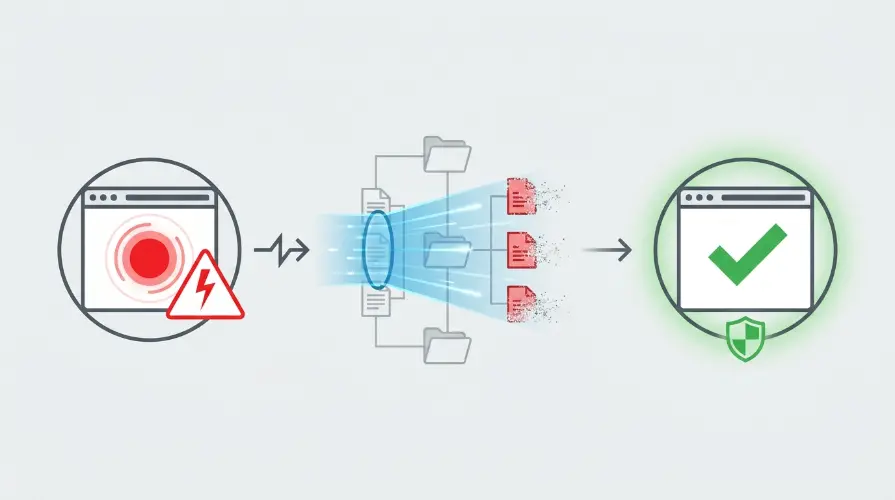
We remove every infected file, every injected code snippet, every malicious database entry and every backdoor file we identify. We review your WordPress core files against the clean version for any modifications. We audit every active plugin and theme file for injected code. We check your uploads directory, which is a common backdoor location that basic scanners frequently overlook.
Database cleaning is part of this process for injection attacks that store malicious content or redirect rules in the database rather than in files. We audit your wp-options table, your user table for unauthorised admin accounts and your posts table for injected content.
Step Three — Root Cause Investigation
This is the step most cleanup services skip. We do not.
We identify how the attacker gained access. The most common vectors on UK WordPress sites are outdated plugins with known vulnerabilities, compromised FTP or hosting credentials, nulled themes or plugins with backdoors built in, weak admin passwords and brute force attacks, and shared hosting environments where another site on the same server was compromised first.
Knowing the entry point is not optional. It determines what needs to be patched, updated or changed to prevent the same attack being successful again. Without this step a clean site is just a temporarily clean site.
Step Four — Verification and Google Recovery
Once the site is clean, we run a full verification scan and check every location where malware was found to confirm removal. We then move to the Google recovery process.
For sites on the Google Safe Browsing blacklist, we submit a review request through Search Console once we are confident the site is completely clean. An incomplete site submitted for review gets flagged, and the review clock resets, so timing matters here. We do not submit until we are certain.
For sites with indexed spam pages, we use Search Console’s URL removal tool for urgent cases and submit an updated sitemap to accelerate Googlebot’s discovery of the cleaned state. For sites that received a manual action we prepare and submit a reconsideration request with the specific documentation Google requires.
The SEO recovery phase continues after the Google-side work is done. We monitor your Search Console for resolution of security issues, track your ranking recovery across affected pages and address any persistent authority signals that the infection period damaged.
WordPress Malware Removal UK — Platform-Specific Considerations
Why WordPress Sites Are Targeted Most Frequently
WordPress runs over 40% of all websites, and that market share makes it the most targeted platform for automated attacks. Attackers run bots that continuously scan the web for WordPress installations running outdated plugin versions with known vulnerabilities. The attacks are not personal. They are automated and opportunistic, and they succeed when plugin updates are delayed, when admin credentials are weak or when security configurations are left at default settings.
The most actively exploited WordPress vulnerabilities we see across UK client sites are in contact form plugins, file upload plugins, old versions of popular page builders and themes purchased from unofficial sources that contain backdoors in their original code.
What a Thorough WordPress Malware Cleanup Involves
A proper WordPress malware removal goes beyond scanning with a security plugin. We perform a file-by-file comparison of your WordPress core installation against the clean version for your specific WordPress release. We review every active plugin’s files for injected code; check your theme files, including parent and child themes; audit your wp-config.php for unauthorised additions; and review your database for malicious entries.
We also check your server-level files, including .htaccess for redirect injections and php.ini for unauthorised configuration changes. These locations are commonly missed by plugin-based scanners because they operate at the file system level rather than the server level.
After the cleanup we update the WordPress core, all plugins and the active theme to current versions; remove any inactive plugins and themes that represent an attack surface; and change all WordPress admin passwords and secret keys.
Google Blacklist Removal UK
How Google Blacklisting Works and How Long It Takes to Resolve
Google’s Safe Browsing system operates on its own crawl schedule and its own review timeline. Once a review request is submitted through Google Search Console, Google states that reviews typically complete within 72 hours, but in practice complex cases can take longer, particularly if the first review finds remaining issues.
The critical point is that a review request submitted with any remaining malware or policy violations results in the review failing and the blacklisting period being extended. This is why we do not rush the submission. The site needs to be completely clean, including all spam pages removed from the index, before the review request goes in.
We have managed Google blacklist removals for UK sites where a previous agency had submitted a premature review request, failed the review and extended the blacklisting by an additional week or more. A careful, sequenced approach takes slightly longer upfront but consistently produces faster final resolution.
Manual Actions and Reconsideration Requests
A Google manual action is more serious than algorithmic blacklisting because it requires a specific documented reconsideration request rather than just a clean site review. Manual actions are issued by Google’s web spam team, and common triggers include unnatural links built by an attacker, deceptive content inserted by spam injection and policy violations introduced through a hack.
The reconsideration request needs to document what happened, what was found, what was removed and what measures are in place to prevent recurrence. A vague or incomplete request results in a denial and an extended manual action period. Webranko writes and submits reconsideration requests as part of the malware removal and SEO recovery service because we understand what Google’s reviewers need to see in that documentation.
Hacked Website Recovery — The SEO Side
What a Hack Actually Does to Your Rankings
Beyond the immediate blacklisting and warning pages, a malware infection damages your organic search performance in several ways that persist after the site is cleaned.
Casino spam injections create hundreds or thousands of indexed pages on your domain targeting irrelevant keywords. Those pages dilute your domain’s topical authority signals and generate crawl budget waste that persists until every spam URL is removed from Google’s index, which does not happen automatically just because the pages are deleted from the server.
Redirect hacks cause Google to observe your site behaving inconsistently, serving different content to different visitors. This erodes the crawl trust signals that contribute to how frequently and thoroughly Google indexes your site.
The trust and authority signals associated with your domain can be genuinely degraded by an infection period, particularly a long one. Recovering them requires active SEO work alongside the cleanup, not just waiting for things to return to normal.
What Our SEO Recovery Work Covers
Webranko’s SEO recovery work after a malware cleanup covers the following as standard.
We conduct a full Google Search Console audit to identify every URL that should not be indexed, every security issue that needs resolving and every manual action that needs a reconsideration request. We submit URL removal requests for all spam pages and update your XML sitemap to reflect the clean site structure. We monitor your crawl coverage report to confirm Google is discovering the cleaned state correctly.
We track your ranking recovery across your priority keywords and identify any pages where rankings have not returned to pre-infection levels within a reasonable timeframe. Where rankings are persistently suppressed despite a clean site, we investigate whether there are residual authority or trust signals contributing to the suppression and address them directly.
For clients on ongoing SEO retainers with Webranko, the malware recovery work integrates directly into the regular monthly management. For one-off cleanup clients, we provide a post-recovery report covering the full resolution status and recommended next steps for ongoing monitoring.
What Our Malware Removal Service Covers
| Service Component | What It Addresses |
|---|---|
| Emergency assessment | Infection type identification, scope assessment, Search Console security review |
| Full malware removal | File system cleanup, database cleaning, backdoor removal, core file verification |
| Root cause investigation | Attack vector identification, vulnerability assessment, credential review |
| WordPress-specific cleanup | Core, plugin and theme file audit, database table review, server-level file check |
| Google blacklist removal | Safe browsing, review request submission, timing management, resolution monitoring |
| Manual action reconsideration | Request preparation, documentation and submission to Google’s webspam team |
| SEO recovery | Spam URL deindexation, sitemap update, ranking recovery monitoring |
| Post-cleanup verification | Full rescan, clean confirmation, ongoing monitoring setup |
Frequently Asked Questions
How quickly can you respond to a hacked website emergency?
We respond to emergency malware removal requests within a few hours during UK business hours. For sites showing active Google blacklist warnings or complete visitor redirects, we prioritise the assessment and begin cleanup work the same day contact is made. We do not operate automated ticketing systems for emergency cases.
My hosting provider says they cleaned it, but the infection keeps coming back. Why?
Hosting provider malware scans remove visible infections but rarely identify and close the backdoor that allowed initial access. Reinfection happens through the same vulnerability that was exploited originally. A proper cleanup requires root cause investigation alongside the removal work to identify the attack vector and patch or close it permanently.
How long does Google blacklist removal take?
Google states reviews typically complete within 72 hours of a review request being submitted. Complex cases and requests submitted with remaining issues take longer. We do not submit the review request until the site is completely clean because a failed review extends the blacklisting period. Most blacklist removals we handle are resolved within three to five working days of the review request submission.
Will my Google rankings recover after a malware hack?
In most cases, yes, but recovery requires active work beyond just cleaning the site. Spam pages need to be removed from Google’s index, manual actions need reconsideration requests and in some cases persistent ranking suppression needs direct SEO intervention. Webranko handles all of this as part of the malware removal service rather than leaving you to manage the Google recovery side separately.
What information do you need to start malware removal?
We need access to your Google Search Console account, your hosting control panel or FTP credentials and your WordPress admin login if the site runs on WordPress. For sites on managed hosting we can sometimes work through the hosting provider’s support process instead. We assess exactly what access is needed during the initial consultation before any work begins.
How much does website malware removal cost in the UK?
Website malware removal in the UK typically ranges from £250 to £1,500 or more depending on the severity of the infection, the platform, the number of sites affected and whether Google blacklist removal and SEO recovery work are included. Webranko provides a clear cost assessment after the initial emergency assessment so you know exactly what the full cleanup will involve before committing.
A hacked site is a solvable problem. The damage is recoverable. What matters is getting the right people working on both the technical cleanup and the Google recovery at the same time rather than treating them as separate problems to be handled separately. Webranko does both, and the difference in recovery time and ranking restoration shows consistently in the outcomes.