
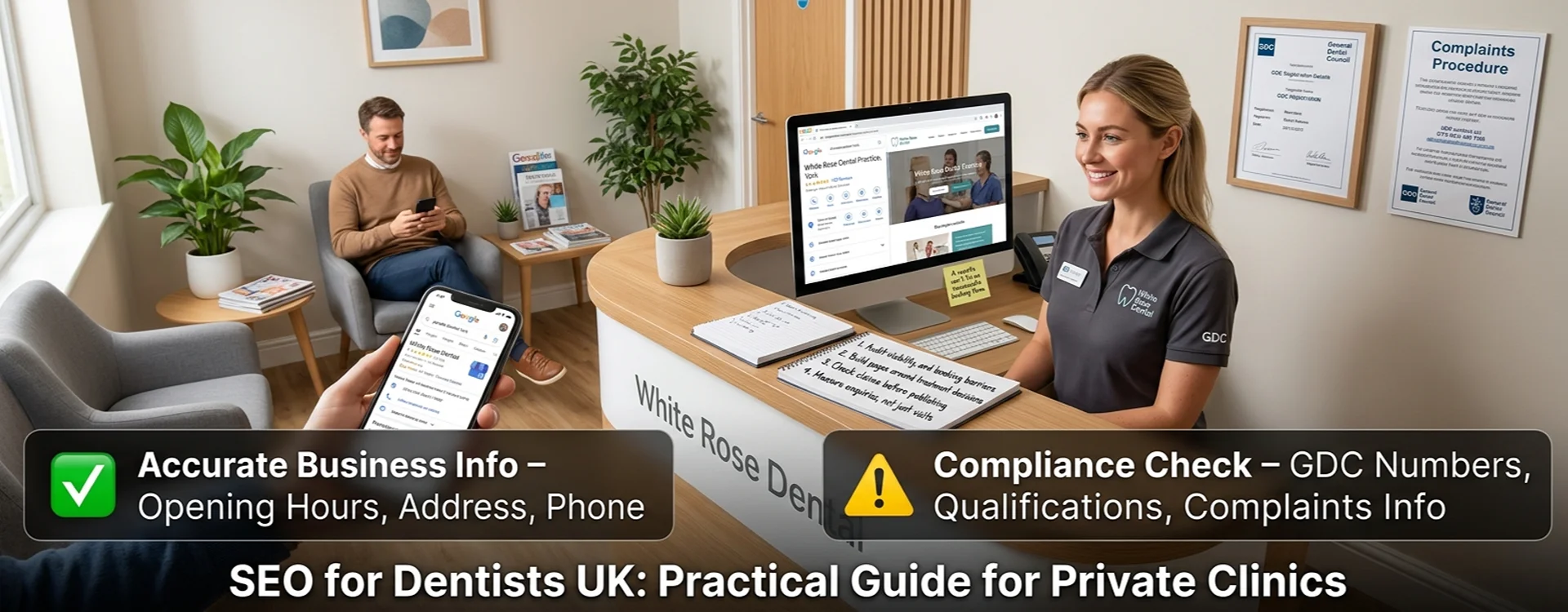
SEO for Dentists UK helps local patients find, review, and contact your practice through organic search and Google Maps. Whether you manage it in-house or with healthcare SEO services, the foundations are the same: your business information must be correct, your treatment pages must be useful, your clinicians’ credentials must be verifiable, and your advertising must be compliant. Private medical clinics can apply the same principles, but the regulations for each profession and service must be checked separately.
Start with the right patient journey
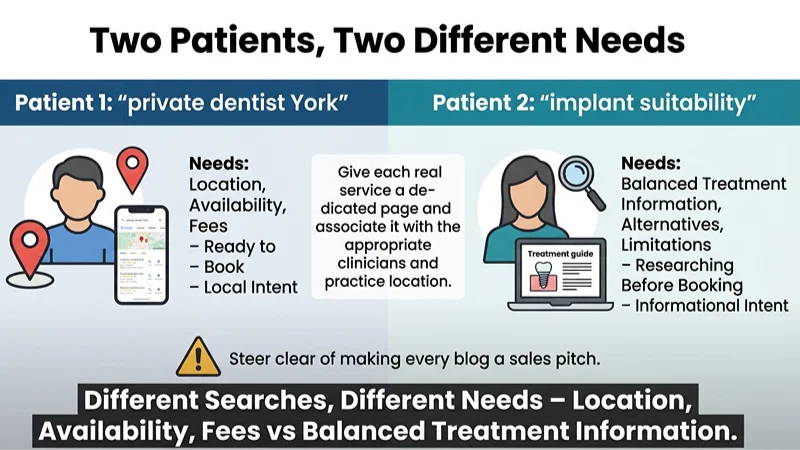
Patients searching “emergency dentist near me” or “private dentist York” need location, availability, and fees; someone researching implant suitability needs balanced treatment information, backed by reliable sources, before booking. Make it clear whether the practice is NHS, mixed, or fully private: the GDC expects this in practice publicity, and it is often the first thing patients check. Give each real service a dedicated page and link it to the relevant clinicians and practice location. Steer clear of making every blog post a sales pitch.
For local results, Google says it mainly weighs three factors: relevance, distance, and prominence. Accurate, complete information helps Google understand your practice, but SEO cannot remove the effect of the searcher’s location.
Which improvement should come first?
Use this decision table before commissioning more content.
| Situation | Priority | Page or asset | Measure |
|---|---|---|---|
| Incorrect opening hours | Correct business details | Google Business Profile | Accuracy across listings |
| Treatment page gets no impressions | Check indexing and intent | Service page | Relevant search impressions |
| Visits produce few enquiries | Clarify fees and booking | Landing page | Enquiry completion rate |
| Several real practice locations | Explain each location | Branch pages | Enquiries by branch |
| NHS profile out of date (England) | Confirm NHS website information | NHS website profile | Confirmed every quarter |
| Clinician described as a “specialist” | Check the GDC specialist lists | Team and treatment pages | Titles match the GDC register |
| Medicine-led campaign planned | Obtain a compliance review | Campaign and destination | Approval before launch |
How to Improve SEO for Dentists UK: 4-Step Implementation Plan
1. Audit visibility and booking barriers
Inspect your most important URLs in Google Search Console and check which queries already bring impressions. Test the mobile booking journey end to end, including the confirmation messages. Compare your website with your Google Business Profile and, for NHS practices in England, your NHS website profile. An effective troubleshooting order is access, indexing, relevance, and conversion: a rewrite won’t fix an inaccessible booking form.
2. Build pages around treatment decisions
Select priority services by considering commercial value and clinical capacity, not just traffic potential. Explain consultation suitability, alternative treatments, limitations, fees, and what happens at each stage. Name the clinician who reviewed the page. The GDC already requires a simple price list to be clearly displayed in the practice, so publishing “from” prices online is a small step that saves patients a phone call. Don’t create almost identical pages for every nearby town. Create useful, real location pages with directions, accessibility, opening hours, and the services actually on offer there.
3. Check claims before publishing
For a compliant dental website, check each clinician’s professional qualification, the country where they qualified, and their GDC registration number, plus the practice contact details, the GDC’s contact details or a link to the GDC website, complaints information, and the date the site was last updated. Only describe a dentist as a “specialist”, or use titles such as orthodontist or periodontist, if they are on the relevant GDC specialist list. “Implantologist” is a common mistake, because there is no GDC specialist list for implant dentistry.
Naming your practice regulator is also a simple trust signal: the Care Quality Commission (CQC) in England, Healthcare Inspectorate Wales (HIW), the Regulation and Quality Improvement Authority (RQIA) in Northern Ireland, or Healthcare Improvement Scotland for fully private practices in Scotland.
The guide to E-E-A-T for UK regulated industries explains how to present these trust signals, and the GDC’s guidance on advertising sets out the website requirements in full. The GDC consulted in 2026 on replacing its Standards for the Dental Team with a new Framework for Professionalism, so check the GDC website for the current position before relying on any checklist. Private medical clinics need checks tailored to their own profession and service; a dental checklist is not enough on its own.
4. Measure enquiries, not just visits
If your systems allow, build a monthly overview of relevant search clicks, enquiries, booked consultations, and treatment uptake. Record the treatment and location each enquiry relates to, but keep clinical details out of analytics, as health information is special category data under UK GDPR. When traffic increases but bookings do not, check query intent, appointment availability, and form failures before ordering more content.
Keep healthcare advertising within bounds
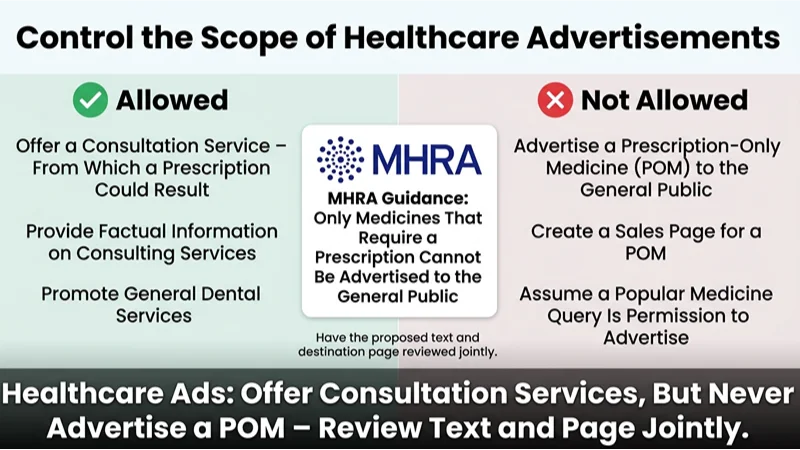
Agreeing your keywords does not settle what your pages are allowed to say. The MHRA states that prescription-only medicines (POMs) cannot be advertised to the general public, and its guidance also covers promotional websites and social media. A popular medicine-related query is therefore not automatic permission to create a sales page.
According to the MHRA, you can promote a consultation service from which a prescription could result, but you must not advertise a POM. This matters for dental practices offering facial aesthetics: botulinum toxin (for example, Botox) is a POM, and the ASA treats indirect terms such as “wrinkle-relaxing injections” as promoting it, so promote a consultation for lines and wrinkles instead. Have the proposed text, images, and destination page reviewed together before launch.
Practical pro tips
- Report booking requests and confirmed appointments separately; otherwise, abandoned enquiries can look like patient growth.
- Keep a register linking clinicians to treatments so pages can be audited when staffing or service availability changes.
- Check appointment capacity before promoting a treatment. Visibility has little commercial value when suitable patients cannot book.
- Give location pages real accessibility and travel information. Patients need more than the name of a town.
- Ask for reviews consistently. Fake reviews and concealed incentivised reviews have been banned practices in the UK since 6 April 2025 under the Digital Markets, Competition and Consumers Act 2024.
Frequently asked questions
What does SEO for dentists involve?
Dental SEO in the UK combines local SEO, such as accurate business information, with technically accessible pages, useful treatment content, and enquiry measurement. Start with the treatments patients can actually book. According to Google, complete business information helps it match a profile to relevant searches, while links, articles, directories, and reviews contribute to prominence in local search results.
How long does dental SEO take?
There’s no dependable deadline for every practice. Timelines depend on indexing problems, the quality of treatment pages, and how established local competitors are. It is better to agree on milestones than a date for guaranteed rankings: first resolve technical barriers, then monitor relevant impressions, enquiries, and bookings. Compare similar periods and take account of changes in appointment capacity.
What is the cost of dental SEO services in the UK?
Be wary of any quote without a clearly defined scope. Ask whether technical fixes, treatment-page writing, and clinical review are included in the price. Keep one-off work separate from ongoing support. Don’t focus only on the headline monthly price; it’s often better to compare deliverables and ownership terms. A low-cost package may exclude implementation, leaving the most important work unfinished.
What information should a dental website show?
Show the practice name, address, telephone number and email, the GDC’s contact details or a link to the GDC website, complaints arrangements (including the relevant NHS body for NHS treatment and the Dental Complaints Service for private treatment), and the date the website was last updated. Every dental professional mentioned should have their professional qualification, the country where they qualified, and their GDC registration number displayed. Make clear whether the practice offers NHS, mixed, or private-only care. Treat this as a publishing checklist, not a substitute for professional judgement.
Can private clinics market prescription-only treatments?
Not directly. Clinics must not promote prescription-only medicines to the public, but they can promote a consultation service. Take care, because content presented as factual information about a service can still promote a medicine if it points patients towards a specific POM. Look at all banners, visuals, marketing text, and links together. MHRA guidance for treatment services (Appendix 6 of the Blue Guide) explains how the restriction applies to public-facing sites.
Does every clinic location need a page?
If a real branch has helpful, unique information, such as clinicians, treatments, hours, directions, and accessibility, give it a page. Don’t create fake branch pages for towns where you have no practice. Make sure the website information matches the Google Business Profile for each location, so patients know where to go.
Why can traffic rise without more bookings?
New traffic may come from informational searches, users too far away to visit, or treatments you don’t offer. The journey can also break down when patients can’t find an available appointment. Assess landing pages by enquiry quality, not just visits. A smaller audience seeking an available service may be more valuable than a large audience researching unrelated symptoms.
Your next actions
For SEO for dentists UK, start this week: inspect five priority URLs in Search Console, test mobile booking, check every “specialist” title against the GDC register, and review one important treatment page with its clinician. If you would rather hand the audit to a UK SEO agency, Webranko can run it with you.

Be the first to leave a comment below.