
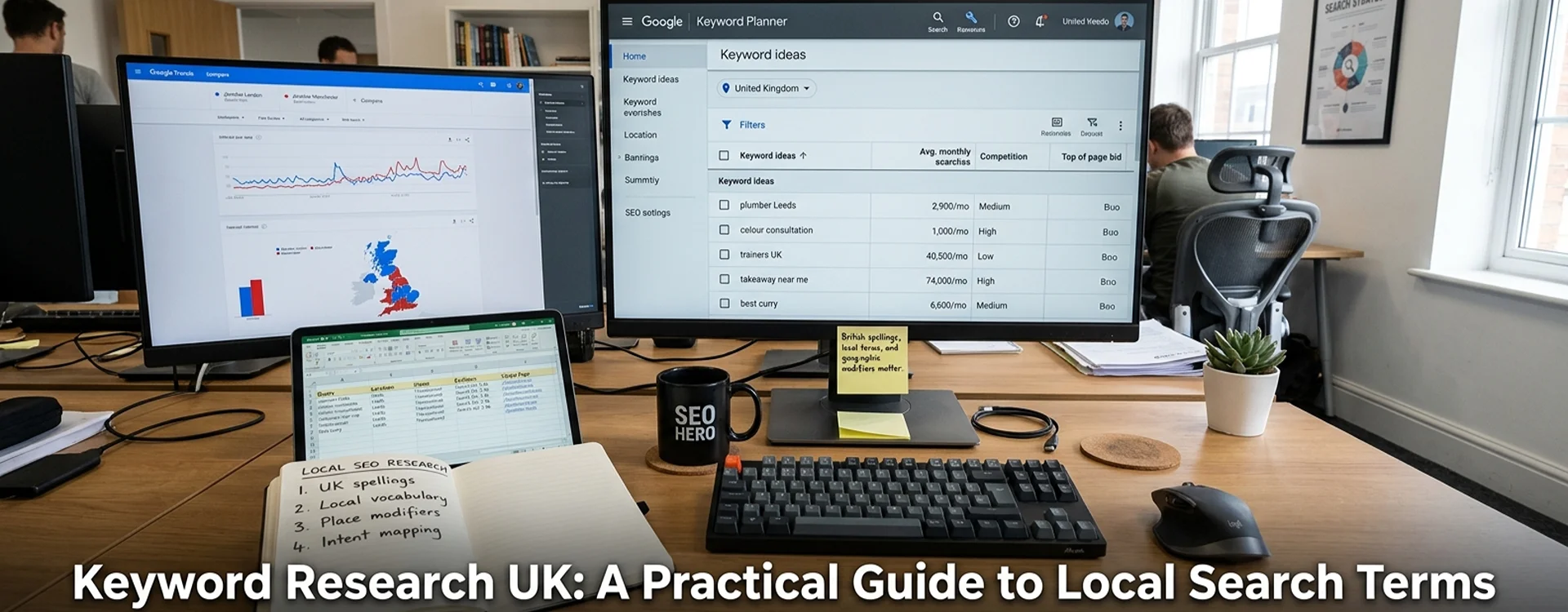
For UK businesses, keyword research begins with UK-filtered data, the words your customers use, and local intent. British spellings, alternative product names and geographical modifiers are the first filter to apply to your terms. Then sort the terms by the job the searcher wants done. Use Keyword Planner, Google Trends and Search Console together, and don’t depend on a single volume figure.
What makes UK search language different?
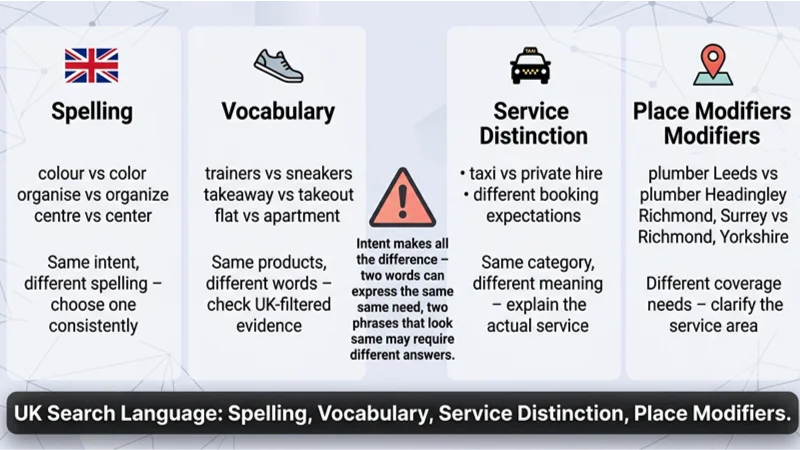
Separate spelling, vocabulary, and service meaning at the very beginning. “Color” and “colour” are spelling variations. Sneakers are also called trainers. Don’t automatically refer to a taxi as “private hire” or vice versa, as they can mean different things. Sorting these differences early is a core part of UK keyword research, because each variation can reflect a different audience or intent. GOV.UK’s style guide, which is useful as a house style reference, recommends UK English, including “organise” rather than “organize.” There is no evidence that it improves rankings.
Review the specific search results for each target phrase: are searchers finding transactional product pages, informational guides, directories, or local service providers? Only build a distinct page when you are providing a genuinely separate, valuable answer.
| Research dimension | Example terms | What to investigate | Recommended starting point |
|---|---|---|---|
| Spelling | color/colour | Same intent and results? | One page using consistent spelling |
| Vocabulary | trainers/sneakers | Same products and audience? | Compare UK-filtered evidence. |
| Local wording | takeaway/takeout | Which wording customers use | Check enquiries and search queries. |
| Place modifier | plumber Leeds / plumber Headingley | Different coverage needs? | Explain genuine service availability. |
| Place ambiguity | Richmond, Surrey / Richmond, Yorkshire | Which location is intended? | Clarify the county or service area. |
| Service distinction | taxi / private hire | Different booking expectations? | Explain the actual service. |
Intent makes all the difference. Two words can express the same need; two phrases that look the same may require different answers.
A 4-step keyword research plan for UK businesses
1. Create a seed list using consumer language
Gather phrases based on questions, category filters, sales conversations, and current website searches. Add spelling variations, product synonyms and town names in another column. Don’t create jargon to sound local: capture the language customers really use. Keep the customer’s original wording next to your preferred term, so unusual phrasing isn’t thrown away by mistake.
2. Set location before comparing demand
In Google Keyword Planner, choose United Kingdom, and then look at locations or cities. Label every export with its location, date range and network settings. Average monthly searches are for close variants. Competition is for ad share, not organic rank. Treat the figures as estimates, not exact counts for each spelling.
3. Check geography and seasonality
When comparing multiple alternatives, make sure to use the same geography and time frame in Google Trends. The trends demonstrate interest on a scale of zero to 100, rather than monthly search totals; equal regional scores don’t mean equal numbers of searches. Use Search Console to check visibility, queries, impressions, clicks, and position.
4. Map intent to useful pages
Group phrases that share the same results and the same need onto one page. Several pages aimed at the same need can lead to keyword cannibalisation. Google’s guidance is to create content made to help people, not to gain search engine rankings.
Practical review box: catch these mistakes early
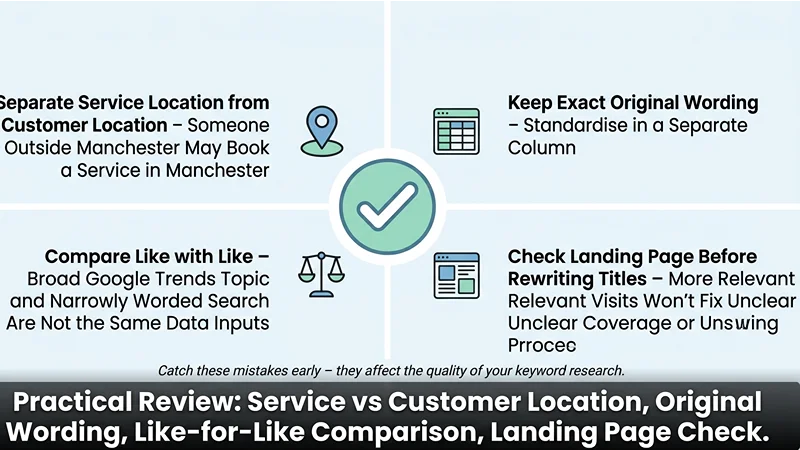
- Separate the service location from the customer location, as somebody outside Manchester may book a service in Manchester.
- Keep the exact original wording in your spreadsheet, and put a standardised version in a separate column.
- Compare like with like. A broad Google Trends topic and a narrowly worded search term are not the same data inputs.
- Check the landing page before rewriting titles. More relevant visits won’t fix unclear coverage or an unusable booking process.
FAQs
How do I perform keyword research for a UK business?
Begin by considering the questions your customers have regarding your service and products. Make a seed list, make use of the UK targeting in the Keyword Planner, and compare the relevant locations. After that, check the search results and assign an intent to a page. Write down your assumptions so that later enquiries and performance data can confirm or contest them.
What is the best tool for UK keyword research?
Begin using the Keyword Planner for estimated demand and geographical targeting, then move to Google Trends for a snapshot of the relative interest, and finally take a look at Search Console for your own visibility. No one tool can replace the others, as they answer different questions. Opt for extra software only when there is a defined research need those resources do not meet.
Does British spelling help SEO?
Use British spelling to keep UK-facing content consistent and appropriate for its audience. However, that guidance doesn’t establish a standalone ranking bonus for “colour” over “color”. Follow your house style, preserve official brand names and prioritise clear explanations over inserting every possible spelling variant into the copy.
How do I find regional keywords in the UK?
Once you filter the research by location, combine the customer language with the relevant towns, districts, and service areas. While Google Trends can show regional interest, that interest is relative. Treat a regional pattern as something to test, and don’t call a term “popular in Yorkshire” without data that shows it.
Should I focus on both UK and US spellings?
When both spellings have the same need, start with one page. Before making another, work out what additional value it would provide. Because of Keyword Planner’s close-variant grouping, reported volumes may not cleanly separate the alternatives. Different content might be warranted for a country because of its specific requirements. Spelling alone is a weak reason for an editorial difference.
Does every town need its own landing page?
No. On different pages, answer distinct local queries about availability, delivery, amenities, or service conditions. If your page has been edited to add nothing except a new place name, think again. If somebody landed on the page straight from the search results, would they find useful information? That’s the practical test. It’s consistent with Google’s overall people-first guidance.
How do I rank for local keywords?
Get an idea of the page you could create based on relevance, service coverage, and likely enquiry value. Avoid dismissing a phrase only due to its low score. In the same vein, don’t take it for granted that it will convert well: record it as a test and assess actual enquiries alongside available search-performance evidence.
Your next actions
Create a worksheet with these columns: query, location, intent, evidence, target page, and next action. Research one service first, then expand the process. If you would like help turning that worksheet into a plan, Webranko can support your UK SEO. In our case study for a Manchester builder, each page used real construction search terms, not generic trade language.

Be the first to leave a comment below.