
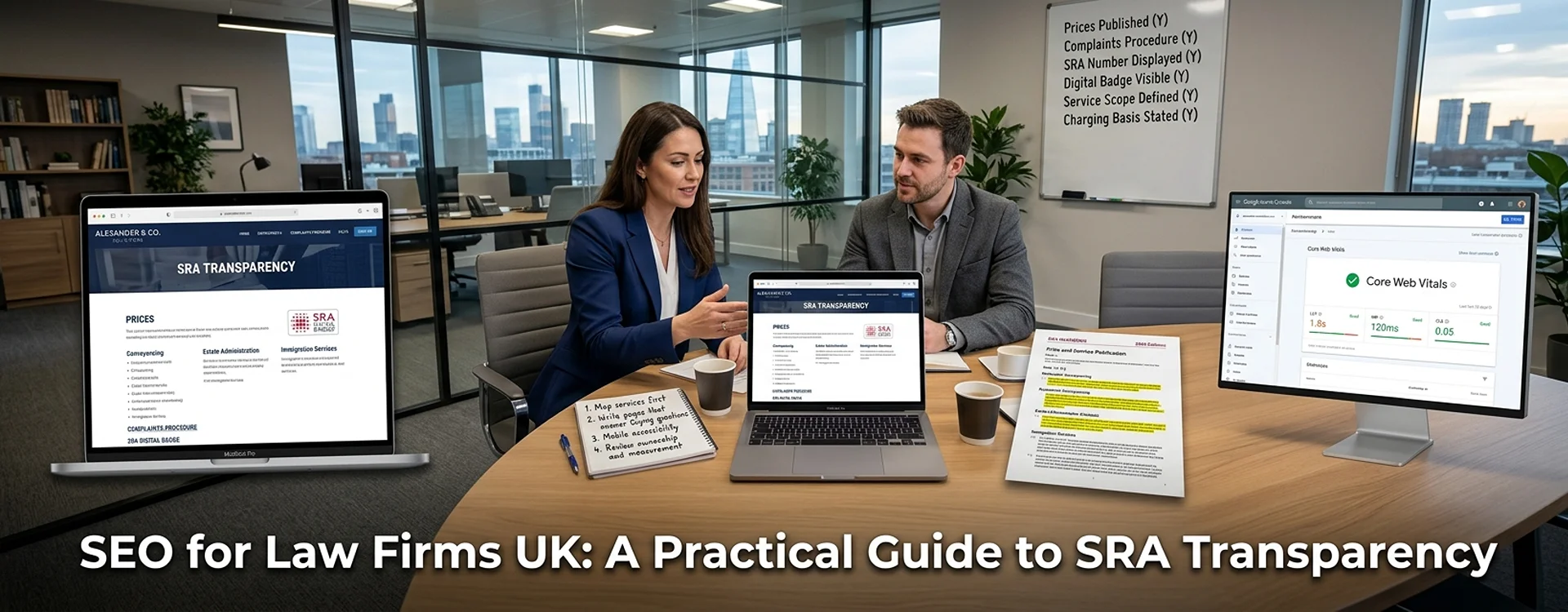
SEO for law firms in the UK helps people find your services through Google and gives them clear, accurate information about your firm before they get in touch. Under the SRA Transparency Rules, SRA-regulated firms must also publish relevant information, including prices for specified services, how to complain, and regulatory information. Given these responsibilities, craft useful service pages instead of making unfounded claims about rankings or legal outcomes.
SEO for law firms in the UK: start with the rules
Transparency is a page-design requirement, not just a footer task, and a specialist UK SEO agency should build it into the page from the start. The SRA Transparency Rules apply to firms regulated by the Solicitors Regulation Authority, which regulates solicitors in England and Wales. Solicitors in Scotland and Northern Ireland are regulated by the Law Society of Scotland and the Law Society of Northern Ireland, which set their own rules.
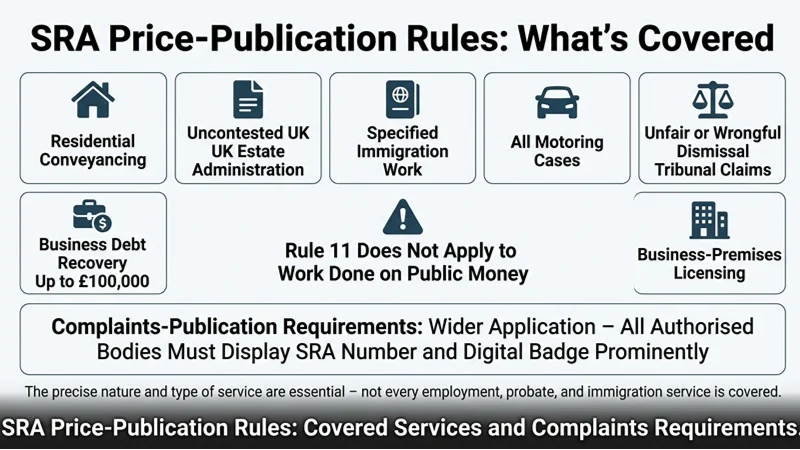
The SRA’s price-publication rules cover specified services that you advertise as part of your usual business. For individuals, these are residential conveyancing (sales, purchases, mortgages and remortgages); the administration of uncontested estates where the assets are in the UK; immigration applications and First-tier Tribunal immigration appeals, excluding asylum; advice and representation at the magistrates’ court on summary-only road traffic offences dealt with at a single hearing; and employees’ unfair or wrongful dismissal claims at the Employment Tribunal. For businesses, they are defending unfair or wrongful dismissal claims, debt recovery up to £100,000, and licensing applications for business premises. Under Rule 1.2, the price-publication duty does not apply to publicly funded work. The precise nature of the service matters: not every employment, probate or immigration service is covered. The complaints-publication requirement applies more widely, and every authorised body must display its SRA number and the SRA’s digital badge in a prominent place on its website.
The SRA has fined firms for missing price information, complaints details and digital badges. It also consulted in 2026 on further rules about how firms keep clients informed about complaints, so check the SRA website for any final changes before updating your complaints page.
Turn compliance requirements into useful page content
The following matrix translates the rules into recommended implementation choices for website design and SEO for law firms; the page locations are suggestions, not prescribed layouts.
| Requirement | Information needed | Suggested location | Common failure |
|---|---|---|---|
| Applicable prices | Total cost, or an average or range where a total is not practicable | Relevant service page | “Contact us” replaces disclosure |
| Charging basis | Fixed fees or hourly rates | Beside price | The starting price lacks context |
| Additional costs | Likely disbursements and applicable VAT amounts | Fee breakdown | Third-party charges omitted |
| No win, no fee terms | If you use conditional fee or damages-based agreements, when clients may have to pay themselves, including from damages | Beside price | “No win, no fee” with no explanation of client costs |
| Service scope | Inclusions, exclusions, key stages and likely timescales | Service section | Headline price promises too much |
| People | Qualifications and experience of those doing the work and their supervisors | Team section | Generic “expert team” wording |
| Complaints | Complaints procedure, and how and when to complain to the Legal Ombudsman and the SRA | Accessible complaints page | Escalation information missing |
| Regulatory identity | SRA number and the SRA digital badge (the SRA number also belongs on letterheads and emails) | Prominent website location | Redesign removes required elements |
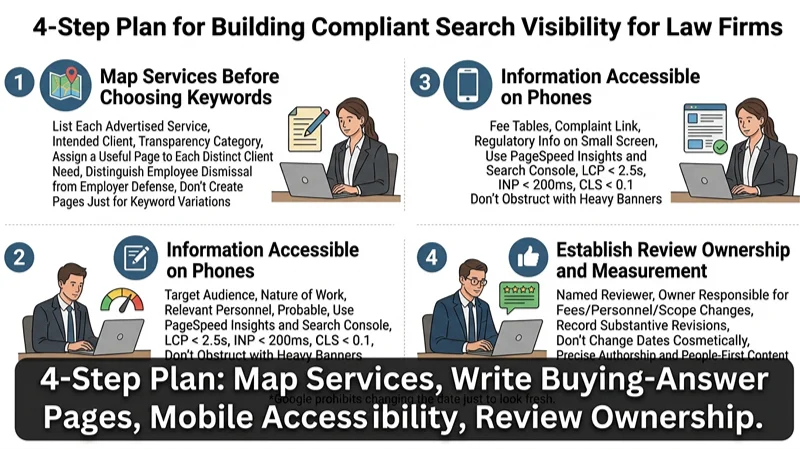
How to build compliant search visibility: 4-step implementation plan
1. Map services before choosing keywords
List each advertised service, its intended client, and the relevant transparency category. Then assign a useful page to each distinct client need. For example, distinguish an employee’s dismissal claim from an employer’s defence. Don’t create separate pages merely to repeat keyword variations. The regulatory categories provide a practical starting point for clearer navigation.
2. Write service pages that answer buying questions
Provide a concise overview of the target audience, the nature of the work involved in the service, the relevant personnel for the job, the probable stages, and the approximate costs. List key qualifications alongside the claims they support, in line with E-E-A-T for UK regulated industries. A headline fee with exclusions buried further down the page leads to confusion. Ensure the responsible solicitor checks the legal content and the accuracy of the publicity before publication.
3. Make key information accessible on phones
Test fee tables, the complaints link and regulatory information on a small screen. You can use PageSpeed Insights along with Search Console to investigate performance. Google’s “good” Core Web Vitals thresholds are an LCP within 2.5 seconds, an INP within 200 milliseconds and a CLS within 0.1. Meeting these targets does not guarantee rankings. Do not obstruct easy access to pricing information with large, heavy banners.
4. Establish review ownership and measurement
Give each service page a named reviewer and an owner responsible for checking changes to fees, personnel, and service scope. Record substantive revisions rather than changing dates cosmetically. This keeps the page answering the questions a potential client is likely to have before making an enquiry. Google’s guidance values clear authorship and people-first content, and it warns against changing dates just to make pages look fresh.
Local search: keep your firm’s details consistent
For many firms, enquiries start with a local search such as “conveyancing solicitor near me”. Keep your firm name, address and phone number consistent across your website, Google Business Profile and legal directories, and link each office’s profile to its most relevant service page. Directory entries and profiles count as publicity, so they must also be accurate and not misleading. Ask clients for reviews fairly, and never write, buy or selectively present them: fake reviews are prohibited under UK consumer law and Google’s review policies.
Practical checks before launch
Implementation tips
- Check each fee statement against its exclusions, rather than reviewing prices in isolation.
- Include supervisors when checking published experience and qualifications.
- Check title tags, meta descriptions and promotional copy as well as the body text, as any of them can contain misleading statements.
- When you plan a redesign, carry out a transparency review and confirm that prices, the complaints procedure, the SRA number and the digital badge are still easy to find.
- Review published prices at least annually and whenever your fees change.
When it comes to law firm marketing SEO, the simple key is to answer the questions someone would ask before instructing you. Google wants people to create content with useful information, original ideas, and trustworthy details. Google has also said it has no preferred word count.
FAQs
What does SEO mean for law firms in the UK?
It is the work of helping search engines discover and understand useful pages about a firm’s services. Pages promoting solicitors’ services must also comply with professional rules. Effective solicitor SEO in the UK therefore links discoverability with accurate publicity, clear information, and relevant disclosures, rather than treating compliance as a separate task added at the end.
Which legal services require published prices?
Rule 1.3 lists the covered services for individuals and Rule 1.4 the covered services for businesses. Examples include residential conveyancing, uncontested UK estate administration, and specified immigration, employment, motoring, and business services. Don’t assume an entire department is covered or exempt: check each advertised service against Rules 1.3 and 1.4, and remember that Rule 1.2 exempts publicly funded work.
Do the SRA Transparency Rules apply across the whole UK?
They apply to firms and individuals regulated by the SRA, which regulates solicitors in England and Wales. Solicitors in Scotland and Northern Ireland are regulated by the Law Society of Scotland and the Law Society of Northern Ireland, so check those bodies’ requirements instead.
Can solicitors use “best” in website marketing?
The key obligation is that publicity must be accurate and not misleading, under paragraph 8.8 of the Code of Conduct for Solicitors and paragraph 7.1(c) of the Code of Conduct for Firms. Treat any unsupported “best solicitor” claim with caution. Check what evidence supports the wording, what it implies to a reader, and whether it could mislead. The SRA Code of Conduct provides the governing publicity requirement.
Is it possible for law firms to hide pricing?
No. A contact form alone does not meet the requirement for clear, accessible, and prominent cost information for covered services. You can still give tailored quotes after an enquiry, but the required information must be published first. Where calculating a total is not practicable, the rules permit an average or a range, which must still include the required charging and service information.
Does SRA compliance improve Google rankings?
There is no basis here for promising a direct ranking benefit from an SRA badge or compliant pricing. Compliance meets regulatory obligations. Separately, clear service information can help readers evaluate your firm, which fits Google’s people-first guidance. Keep those purposes distinct when assessing proposals framed around “SRA website rules SEO”.
How should a law firm choose an SEO agency?
When evaluating a legal SEO agency in the UK, request a sample service-page brief, approval workflow, and reporting process. Check who verifies legal claims and the accuracy of disclosures. Google’s guidance values accurate authorship information, and SRA publicity must not be false or misleading.
Your next actions
To start SEO for law firms in the UK, begin with one priority service page. Compare it with Rules 1–4 of the SRA Transparency Rules, resolve any missing disclosures, and obtain legal approval; only then check mobile usability and search performance. Expand to other pages once that workflow works.

Be the first to leave a comment below.