
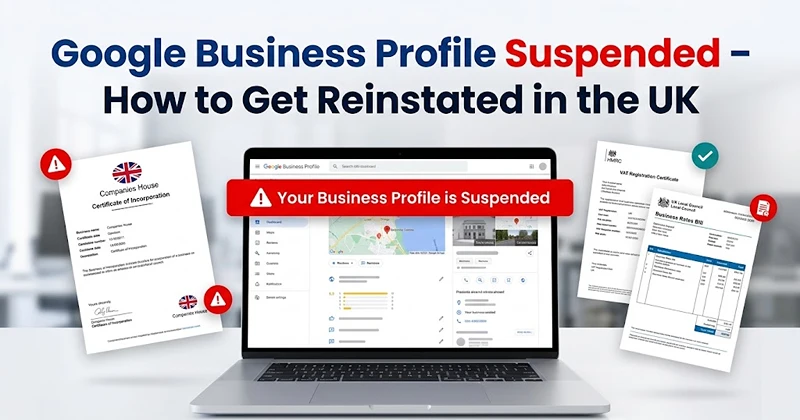
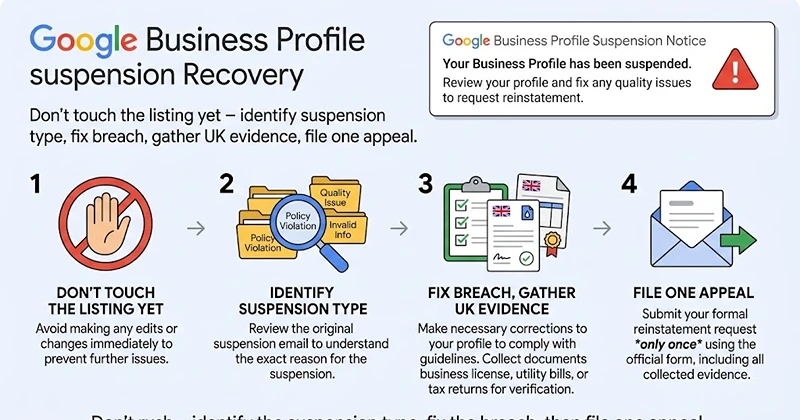
If your Google Business Profile is suspended, don’t touch the listing yet. Work out whether it’s a soft or a hard suspension, fix the actual guideline breach, gather UK proof such as your Companies House record and a business rates bill, then file one appeal through Google’s appeals tool. Most decisions come back within five working days.
That’s the short version. The detail matters though, because an appeal is effectively a one shot document review, and a rushed submission is how good businesses end up permanently off the map.
First, work out which kind of suspension you’ve got
Three different things get called “suspended” and they don’t share a fix. Open an incognito window, search your business name plus town on Google and Maps, then check the dashboard.
| What you’re seeing | What it actually is | Where the appeal goes |
|---|---|---|
| Listing still visible publicly, but the dashboard shows a suspension notice and your edits won’t publish | Soft suspension. Usually a rejected edit or a policy flag on one field | Business Profile appeals tool |
| Listing has vanished from Search and Maps, reviews gone with it | Hard suspension. Google has removed the profile entirely | Business Profile appeals tool |
| Every profile you manage went down at once and you can’t claim or create new ones | Account level restriction, not a listing problem | myaccount.google.com/restrictions first, then appeal the profile separately |
That third row catches people out. When a Google account is restricted, every profile it manages goes down as a consequence, so appealing the listing achieves nothing until the restriction is lifted. If you’ve inherited a profile from a previous agency, check this first. A manager with poor account standing takes your listing down with them.
Why UK profiles get pulled
The guidelines are global. The traps are local.
The registered office trap is the big one. Plenty of UK limited companies register at their accountant’s address, which is perfectly legal, then list their actual trading address on Google. Cross check that name against Companies House and the two don’t line up, so the profile reads as fabricated to someone scanning documents in bulk. It isn’t. It just looks that way.
Serviced offices are the other grey area. A desk at a Regus or Spaces building is somewhere you can genuinely be found, but Google treats shared and virtual offices with heavy suspicion, given how many lead generation operations have abused them. If nobody’s there during your stated opening hours, you’re on thin ice.
Other common triggers, roughly in order of how often they turn up:
| Trigger | What it looks like |
|---|---|
| Keyword stuffed names | “Smith Plumbing” on the invoice, “Smith Plumbing | Emergency Plumber Leeds | 24hr Boiler Repair” on the profile |
| Exposed home address | Service area businesses showing a home address instead of hiding it and setting service areas properly |
| Several fields edited in one session | Change name, phone, address and category on a Tuesday afternoon and the automated systems read it as a hijacking attempt |
| Duplicate listings | Left behind after a rebrand or an office move, where someone built a new profile instead of updating the old one |
| Review manipulation | Including a sudden spike from staff and family. Google removed more than 13 million fake profiles in 2025 alone, and detection has only sharpened since |
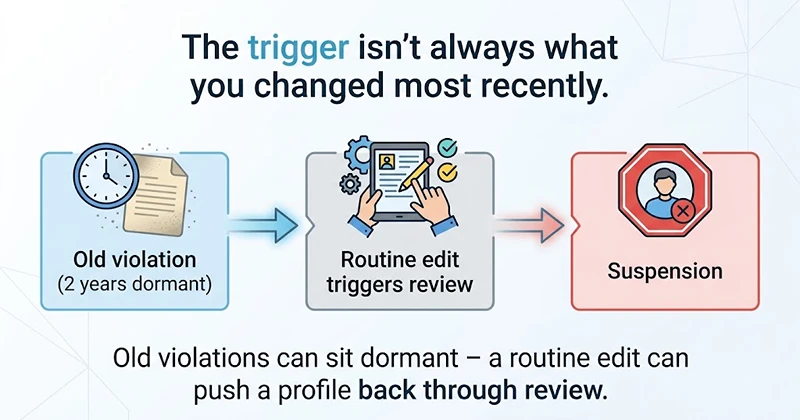
What often gets missed: a suspension isn’t always caused by the thing you changed most recently. Sometimes an old violation sat dormant for two years until a routine edit pushed the profile back through review.
The reinstatement process, step by step
- Stop editing and screenshot everything. Your business information, your review count, your photos, the suspension notice itself. If the profile comes back with data missing, that record is the only way to prove what was there.
- Read the reason Google gives you. The appeals tool shows the restricted profile, the reason for the moderation action, and a link to the policy breached. Older guides skip this because the tool didn’t always surface it. It usually does now, and it tells you what to fix.
- Fix the violation before you appeal, not after. Appealing a profile that still has a keyword stuffed name is an automatic denial. This is the single most common reason a first appeal fails.
- Get your evidence together before you open the form. The evidence step runs on a 60 minute timer once opened. Google tidied the flow in July 2026 so the bulk reinstatement question comes first and uploads sit inside the appeal rather than a separate form, but that clock is still there. Files ready and sensibly named before you start.
- Submit once. Filing repeatedly before a decision arrives slows you down. Keep the explanation to three or four factual sentences: what the business is, what was wrong, what you changed, what the documents prove. No apologies, no company history, no mention of lost revenue. Nobody reading it is empowered to care.
- Check the status in the appeals tool. It’ll show Submitted, Approved, Not Approved, Can’t be appealed, or Eligible for appeal.
Evidence that carries weight in the UK
Google accepts business registration, licences, tax certificates and utility bills. Translated for a UK business, the strongest bundle looks like this:
| Document | Detail that matters |
|---|---|
| Companies House incorporation certificate or company overview page | With the company number visible |
| VAT registration certificate | If you’re registered |
| Business rates bill from the council | The closest UK equivalent to the “business licence” Google keeps asking for |
| Utility bill in the business name at the profile address | Dated within three months |
| Employers’ liability insurance certificate | Which most UK service businesses must display anyway |
| Photographs of permanent exterior signage | With the street and door number in shot, plus signwritten vehicles for service area businesses |
Redact bank details first. Match the name and address on every document to the profile exactly, right down to whether you write “Ltd” or “Limited”.
One thing UK businesses get that most guides don’t mention
Google routes appeals differently depending on where a business operates, and the UK sits in the more generous bucket alongside the EEA. From here you can appeal rejected business information edits and restricted media (posts, photos, videos) in the appeals tool itself. Businesses outside the UK and EEA have to use the general contact form for those. Small advantage, but it stops a rejected name change becoming a support ticket lottery.
The flip side deserves an honest mention. EEA businesses can escalate to an out of court dispute settlement body under the Digital Services Act. The UK left the EEA, so that route isn’t open here. After Google’s own appeals, the realistic last step is the Business Profile community forum, where volunteer Product Experts sometimes escalate stuck cases. They aren’t Google staff and can’t promise anything.
If your appeal is denied
You get one more meaningful attempt: Google’s additional review request, where you submit evidence that wasn’t in the original appeal. Don’t resend the same documents in a stronger tone. Something in that first bundle failed to prove what it needed to, and until you know what, another attempt only burns credibility.
Google reviews appeals within five business days. Clean cases often land inside a week, while anything involving account restrictions or multiple locations stretches further.
Frequently asked questions
Will I lose my reviews if my profile is suspended?
Usually not. When a hard suspended profile is reinstated, reviews and photos normally return with it. Reviews are only lost permanently if the profile is deleted outright rather than suspended, or if they were removed separately for policy reasons.
Can I create a new Google Business Profile while mine is suspended?
No. Google explicitly tells you not to create a new profile for the same business while an appeal is under review. It creates a duplicate, which is a violation in itself, and it pushes a temporary suspension towards a permanent one.
My business is home based. Do I have to show my address?
No, and you shouldn’t. If customers don’t come to you, set the profile up as a service area business, hide the address, and define the postcodes or towns you cover. Listing a home address publicly when nobody visits is a frequent suspension trigger.
Does a suspension affect my Local Services Ads?
Yes. Local Services Ads are tied to the Business Profile, so a suspension usually takes your Google Guaranteed listing down with it. For trades businesses that’s often the bigger revenue hit, and it’s worth telling whoever manages your ad spend on day one.
Why was my appeal denied when I hadn’t done anything wrong?
Almost always because the profile still breached a guideline when the appeal was reviewed, or the documents didn’t match it exactly. A trading name on the listing and a legal name on the paperwork is enough to fail. Fix the mismatch, then request an additional review.
Getting help with a suspended profile
If you’d rather not gamble a one shot appeal on your own reading of the guidelines, this is work we handle regularly for businesses across the UK: auditing the profile, finding the real trigger, building the evidence pack, filing it properly first time. Our local SEO services cover the recovery and the rebuild afterwards. If your profile is healthy, our guide to getting more from a live Business Profile is the better place to start.
A suspension feels like a punishment. It’s closer to an automated system asking a question it couldn’t answer from the data in front of it. Answer clearly, with documents that match, and most legitimate UK businesses get back on the map. Answer in a hurry and you spend three weeks discovering how little room for error there is.

Be the first to leave a comment below.