
Written by Ryan Mitchell, Head of SEO | Last updated August 2026
You cannot delete a Google review yourself. What you can do is flag it, track the outcome in Google’s Reviews Management Tool, and — if Google says no — submit a one-time appeal. Reviews only come down when they break Google’s content policies or UK law. Nothing else, and no amount of paying a third party, changes that.
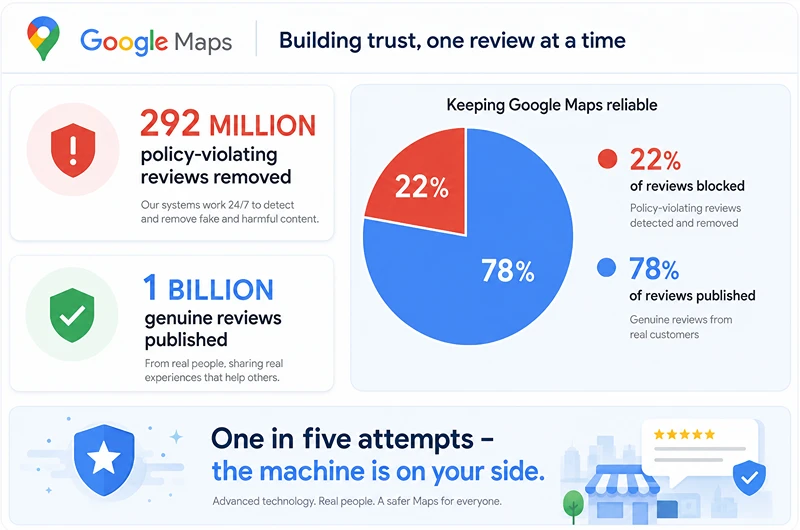
That sounds discouraging until you look at the numbers. In its 2025 Maps Trust & Safety Report, Google says its systems and analysts blocked or removed over 292 million policy-violating reviews, while the Maps community published more than a billion reviews in the same year. Set side by side, that is roughly one submission in five stopped or pulled. The machine is already working in your favour. You just have to make your case in the language it reads.
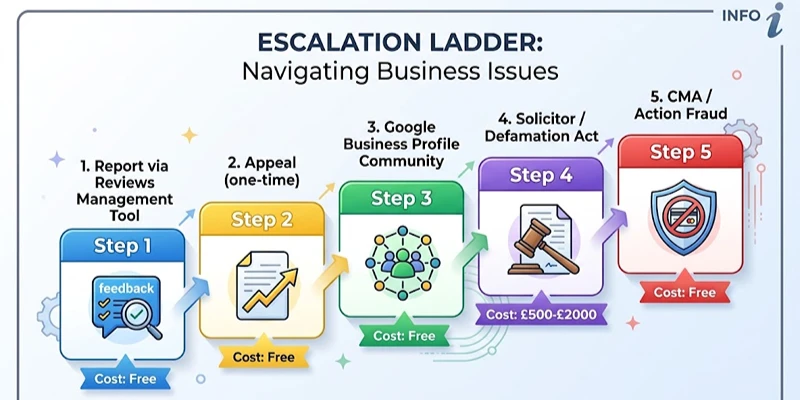
The escalation ladder
Most guides stop at step one. Here is the full path, and where you should stop on it.
| Situation | Route | Cost | What to expect |
|---|---|---|---|
| Review breaches a Google content policy (spam, off-topic, conflict of interest, profanity, fake engagement) | Report via your Google Business Profile or the Reviews Management Tool | Free | Status shows “Decision pending”, the review is removed, or you get “Report reviewed – no policy violation” |
| Google returns “no policy violation” | One-time appeal in the same tool (up to 10 reviews per appeal) | Free | You complete the appeal form and Google emails you the decision |
| The appeal is refused | Post in the Google Business Profile Community, including your case ID | Free | Volunteer Product Experts can escalate a well-documented case for a further look |
| Review states a false fact that is costing you real money | Notice of complaint under section 5, Defamation Act 2013 (England and Wales), then a formal legal removal request to Google | Solicitor’s letter, typically £500–£2,000 | An operator relying on the section 5 defence has 48 hours (working days only) to respond to a valid notice. Removal is not guaranteed |
| Review is paid, incentivised, or part of a competitor’s campaign | Report to Google, and report the trader to the CMA or Trading Standards under the DMCC Act 2024 | Free | A regulatory route, not a fast takedown |
| Reviewer demands payment to remove the review | Report to Google as extortion, and to Action Fraud (in Scotland, Police Scotland on 101) | Free | Google now actively screens for payment-demand scams of this kind |
The appeal almost nobody uses
It is the highest-value step in the process, and the one UK guides most often skip.
To check a review you have already reported: open the Reviews Management Tool, confirm the email address linked to your profile, select your business, then choose the option to check the status of a review you reported previously. At the bottom of the list you will find “Appeal eligible reviews”. Select the review, complete the appeal form and submit it. You can include up to 10 reviews in a single appeal.
The reason it works so often is that your first report was probably screened automatically. The appeal is what a person reads, and it is essentially a written argument. So write one. Do not argue that the review is unfair — name the policy clause it breaches and attach the evidence. You do not always need to wait for a final decision before appealing either; check the “Appeal eligible reviews” list rather than assuming, as BrightLocal’s walkthrough notes.
Keep the case ID. You get one appeal per review, and the tool will not let you file a second, so the community forum route depends on that reference number.
Evidence that works in a UK appeal
The export from your booking system showing no such customer. Till or card terminal records for the date named. A timeline from your CRM. Screenshots showing the same reviewer posting one-star reviews across several businesses in your sector on the same day, or in places they could not physically have visited in that window.
What a successful appeal actually looks like
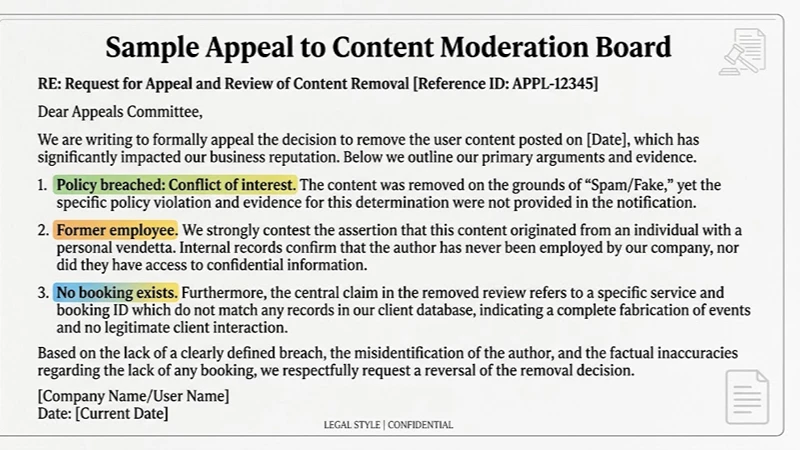
Here is the shape of an appeal that works, using the two clauses most UK removals turn on.
Conflict of interest. Google’s policy does not allow a review from a competitor, or from someone who used to work for the business. The appeal text:
Policy breached: Prohibited and restricted content, Conflict of interest. The reviewer, listed as “J. Warren”, is a former employee whose employment ended on 14 March 2026. Attached: signed termination letter and payroll record confirming employment dates. The review was posted on 19 March 2026, five days after leaving. The review describes internal management decisions, not a customer experience. No booking, invoice or card transaction exists for this name on any date. Attached: full customer export for the period 1 January to 31 March 2026.
Fake engagement. Google requires contributions to reflect a genuine visit, and states plainly that it does not allow content that is not based on a real experience.
Policy breached: Prohibited and restricted content, Fake engagement. The review references a consultation on 2 April 2026. Our booking system holds no appointment on that date under this name or any variant. Attached: diary export for 2 April 2026 and card terminal report for the same day. The same reviewer account has posted one star reviews to four other practices within a six mile radius on the same day. Attached: screenshots with timestamps.
Notice what neither version does. It never says the review is unfair, never mentions how upsetting it is, and never asks Google to be reasonable. It names one clause, states a fact, and points at a document. That is the whole trick.
When UK law does the heavy lifting
If the review states a factually false thing — not merely a harsh opinion — you have a route Google’s policy team cannot offer. Which route depends on where in the UK you are, because defamation law is not the same across all four nations.
England and Wales. Under section 1 of the Defamation Act 2013, a statement is not defamatory unless it has caused, or is likely to cause, serious harm to reputation. For a body that trades for profit, section 1(2) means that harm is not serious unless it has caused or is likely to cause serious financial loss. That is a real bar. A few bad nights’ sleep will not clear it. A named contract lost after the review appeared might. In Brett Wilson LLP v Persons Unknown [2015] EWHC 2628 (QB), the court was willing to infer serious financial loss from the circumstances, including a prospective client who withdrew instructions after finding the material online. That case concerned a defamatory listing on a third-party website rather than a Google review, but the reasoning on financial loss carries across.
For a Google review specifically, The Bussey Law Firm PC v Page [2015] EWHC 563 (QB) is the reference point: a fabricated Google Maps review led to £50,000 in damages, and over £100,000 once costs were added. It was decided on a posting made before the 2013 Act applied, so the serious harm test was not in play. Treat it as a demonstration of what a court will do about an invented review, not as a shortcut past section 1.
Scotland. The 2013 Act does not apply. The Defamation and Malicious Publication (Scotland) Act 2021 governs instead. It mirrors the serious harm test and the serious financial loss requirement for bodies trading for profit, but the procedural detail differs.
Northern Ireland. The Defamation Act (Northern Ireland) 2022 deliberately left out the serious harm test, so the threshold for a claim is lower than in England and Wales. It also does not contain the website operator regime described below.
The notice of complaint mechanism
This is the procedural step most people overlook. Section 5 of the Defamation Act 2013 gives website operators a defence for statements they did not post themselves. The defence is only defeated if you can show three things: that you could not identify the poster, that you gave the operator a valid notice of complaint, and that the operator failed to respond in line with the Defamation (Operators of Websites) Regulations 2013. That third point matters — the route bites hardest against anonymous reviewers.
On timing: within 48 hours of receiving a valid notice, an operator relying on the defence must either pass it to the poster or, where it cannot contact them, remove the statement. Weekends and bank holidays are excluded from that 48 hours, and the court has discretion to extend it. If your notice is defective, the operator has the same window to tell you so. The Ministry of Justice has published guidance on how the timings work.
Importantly, the notice requirements are a box-ticking exercise rather than an evidential standard you have to satisfy up front. Get the notice right and the clock starts.
Be honest about the limits. This is contested territory. Commentators have argued since the regulations were made that they encourage the removal of material that was never actually defamatory, and Google is a well-resourced operator that can decline and rely on other defences. Treat it as leverage, not a certainty.
The Online Safety Act 2023 route
Section 179 of the Online Safety Act 2023 makes it an offence to send a message conveying information the sender knows to be false, where they intend it to cause non-trivial psychological or physical harm to a likely audience and have no reasonable excuse. The Part 10 communications offences came into force on 31 January 2024. That fits a sustained malicious campaign far better than a disgruntled customer, and it is a criminal matter for the police rather than a delete button. The offence sits alongside older communications offences that were repealed only for England, Wales and Northern Ireland, so the position in Scotland differs — take local advice.
The regulator is now on your side
Since 6 April 2025, the Digital Markets, Competition and Consumers Act 2024 has treated fake reviews, concealed incentivised reviews and misleading presentation of review information as banned practices — unfair in all circumstances, regardless of their effect on any individual consumer. The CMA can impose fines directly, up to 10% of global turnover, and has estimated that up to £23 billion of UK consumer spending each year is influenced by online reviews. The detail sits in the CMA’s fake reviews guidance, CMA208.
That cuts both ways. Under undertakings signed with the CMA on 24 January 2025, Google agreed to add warning banners. These banners will appear on some UK business profiles. These businesses were found to have boosted ratings with fake reviews. Google also agreed to switch off their review function. For repeat offenders, Google may delete reviews from the last six months or more. Then in April 2026 Google added two clauses to the rating manipulation section of its Maps user-generated content policy: merchants must not direct staff to collect a set number of reviews, and must not direct staff to solicit reviews containing specified content, including content that names a staff member. A customer who spontaneously praises Jake by name is still fine. Engineering it is not. If your team runs either practice, fix that before you file anything.
What usually goes wrong
Flagging from a personal Gmail account rather than the profile owner account. Replying publicly in anger, which pushes the review back up the feed. Asking twelve colleagues to mass-flag, which reads as coordinated abuse. Paying a vendor that promises guaranteed removal when the only levers it has are the free ones described above. And review gating — filtering unhappy customers out before they reach the review form — which is now a compliance problem under the DMCC Act, not a clever tactic.
Your next three moves
First, open the Reviews Management Tool and check the status of everything you have already flagged. Anything sitting at “no policy violation” is a candidate for your one appeal. Second, read the CMA’s fake reviews guidance (CMA208) on GOV.UK and audit how your business collects reviews against it, including staff quotas and name prompts. Third, if a review is factually untrue and is costing you contracts, get a solicitor’s view on whether you can meet the serious harm threshold in your jurisdiction before spending anything on removal services.
FAQ
Can I delete a Google review myself?
No. Only the author or Google can remove a review. As the business owner you can flag it, submit one appeal if Google refuses, then use your case ID to escalate in the Google Business Profile Community. Beyond that, the routes are legal or regulatory. Buying reviews to bury it is itself a banned practice under the DMCC Act.
How long does Google review removal take?
Initial screening is usually automated and typically returns a status within a few days. Appeals generally take longer, and the decision arrives by email. Do not sit and wait — check the Reviews Management Tool, and look for the “Appeal eligible reviews” option rather than assuming you need a final decision first.
What does “Report reviewed – no policy violation” actually mean?
Usually that an automated screen found nothing, not that a person weighed your case and disagreed. You are not finished. Make the argument in a written appeal, citing the specific policy clause and attaching evidence. If that fails, post in the Google Business Profile Community with your case ID.
Can I sue someone in the UK for a bad Google review?
Only if it states false facts rather than opinion, and only if you clear the threshold that applies where you are. In England and Wales, section 1(2) of the Defamation Act 2013 requires a company to show serious financial loss, which is a high bar. Scotland applies the 2021 Act; Northern Ireland has no serious harm test at all. Get advice before spending. The cheaper first step is usually a notice of complaint to the operator.
How do I report a fake Google review?
Flag it through the Reviews Management Tool and choose the violation reason that fits best — usually fake engagement, spam or conflict of interest. If you are hit by a spike of reviews from new accounts, report each one individually rather than as a batch, and screenshot the pattern (timestamps, reviewer histories, overlapping targets) before anything disappears.
Can I pay a company to remove Google reviews?
You already have access to the same free flagging and appeal routes that removal firms use. Some of them are genuinely good at writing appeals, and that can be worth paying for. But nobody can guarantee removal, and any vendor claiming a back-door into Google is misrepresenting how the process works.
Can a competitor be prosecuted for posting fake reviews?
Posting or commissioning fake reviews has been a banned practice since 6 April 2025 under the DMCC Act, enforced by the CMA, which can fine up to 10% of global turnover. Google separately says it takes action against businesses and individuals running fake review services. Whether any specific case is pursued is a matter for the regulator.
This article is general information about the process, not legal advice. Defamation and consumer law differ between England and Wales, Scotland and Northern Ireland. Take advice from a qualified solicitor in your jurisdiction before acting on the legal routes described here.


Be the first to leave a comment below.