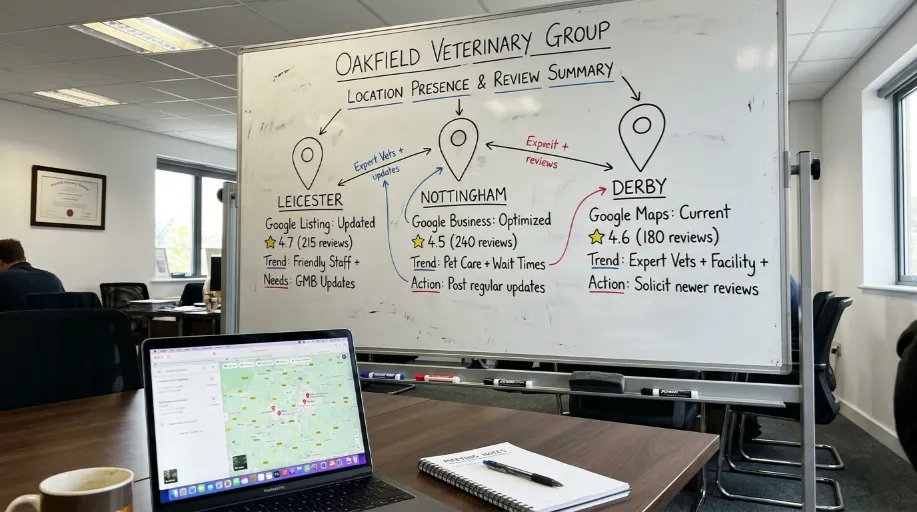
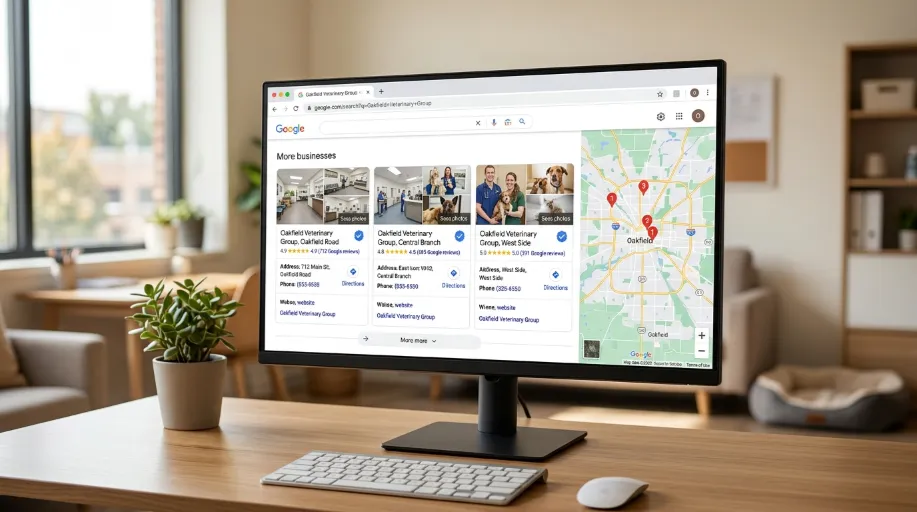
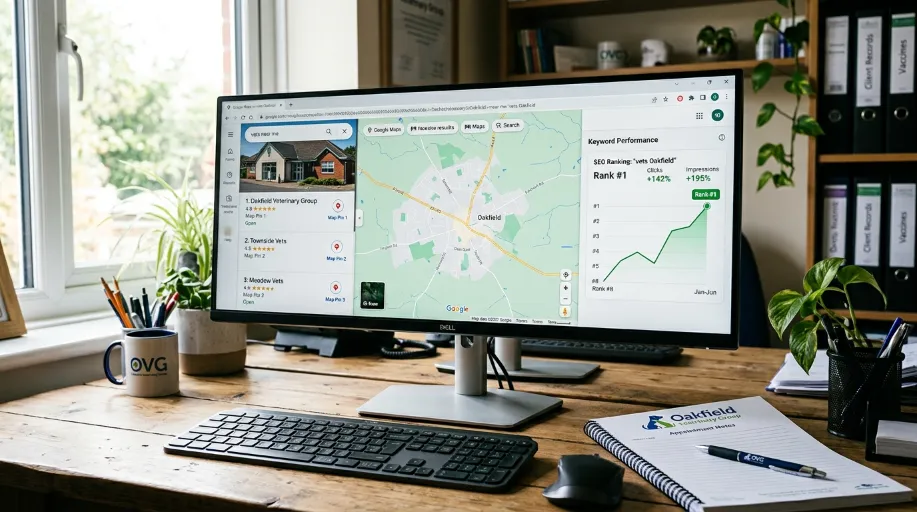
All three Oakfield Veterinary Group practices reached the top 3 map pack position for their core local search terms within eight months, replacing years of conflicting local visibility caused by a merged Google Business Profile. The fix started with untangling the listings, not with content, since no amount of writing would have solved a technical local SEO problem.
| Detail | Value |
|---|---|
| Client | Oakfield Veterinary Group, three site veterinary practice |
| Location | Leicester, Nottingham and Derby, UK |
| Timeline | 8 months |
| Practices in map pack top 3 | 3 of 3, up from 1 of 3 |
| Keywords on page one across sites | 29, up from 6 |
| Average Google review rating | 4.9, up from 4.3 |
Who Oakfield Veterinary Group Is
Oakfield Veterinary Group operates three veterinary clinics in Leicester, Nottingham and Derby, offering routine care, emergency treatment and referral services. Before this project, each practice had its own basic website page, but the group had never managed its local SEO as one. Nobody had looked closely at how the three Google Business Profiles related to one another, and they were not connected the way anyone assumed.
The practices had grown somewhat organically over the years, with Leicester as the original site and Nottingham and Derby added later. That growth history mattered more than expected once we started digging into the listing structure.
The Problem
A listing conflict nobody had noticed
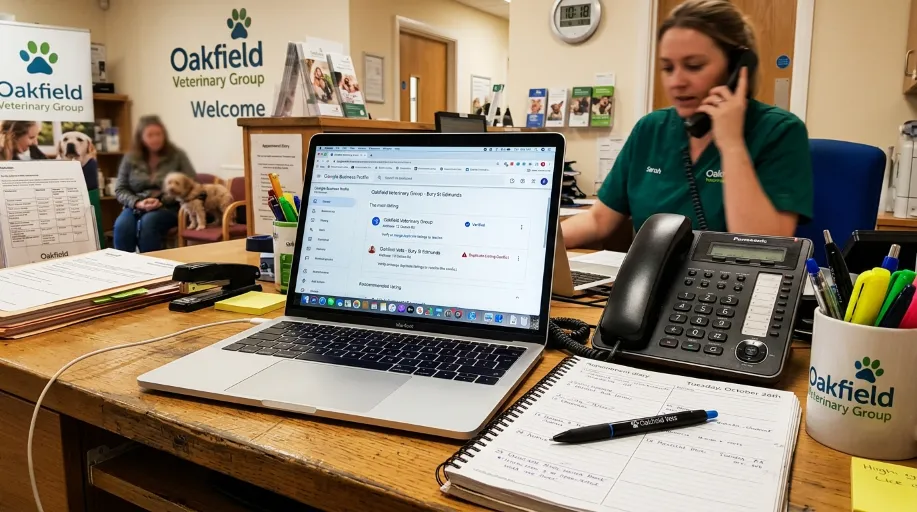
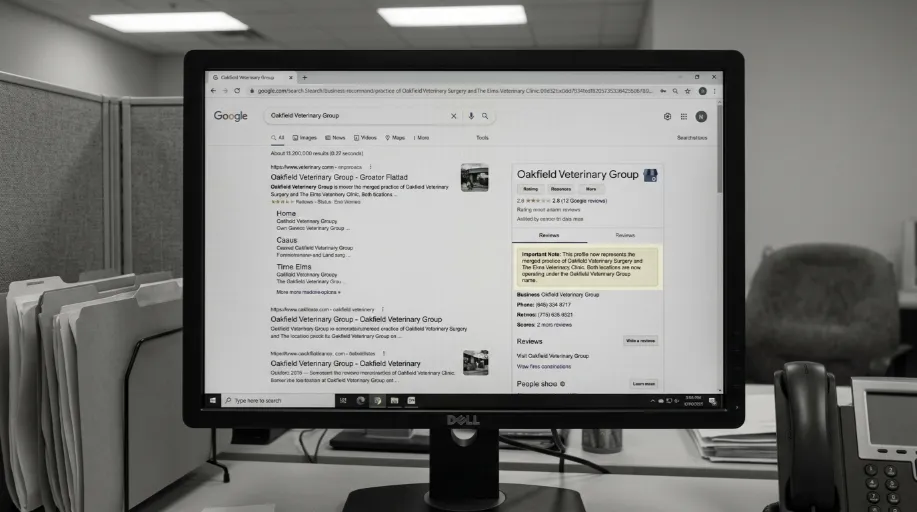
The audit found the Nottingham and Derby practices were using a single Google Business Profile, which Google had merged years earlier after a data import error that no one spotted at the time. As a result, Derby had almost no independent presence on Google Maps, and searches for either practice often showed the wrong practice entirely, with some emergency callers sent to the wrong branch.
- Nottingham and Derby sharing one merged Google Business Profile
- Derby effectively invisible in Google Maps because of the merge
- Emergency callers occasionally directed to the wrong practice location
- No consistent NAP data across directories for any of the three practices
Content and review gaps across all three sites
Review distribution was badly skewed. Leicester held 214 reviews while Derby held just 9, despite similar patient volumes across all three locations. None of the three practices had dedicated service area pages, and emergency vet searches, which carry high urgency and strong local intent, returned no relevant page from any Oakfield location.
- No dedicated service area pages for any of the three practices
- No content targeting emergency vet searches despite clear local intent
- No process in place for requesting reviews consistently across sites
- Review count heavily concentrated in Leicester alone
What We Did
Phase one, separating the merged listing
The first priority was resolving the Google Business Profile conflict, since no content work would fix rankings while Derby and Nottingham were sharing a listing. We worked through Google’s verification process to split the merged profile into two independent, individually verified listings, then corrected NAP data for all three practices across the major UK directories. This phase took longer than expected, since unmerging a Google listing required several rounds of verification before Derby’s profile was fully separated and confirmed live.
Phase two, location and service area pages
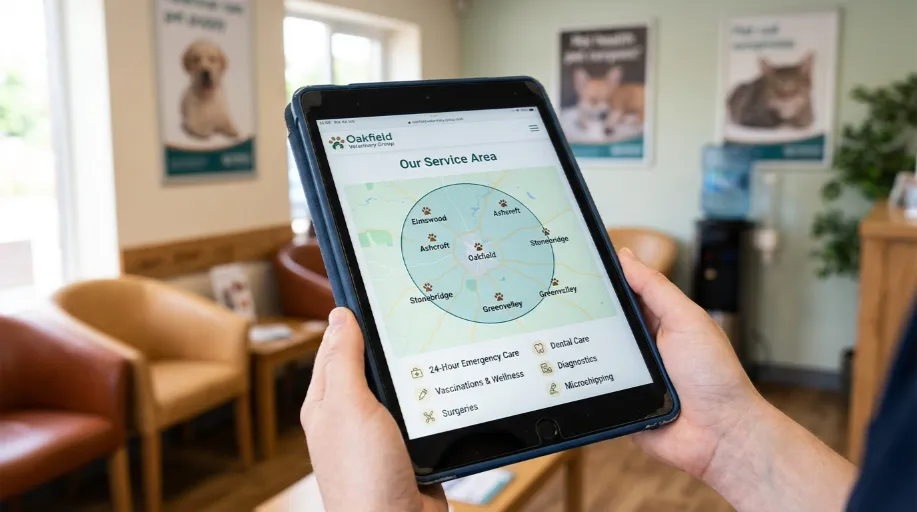
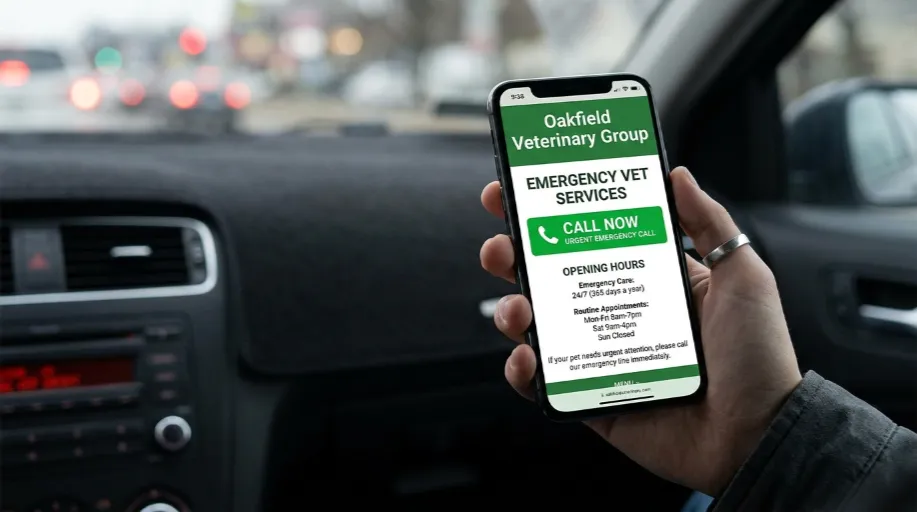
Once each practice had its own verified listing, we built dedicated location pages with practice specific service information, along with service area pages targeting the surrounding towns each practice actually served. Emergency vet content was created specifically for the high urgency, high intent searches, such as emergency vet Derby, that had previously returned nothing from any Oakfield site, since someone searching for an emergency vet at short notice needs a page that answers the question immediately rather than a generic homepage.
Phase three, closing the review gap
- Consistent post visit review request process introduced across all three practices
- Practice specific schema added marking up opening hours and emergency availability
- Derby prioritised for review generation given its much lower starting count
Derby’s low review count was still holding back its map pack position even after the listing separation, so review generation became a deliberate focus rather than something left to happen naturally.
What the practice manager was sceptical about
The practice manager had been sceptical that Derby could catch up to Leicester’s review volume within the project timeframe, given how far behind it started. That scepticism eased once Derby’s reviews began climbing steadily each month rather than in occasional bursts.
The Results
Month by month
- Months 1 to 2: three individually verified Google Business Profiles live with corrected NAP data
- Months 2 to 4: first map pack movement visible for Nottingham and Derby
- Months 4 to 6: Derby’s review count passed 40 for the first time
- Months 6 to 8: all three practices reached the map pack top 3 for their core search terms
Nottingham and Derby showed the first map pack movement by month three, almost as soon as their individual profiles were verified and live, since the listing merge had been actively suppressing both locations beforehand. Derby’s review count passed 40 for the first time by month five, still behind Leicester’s total but enough to close the credibility gap that had been holding its map pack position back.
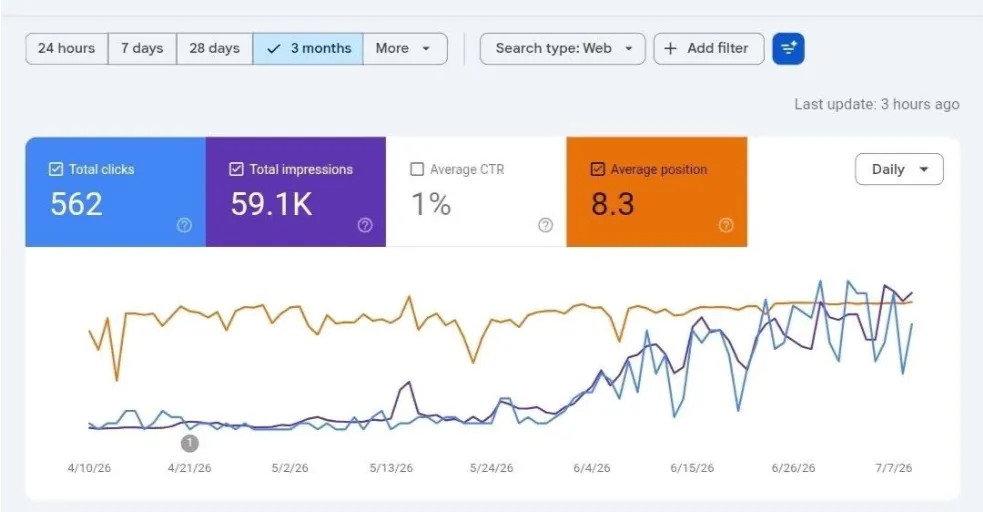
By month eight, all three practices held a top 3 map pack position for their core local search terms. 29 keywords were ranking on page one across the three sites combined, up from 6 at the start of the project, and the average Google review rating across all locations reached 4.9, confirmed through Google Business Profile insights and Search Console data.
What This Means For Veterinary Practices
Multi location veterinary groups often assume their local SEO problems are about content or reviews, when the underlying issue can be a technical listing conflict that content alone will never fix. Checking whether every location has its own independent, correctly verified Google Business Profile is one of the first things any multi site practice should do, in the same way our local SEO work for other service businesses always starts with the listing structure before moving into content.
Review distribution also matters more for multi site practices than single location businesses realise, since a newer or smaller site can look far less trustworthy than it actually is simply because review requests were never managed consistently across locations. The same principle applies across other healthcare niches, as we found in our dental SEO case study, where consistent review generation played a similar role in building local trust. For any veterinary group planning a multi location website, the technical foundation matters as much as the content sitting on top of it, which is why we approach these builds with the same structure used in our healthcare web design and SEO work.
Frequently Asked Questions
How are vets ranked on Google Maps in the UK?
Vets land in the map pack through a verified Google Business Profile, consistent NAP data across directories, a good volume and quality of reviews, and service area pages that clearly match the services and areas each practice actually covers.
What does local SEO mean for veterinary clinics in the UK?
Local SEO for veterinary clinics involves managing your Google Business Profile, ensuring your service area is clearly defined on your website, generating reviews, and confirming technical accuracy across your listings to help your clinic appear in the local map pack when someone searches for a vet near them.
Can a merged Google Business Profile hinder a multi location practice?
Definitely. Google sees the two practices as one and not two different locations with their own rank, so if you merge the two listings together, one location can disappear almost entirely. That’s what happened with two of Oakfield’s three sites.
Why are emergency vet search results important for local SEO?
A search for an emergency vet has high intent and urgency, so if a practice has no content that answers that specific search, it is missing out on a type of enquiry that often converts instantly. General informational searches take longer to turn into a booking than an emergency vet search.