
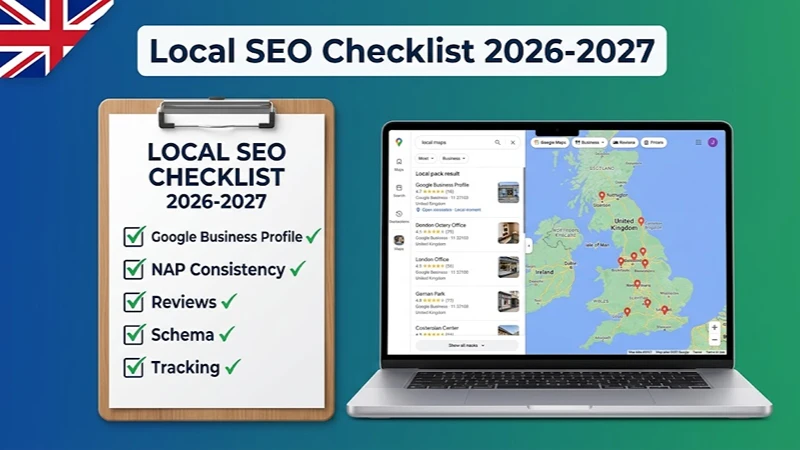
Local SEO Checklist for UK Small Businesses 2026–2027
A local SEO checklist for UK small businesses covers Google Business Profile setup, NAP consistency across directories, reviews, on-page optimisation, local schema, and tracking. Done right, it helps you rank in the local pack and Google Maps when nearby customers search for your services. If your business also sells products online, pairing this with dedicated eCommerce SEO services keeps your website and your local presence working together.
Why this checklist works (and what most miss)
Local SEO isn’t about ticking boxes. It’s about proving to Google that your business is relevant, trustworthy, and genuinely serves the areas you claim. The three core ranking signals are proximity, relevance, and prominence. Your checklist should strengthen all three without creating new problems.
Most guides list tasks but don’t explain the why or what breaks. Below is a prioritised 90-day plan that focuses on impact, not activity.
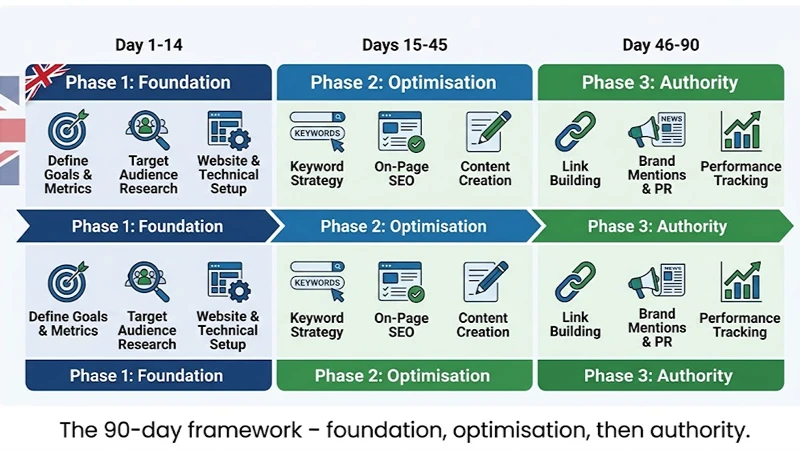
The 90-Day Local SEO Framework
| Phase | Focus | Key Actions |
|---|---|---|
| Days 1–14 | Foundation | Claim and verify GBP, fix NAP on website, audit top 10 citations |
| Days 15–45 | Optimisation | Complete every GBP field, add services and photos, launch review system, add LocalBusiness schema |
| Days 46–90 | Authority | Build location pages, earn local links, publish local content, track and refine |
Phase 1: Days 1–14, Get the basics right
Claim and verify your Google Business Profile
Search your business name on Google. If a profile exists, claim it. If not, create one at google.com/business. Verification usually comes by postcard, phone, or email depending on your category. Don’t skip this. Unverified profiles rarely rank well.
Decide on one canonical NAP format
Your Name, Address, and Phone number must match everywhere. Pick one format and stick to it. For example, use “Road” not “Rd” in some places and “Road” in others. This includes your website footer, contact page, social profiles, and every directory listing.
Audit your top 10 citations
Start with the big UK directories: Yell, Thomson Local, Bing Places, Apple Business Connect, and industry-specific sites like Checkatrade for trades or Treatwell for salons. Use a tool like BrightLocal or Whitespark to find inconsistencies, then fix them manually.
Common mistake: businesses list multiple phone numbers or old addresses. Google sees this as a trust signal problem.
Phase 2: Days 15–45, Optimise everything
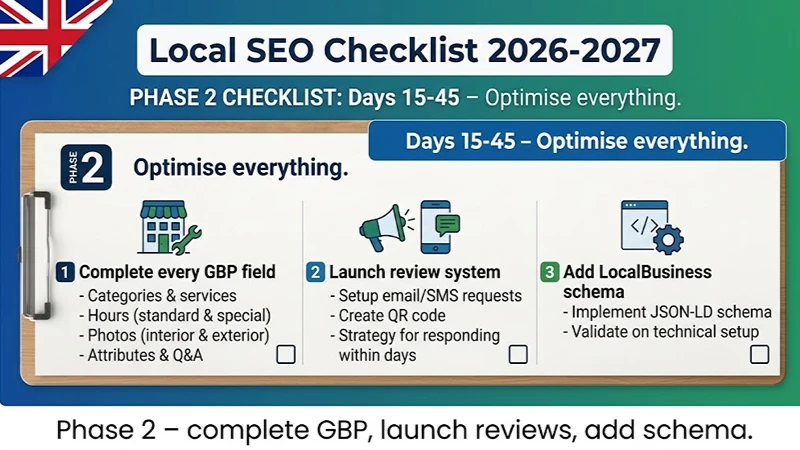
Complete every GBP field
Don’t stop at name and category. Add:
| GBP Fields to Complete |
|---|
| Accurate primary and secondary categories |
| Full service list with descriptions |
| Opening hours (including special hours for holidays) |
| High-quality photos of your team, premises, and work |
| Attributes like “women-led” or “free Wi-Fi” where relevant |
Launch a review system
Ask every satisfied customer for a review at the natural moment, right after a job is done or a purchase is completed. Use email, SMS, or QR codes on receipts. Respond to every review within a few days, positive or negative. This shows engagement and builds trust.
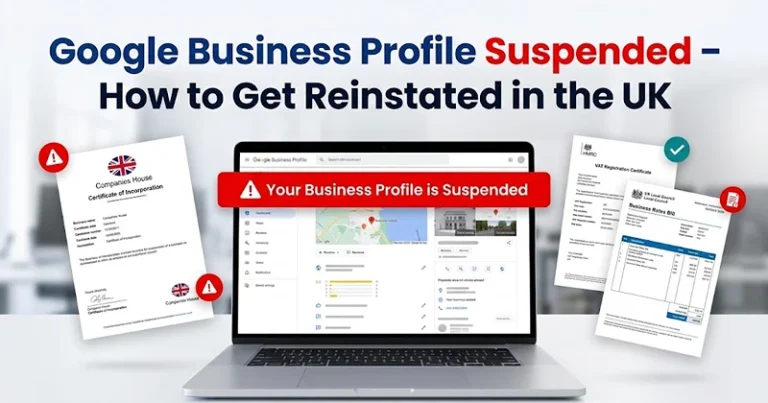
Edge case: if you’re a service-area business without a public address, hide your address on GBP and list only your service areas. Don’t fake an address. Suspensions are common.
Add LocalBusiness schema to your website
Schema markup helps search engines read your details unambiguously. Use the LocalBusiness type with your exact NAP, opening hours, and geo-coordinates. If you’re not technical, ask your developer or use a plugin if you’re on WordPress.
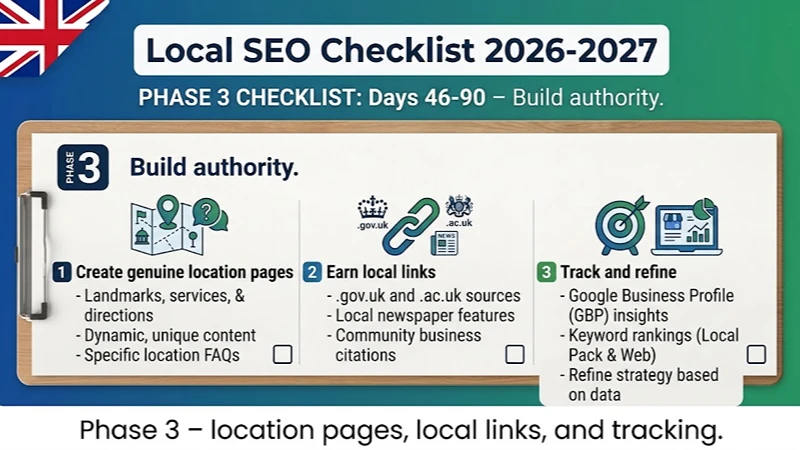
Phase 3: Days 46–90, Build authority
Create genuine location pages
If you serve multiple towns, give each a useful page. Include local landmarks, specific services in that area, and real customer questions. Avoid thin doorway pages. Google penalises these.
Earn local links
Partner with local charities, sponsor community events, or get featured in local news. Links from .gov.uk, .ac.uk, or reputable local publications carry weight.
Track and refine
Use Google Business Profile insights to monitor calls, direction requests, and website clicks. Track your local pack rankings from a consistent location. Double down on what moves the needle.
What usually goes wrong (and how to avoid it)
- Duplicate GBP listings: Search your business name and address. If duplicates exist, merge or request removal through Google’s support.
- Keyword stuffing in GBP name: Don’t add “Plumber in Manchester” to your business name. Use your legal name only. Proper keyword research services help you target the right search terms without resorting to stuffing.
- Thin location pages: A page with just a town name and one sentence won’t rank. Add real value.
- Ignoring AI search: Google’s AI Mode and SGE are changing how local results appear. Keep your content structured and authoritative.
FAQ
What is a local SEO checklist?
A local SEO checklist is a step-by-step plan to optimise your business for location-based searches. It covers Google Business Profile setup, NAP consistency, citations, reviews, on-page SEO, schema markup, and tracking.
How do I do local SEO for my small business in the UK?
Start by claiming and verifying your Google Business Profile. Fix your NAP across your website and directories. Build reviews, add LocalBusiness schema, and create location-specific content. Track results monthly and adjust.
What are the most important local SEO ranking factors in 2026?
Google’s core local ranking factors are proximity (how close you are to the searcher), relevance (how well your profile matches the query), and prominence (your reputation and authority). Reviews, citations, and GBP completeness feed into these.
Do I need a website for local SEO?
You can rank in the local pack without a website, but having one significantly improves your chances. A website lets you add schema, location pages, and content that strengthens relevance and prominence.
How long does it take to see results from local SEO?
Most businesses see movement in 4–8 weeks, with stronger results after 3–6 months. Competitive sectors like legal or property take longer. Consistency matters more than speed.
What are NAP citations and why do they matter?
NAP citations are online mentions of your Name, Address, and Phone number. Consistent citations across directories signal trust to Google. Inconsistent NAP confuses search engines and hurts rankings.
Should I use LocalBusiness schema on my website?
Yes. LocalBusiness schema helps search engines understand your details accurately. It’s not a ranking factor on its own, but it reduces ambiguity and supports your overall local SEO.

Be the first to leave a comment below.