
Local SEO for tradesmen helps Google and local customers find, understand, and trust your business. For plumbers, electricians, and builders, showing up in the Google Map Pack often comes down to having an accurate Google Business Profile, clear local signals, helpful service pages, and a strong reputation built on real work and genuine reviews.
When someone searches “emergency plumber near me” at 7am, they are not researching branding. They want a reliable number, proof that you cover their area and enough confidence to call.
That is what local SEO needs to support.
What gets a trades business into the Map Pack?
Google’s local results are mainly based on relevance, distance, and prominence. Relevance means how closely your business information matches the search. Distance is the searcher’s location or the place they specify. Prominence is the level of recognition Google can see through reviews, links, articles and other signals across the web.
This matters because there is no single trick that puts a plumbing firm or builder into the top three map results. A well-completed profile may be more relevant than competitors, yet still lose visibility when the customer is several miles away. Equally, a business based nearby may not appear if its profile is vague, poorly reviewed or inconsistent online.
In practice, the most common mistake is trying to beat distance with keyword stuffing. Changing a business name to include every town, or creating multiple profiles from virtual offices, is risky and against Google’s business representation guidelines. Service area businesses should use one profile for their real central location and a genuine service area. If customers do not visit that address, for example because you work from home, hide the address and show your service area instead.
Start with the work Google can verify
Your Google Business Profile is not a brochure. It is structured business information that helps Google decide when your company is a sensible local answer.
Use your genuine trading name. Choose the most accurate primary category available, such as “Plumber”, “Electrician” or “Builder”, rather than a broad category that only loosely describes the work. Add relevant services individually, including boiler repair, consumer unit upgrades, bathroom fitting or extensions where those are services you actually provide.
Then make the details boringly accurate:
| Detail | What to do |
|---|---|
| Telephone number, website and opening hours | Keep them current, including special hours for bank holidays |
| Service areas | Set them to the towns and districts you genuinely visit. Google advises keeping the overall area within roughly two hours’ drive of your base |
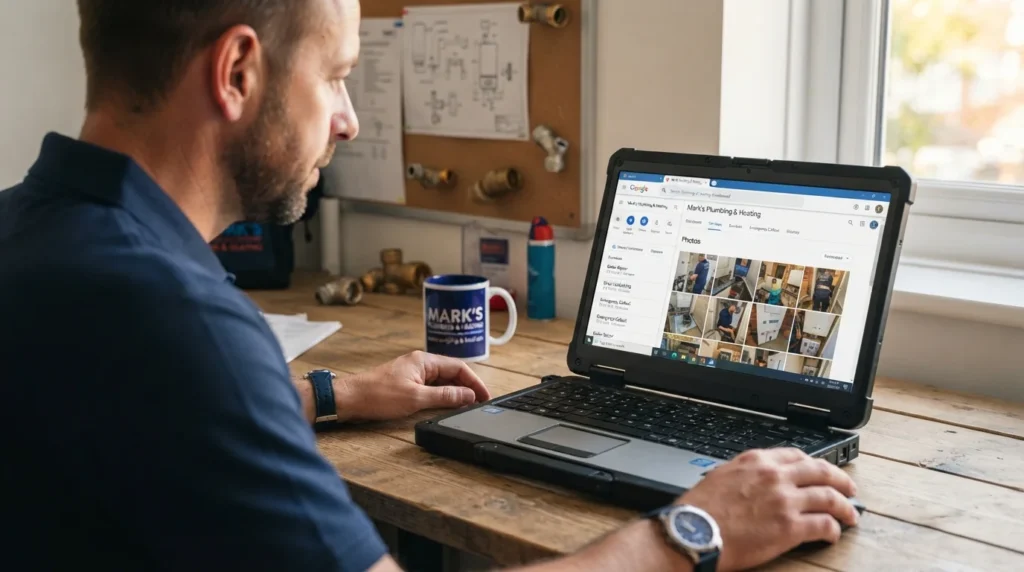
| Photos | Upload recent photos of completed work, vehicles, team members and premises where appropriate |
| Services | Add job-specific services rather than relying on a generic business description |
| Address and map pin | If customers visit your premises, make sure the pin marks the real location. If you only travel to customers, hide the address and rely on your service areas |
| Reviews | Reply in a natural, professional way without publishing private customer details |
The boring details win more often than people think.
A customer seeing an electrician with an active profile, a direct phone number, current hours and a handful of recent local reviews has fewer reasons to keep searching. Google sees a more complete entity too.
Build pages around real jobs
A trades website should not have one page that lists “plumbing, electrical, roofing, landscaping, kitchens and more”. That can make sense for a large contractor, but it often leaves Google and the customer unsure what you are best known for.
Create a strong page for each core revenue service. A plumber might need separate pages for emergency plumbing, boiler installation, boiler repairs and bathroom plumbing. An electrician could separate EICR certificates, rewires, fault finding and EV charger installation.
Each page should answer practical questions:
| Page element | Why it helps local customers |
|---|---|
| Clear service description | Confirms that you do the precise job they need |
| Areas genuinely covered | Helps customers decide whether to contact you |
| Pricing approach or quotation process | Reduces uncertainty before they call |
| Qualifications and insurance | Provides reassurance for safety-sensitive work |
| Original job photos | Shows evidence rather than generic claims |
| Simple contact route | Turns search visibility into an enquiry |
For UK trades, credentials should be specific. If a gas engineer is Gas Safe registered, say so. Point readers to the Gas Safe Register. They can check an engineer’s registration there. If an electrician works to BS 7671 (the IET Wiring Regulations) or provides EICRs, explain what the customer receives at the end of the job. In England and Wales, much domestic electrical work is notifiable under Part P of the Building Regulations, so mention whether you are registered with a competent person scheme. Empty claims such as “best quality service” add little.
What often gets missed is the difference between a service page and a location page. A service page explains the work. A location page explains how you deliver that work in a particular place.
A useful “Electrician in Leeds” page, for example, may mention the types of properties commonly served, typical call-out coverage, parking or access considerations where relevant, and nearby areas you also visit. It should not be the same electrician page copied 20 times with only the town name changed.
Reviews create trust, not just stars
Reviews contribute to prominence, but their real value is often simpler. They help a nervous customer decide whether you will turn up, communicate clearly and leave the property tidy.
Ask after the job is complete, ideally when the customer has seen the finished result. A brief message with a direct review link is enough. Do not write reviews for customers, offer incentives in return for positive feedback, ask only the customers you expect to be happy, or pressure people to mention keywords. Google’s policies ban incentivised reviews. Since April 2025, fake reviews and hidden incentivised reviews are banned. The Digital Markets, Competition and Consumers Act 2024 bans these practices. The CMA’s fake reviews guidance explains what this means for businesses.
A steady pattern of genuine reviews is more believable than a sudden batch of identical five-star comments. It also gives you clues about the wording customers use. If clients repeatedly mention “arrived on time”, “sorted a leaking radiator” or “explained the fuse board issue clearly”, those are useful themes for your service pages and profile.
Local proof beyond Google Maps
Citations still matter, but not because you need to submit your business to hundreds of low-quality directories. Focus on places customers and local organisations might genuinely use: established trade directories such as Checkatrade, TrustATrader or Which? Trusted Traders, relevant professional bodies, local chambers of commerce, community sponsorship pages and suppliers who list approved installers.
Your name, address and phone number should match closely everywhere. A minor formatting difference is rarely a disaster. Different phone numbers, outdated addresses and conflicting trading names are more serious because they make it harder for Google to trust which record is correct.
Local links can help too. A link from a town football club you sponsor, a local builder you collaborate with, or a regional property publication is more useful than a random directory placed on a site with no connection to your area or trade.
For a clear view of the technical issues that can stop good service pages from being found, Web Ranko can identify crawl, speed and internal linking problems that are holding visibility back.
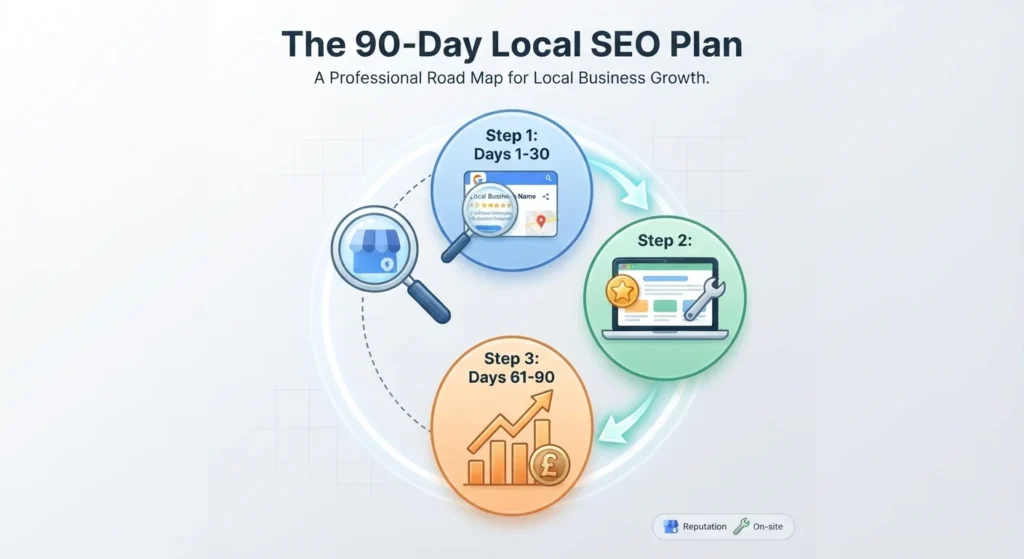
A sensible 90-day approach
Do not change everything at once. You will not know which improvement helped, and you may spend time on work that does not affect enquiries.
- Audit your Google Business Profile, website contact details, core services and service areas for accuracy.
- Improve the pages that represent your highest value jobs first, especially services customers search for urgently or frequently.
- Put a simple review request process into your job completion routine and respond to new reviews.
- Check the businesses appearing for searches in your target towns. Compare their categories, review pattern, service detail and local mentions. Do not copy their wording.
- Track calls, website clicks, direction requests, form enquiries and booked jobs. Map Pack rankings are useful, but booked work pays the bills.
Expect fluctuations. Local results can change depending on where a person searches, their device and the exact wording they use. A business may appear strongly for “plumber in Croydon” and be far less visible a few miles away. That is normal, not automatically a sign that SEO has failed.
Google’s own guidance is refreshingly plain: create helpful, reliable content for people first, and make important terms clear in titles, headings and descriptive link text. For trades businesses, that means showing the work you do, the places you serve and the reasons local customers can trust you.
If you want an independent view of where the opportunities are, Web Ranko can review your profile, service pages and local search signals through an SEO audit service. Start with the gaps that affect enquiries, not a long list of cosmetic tasks.
Questions tradespeople ask
How do tradesmen get into the Google Map Pack?
Tradesmen reach the Google Map Pack by improving relevance and local prominence. Use a complete Google Business Profile, accurate service categories, genuine reviews, strong service pages and consistent business details. You cannot directly control a searcher’s distance from your base, so focus on the factors you can improve.
Does a Google Business Profile help plumbers get more work?
Yes, because it can place a plumber in Google Maps and local results when nearby customers search for urgent or planned work. A profile alone is not enough, though. It needs accurate services, current hours, reviews, photos and a website that clearly explains what the business does.
Can I rank in nearby towns without an office there?
You can appear in nearby towns when your services are relevant and your business genuinely serves those areas, but there is no guarantee. Distance remains a factor. Create useful area content and set an honest service area, but do not create false addresses or separate profiles for places where you do not operate.
How many reviews does a local trades business need?
There is no fixed number. You need enough recent, genuine reviews to reassure customers and compare credibly with local competitors. Review quality, recency, detail and your responses matter more than chasing a target number. A consistent flow after completed jobs is usually the strongest approach.
Why is my business on Google Maps but not in the top three?
Your profile may be visible but less relevant, farther away or less prominent than the businesses above it. Check your primary category, service list, review profile, website pages, business details, and local mentions. Also test searches from different parts of your service area because local rankings vary by location.
A local SEO checklist for small businesses can help you review these essentials before deciding what needs attention first.
How long does local SEO take for an electrician or builder?
Basic profile corrections can improve visibility within weeks, but building prominence usually takes longer. Expect several months of steady work on reviews, service content, local references and website quality. The exact timeline depends on competition, location, your existing reputation and how consistently the business earns local trust.

Be the first to leave a comment below.