
AI Overviews UK SEO now works on two layers: ranking in the blue links, and being cited inside Google’s AI answer above them. Exposure varies enormously by topic, so the first job isn’t tactics. It measures how often an AI Overview shows above your queries. Then it helps you decide to compete for the citation or work around it.
That number is where most UK strategies go wrong. Teams read a headline about a 60% CTR collapse, panic, and rebuild a content plan for a threat that barely touches their vertical. Or they assume they’re safe because traffic looks flat, right up until it doesn’t.
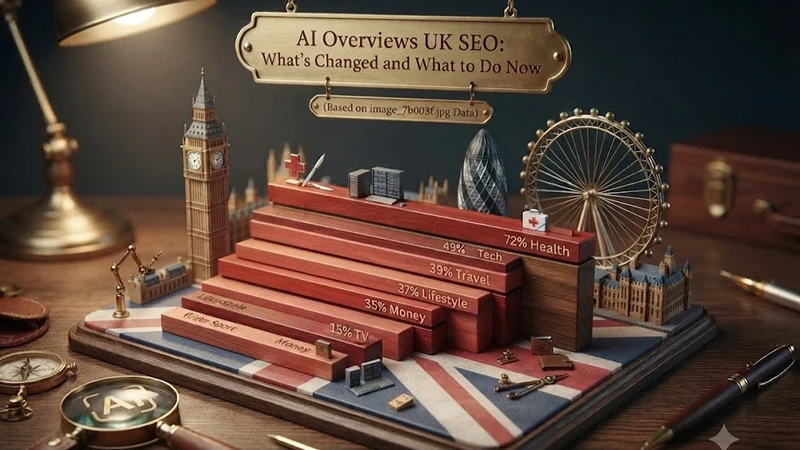
UK AI Overview exposure by topic
Sistrix analysed major UK newsbrands between 14 January and 24 April 2026 and shared the results with Press Gazette. The spread is the story.
| Topic vertical | AI Overview exposure | What it means for you |
| Health | 72% | Assume the answer is taken. Compete on primary evidence, clinician bylines, or don’t compete. |
| Tech | 49% | High risk on explainers, lower on reviews and hands-on testing. |
| Travel | 39% | “Best of” and itinerary content heavily exposed. |
| Lifestyle | 37% | Mixed. How-to content exposed, opinion and personality less so. |
| Money | 35% | Exposed on definitions, protected on regulated advice and live rates. |
| TV | 15% | Largely safe. |
| Wider sport | 15% | Largely safe. |
| Puzzles | 7% | Safe. |
| Football | 5% | Safe. |
Source: Sistrix data, reported by Press Gazette. It found AI summaries replaced links in health sections 72% of the time. Tech saw 49%, travel 39%, lifestyle 37%, and money 35%. Football was most resilient at 5%. Puzzles were at 7%. TV and wider sport were both at 15%.
The pattern isn’t random. As Barry Adams of Polemic Digital put it, faster-moving query categories that need fresh information regularly, such as sport and television, are less suitable for AI summaries. Google summarises settled consensus well. It summarises this morning’s team news badly. That single distinction should drive your editorial calendar more than any keyword tool.
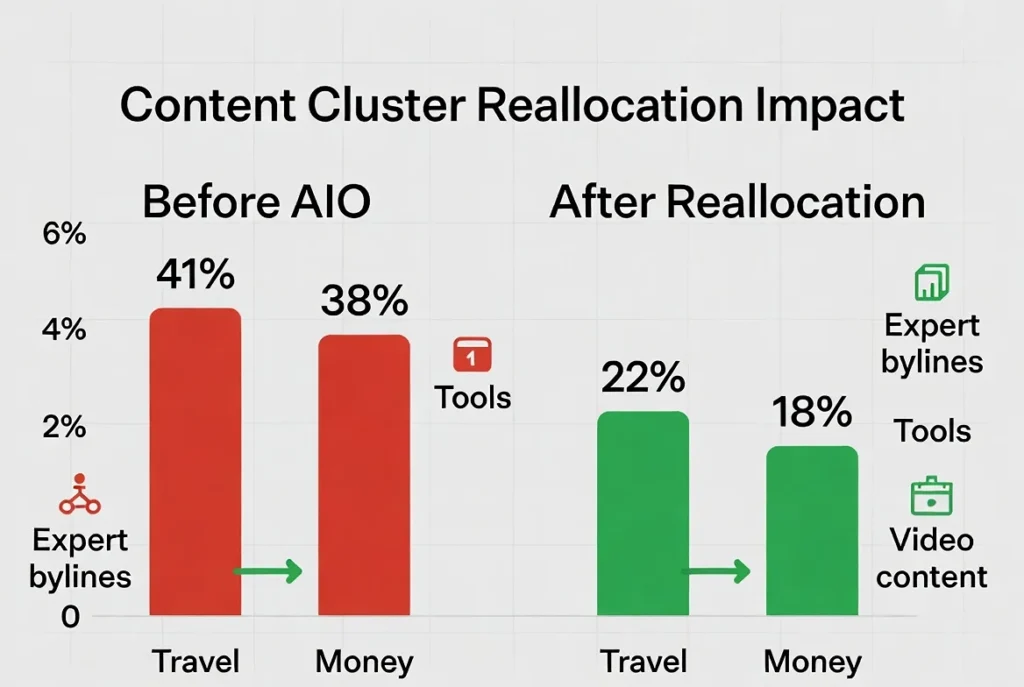
Client Case Study: Before vs After Reallocation
Client: UK personal finance + travel publisher.
Before (high exposure clusters): Heavy investment in listicles and generic how-tos.
After: Shifted budget to expert-led, data-rich, and personality content.
Why citation now matters more than position
Ranking first used to be the whole game. It isn’t any more, because the AI Overview sits above position one and answers the question before anyone scrolls.
The behavioural shift is real in the UK, not just imported from American studies. Ofcom’s recent Adults’ Media Use and Attitudes research found that more than half of UK adults (54%) now use generative AI tools such as ChatGPT, Copilot, or Gemini, rising to 79% among 16 to 24-year-olds, with three-quarters of online adults reading AI-generated search summaries at least occasionally.
But here’s the UK-specific nuance the global write-ups miss. The Daily Mail’s search team told Press Gazette that AI Overview visibility across the keywords they track has plateaued at around 12% of non-brand terms on mobile in the UK, against 19% in the US. UK SERPs are meaningfully less AI-saturated than American ones. If your agency is quoting US prevalence figures at you, they’re overstating your exposure. (Press Gazette)
The UK has rules nobody else has
This is the part almost no SEO blog has caught up with. Following the CMA’s designation of Google as having strategic market status in general search, new conduct requirements have been introduced. Publishers can now prevent their content from being used to power AI features like AI Overviews, Google must attribute publisher content with clear links, and publishers can opt out of their content being used for training AI models.
A fortnight later, on 17 June 2026, the CMA added conduct requirements on transparency and fairness in how search results are ranked, explicitly including AI Overviews. (GOV.UK)
Practically, that means a UK business has a lever a German or Australian one currently doesn’t. Use it carefully.
What usually goes wrong
| Common Pitfall | Explanation |
| Chasing the wrong number | Reported AI Overview prevalence in 2026 ranges from roughly 21% to over 60% depending on the study, because each tracker uses a different keyword set, geography, device mix and detection method. Quoting any single figure without context is close to meaningless. Measure your own query set. (QuickSEO) |
| Trusting your rank tracker’s AIO flag | Mail Online found tools were reporting an AI Overview present when it was actually only appearing inside the People Also Ask box, which has far less impact. That skews perceived risk badly. Spot-check manually. |
| Assuming impressions are wins | On 3 June 2026 Google launched Search Generative AI performance reports in Search Console, giving site owners dedicated views of impressions within generative AI features such as AI Overviews and AI Mode, plus generative AI features in Discover. Note the word impressions. There is no click data, no CTR and no query breakdown in the current version. You can prove you appeared. You cannot yet prove it was worth anything. (Google, Weblumino LLP) |
| Pulling the opt-out lever emotionally | Google says opting out forfeits AI impressions and traffic entirely but does not affect standard organic rankings. That trade only makes sense if your model is licensing or subscriptions, not advertising. There’s genuine industry disagreement here, and reasonable people are on both sides. (Weblumino LLP) |
| Ignoring branded search | The Mail’s overall traffic impact stayed modest because most of its search traffic is branded and over half its users arrive direct. For a UK SME on a £1,500 to £3,000 monthly retainer, that’s the highest-leverage insight in this article: brand investment is now a search defence, not a separate budget line. |
FAQ
What are AI Overviews and how does Google choose sources?
They’re AI-generated summaries above the organic results. SEOClarity’s analysis of 432,000 keywords found 97% of AI Overviews cite at least one source from the top 20 organic results, averaging five URLs per Overview. Ranking well is a strong signal but not a guarantee. Extractability matters as much as position. (seoClarity)
Do AI Overviews reduce click-through rate?
Yes, though by how much is contested. Sistrix found the average click rate on the first result falls from 27% to 11% when an AI Overview appears, roughly a 60% decline. Other studies land between 34% and 61%. UK figures tend to sit at the gentler end because UK exposure is lower.
How do I get my site featured in Google’s AI Overviews?
Rank in the top 20 for the query, answer the question in the first 40 to 60 words under a question-formatted heading, use lists and tables, and give the AI something specific to lift. Named authors with verifiable credentials help. There is no markup that switches it on.
What’s the difference between AI Overviews and AI Mode?
An AI Overview is a summary module on a normal results page. AI Mode is a full conversational search experience that replaces the links entirely. AI Mode reached the UK in July 2025 and Google announced at I/O in May 2026 that it had passed a billion monthly users. Optimising for one largely helps the other. (Claudio Novaglio)
Can I stop my content appearing in AI Overviews?
Yes. Search Console now includes a toggle to block your content from AI Overviews, AI Mode and generative Discover features, and UK publishers have additional rights under the CMA’s publisher conduct requirement. Opting out costs you all AI-surface visibility. It’s a licensing play, not an SEO one.
Does Search Console show clicks from AI Overviews?
Not yet in the dedicated report. The generative AI performance reports launched 3 June 2026 with impressions only, broken down by page, country, device and date, rolling out to UK site owners first. Google has said it will add metrics over time without committing to a date. (Smart Team)
Is SEO dead because of AI Overviews?
No, but the success metric has moved. Position one no longer guarantees the click. Citation share, branded search volume and direct traffic are becoming the honest measures of search health, and the disciplines that earn citations are the same ones that earned rankings.
Where to go from here
Open Search Console and check whether the Search Generative AI performance report has appeared on your property. UK sites got it first, so there’s a decent chance it’s already sitting there with a few weeks of backfilled data.
Then run your top 30 commercial queries manually on google.co.uk, on mobile, logged out, and record whether an AI Overview appears and whether you’re cited. Thirty minutes of that beats any third-party estimate. Cross-check against Sistrix, Semrush’s AI Overview tracking or Ahrefs Brand Radar if you have a licence.
Read the CMA’s case page on Google’s general search services on GOV.UK before deciding on the opt-out toggle. Also read Google’s Search Central blog post on the generative AI reports. It explains what the data covers and what it does not cover.If you create health, medical, or clinical content, read the NHS Knowledge and Library Services review of AI Overviews. It is worth an hour.

Be the first to leave a comment below.