

llms.txt can give AI tools a short, curated map of your website, if they choose to read it. But it does not boost Google rankings. It also does not make your site appear in Google AI Overviews. For most UK businesses, including those working with an SEO agency in Manchester, it is a low-effort optional file, not an SEO priority. Fixing crawlability, content quality, and clear page structure will usually deliver more value first.
What llms.txt actually is
An llms.txt file is a plain text Markdown document, usually placed at the root of a website. The format was proposed in 2024 by Jeremy Howard of Answer.AI. Think of it as a short introduction to the parts of your site you would most want an AI system to understand.
A well-maintained file might include:
- A brief description of your business and who you serve
- Links to your most important service pages
- Links to useful guides, documentation or product information
- Short explanations of why each page matters
- A link to a fuller version of the file, if your site needs one
That sounds familiar because it is. The file is often compared with robots.txt and an XML sitemap, but the comparison can cause trouble.
Robots.txt tells compliant crawlers where they may or may not go. An XML sitemap helps search engines discover URLs. llms.txt is neither of those things. It does not grant access, block access, guarantee indexing or force an AI system to cite your website.
It is simply a proposed convention. Any platform can choose to read it, ignore it or never request it at all.
The important Google answer
If your question is, “Will llms.txt help my website rank on Google?”, the answer is no.
Google’s own guide to optimising for generative AI features says that you do not need special machine-readable files, AI text files or new markup to appear in Google Search’s generative experiences. It specifically says publishing an llms.txt file will neither help nor harm visibility or rankings because Google Search ignores it.
That includes the outcome many businesses actually care about: more qualified visits from Google.
So why does this keep happening? Because the phrase “AI visibility” makes several different activities sound like one thing.
A business may want to rank in ordinary Google results. It may want to be cited by a chatbot. It may want an AI browsing agent to find a booking page or product specification. Those goals can overlap, but they have different systems, evidence and success measures.
Do not let a supplier bundle them together and sell one small text file as the answer. If you are comparing suppliers, it is also worth being clear on SEO contract notice periods and ownership before any work begins.
What llms.txt may help with
The honest answer is narrower, but not quite “nothing”.
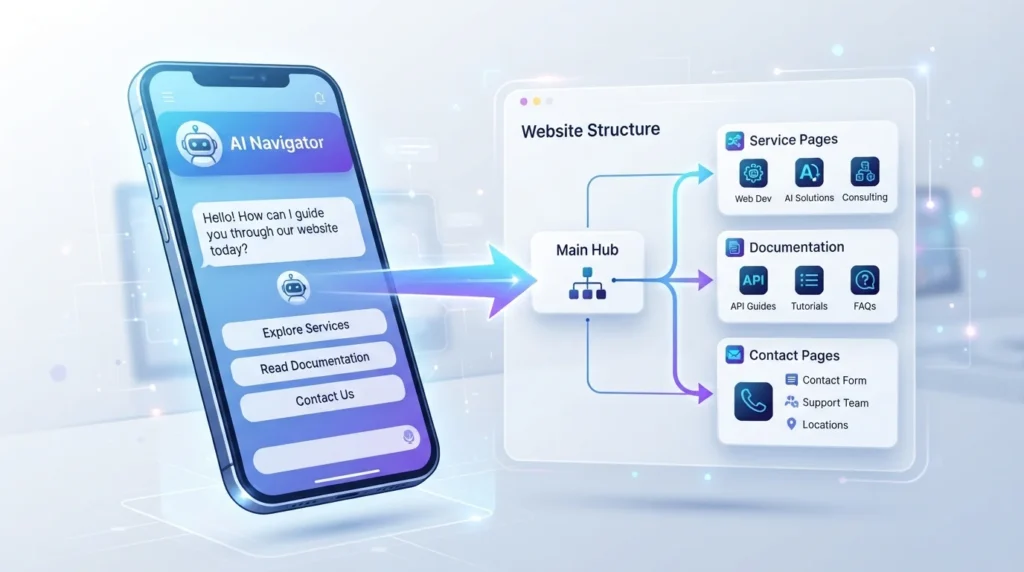
Some AI tools and agent-based systems may use llms.txt as a quick orientation layer. A concise file can point them towards canonical service pages, reliable documentation and the pages that best represent your business. The format was proposed to give language models a curated route through a website rather than making them interpret every navigation menu, widget and repeated page element. Even within Google, the picture differs by product: Chrome’s Lighthouse tool now includes an experimental agentic browsing audit that checks for the file, even though Google Search does not use it.
That could be useful where your website has:
- Large help centres or technical documentation
- Software products with many feature pages
- Complex service information spread across several sections
- Important content hidden under filters, scripts or busy navigation
- An audience that already uses AI assistants to research solutions
Still, “could be useful” is not the same as “has been proven to increase leads”.
There is no dependable public evidence that simply publishing llms.txt raises Google positions, wins more AI citations or increases enquiries for a local service business. Even industry coverage that sees a possible future use case acknowledges that support is not widespread.
A practical decision guide
| Your situation | Is llms.txt worth adding? | What should come first? |
|---|---|---|
| Your site has weak rankings, thin pages or indexing issues | Not yet | Technical SEO, better service content and stronger internal linking |
| You run a small local UK service site with 10 to 30 key pages | Optional | Clear location pages, reviews, contact details and useful FAQs |
| You have extensive documentation or a SaaS knowledge base | Probably | Add it after your core pages have accurate titles, canonicals and internal links |
| An agency promises higher Google rankings from llms.txt | Be cautious | Ask for platform-specific evidence and measurable outcomes |
| You are testing AI agent journeys or non-Google discovery | Reasonable | Document a baseline and treat it as an experiment |
In practice, the most common mistake is implementing llms.txt before the website has answered basic customer questions properly.
A Manchester accountancy firm, for example, will gain more from a genuinely useful page explaining VAT registration thresholds, pricing approach, eligibility and the next step than from a file that lists a weak page. The same applies to a Bristol electrician, a Leeds software provider or a London legal practice. AI systems need source material worth finding.
How to test it properly
If you decide to publish llms.txt, treat it as a controlled test rather than a belief.
First, record a baseline. Note organic clicks, impressions, indexed page count, relevant ranking positions, referral traffic and genuine enquiries. Google Search Console is particularly useful for seeing whether your ordinary organic visibility changes over time.
Next, create a file that reflects your actual priorities. Include only canonical, live and useful pages. Avoid listing every blog post you have ever published. A short selection of your strongest pages is more useful than a cluttered directory.
Then leave the rest of your SEO activity as stable as reasonably possible for several weeks. If rankings rise after the file goes live, do not assume causation. A new link, seasonal demand, an algorithm update, an improved page or a competitor change may explain the movement.
Finally, separate the measurements:
- Google organic performance
- Referrals from AI platforms, where analytics can identify them
- Brand mentions or citations in relevant AI responses
- Enquiries where customers say they used an AI assistant
That last metric matters most. Visibility that never reaches the right audience is not a business result.
The work that matters more
Before spending time on llms.txt, check whether your site is already doing the fundamentals well.
Your pages should be crawlable and indexable. Service pages need enough specific information to help someone make a decision. Important claims should be supported by real experience, qualifications, processes, pricing context or evidence. Clear author information and accessible contact details matter too, especially for services where trust is central.
What often gets missed is internal linking. A good guide about choosing a service should point naturally to the relevant service page. A service page should lead visitors towards proof, case information where you can substantiate it, and an uncomplicated contact route.
These are not glamorous tasks. They are usually more effective.
UK SEO and web development services can support the technical groundwork that makes a website easier for Google and users to understand.

Should UK businesses create one?
For many UK service businesses, llms.txt is fine to add if it takes little time, is maintained properly and does not distract from higher priority work. It is not harmful simply because it exists.
But it should not be positioned as a shortcut to Google rankings, AI Overviews or automatic ChatGPT recommendations. That claim asks the file to do something it was never designed to do.
If your team is already working through technical fixes, improving key service pages and creating content based on real customer questions, an llms.txt file can sit quietly in the background as an optional interoperability experiment. If those essentials are not in place, start there.
Web Ranko can help UK businesses assess whether llms.txt makes sense in their wider SEO plan, then focus effort on the pages and technical improvements most likely to support meaningful organic growth. A sensible first step is a review of what Google can already crawl, understand and rank on your site.
FAQs
Does llms.txt improve Google rankings?
No. Google states that llms.txt does not help or harm a site’s visibility or rankings in Google Search because Google Search does not use the file. Do not treat it as a replacement for technical SEO, helpful content or a properly structured website.
Does llms.txt help with Google AI Overviews?
No. Google’s guidance says you do not need special AI files or new markup to appear in its generative search features, and that Google Search ignores llms.txt. The practical focus should remain on useful, crawlable content that clearly answers the searcher’s question.
Is llms.txt the same as robots.txt?
No. Robots.txt communicates crawl access rules to compliant bots, while llms.txt is a suggested Markdown guide to important website pages. It does not block crawlers, allow crawling or control how search engines index a URL.
Should a small UK business add llms.txt?
Possibly, but only as an optional task. A small business with a simple website is unlikely to see meaningful gains from the file alone. Better service pages, accurate local information, strong reviews and a healthy technical foundation should take priority.
Which AI tools read llms.txt?
Support is inconsistent. Some AI tools, agents and developer-focused systems may choose to use the file, but there is no universal requirement for platforms to read it. Google Search does not use it as a ranking or visibility signal.
What should an llms.txt file contain?
Include a short business description and links to your most important canonical pages, with concise notes explaining each page. Keep the list selective and current. Do not include broken URLs, duplicate pages, irrelevant posts or information that conflicts with the site itself.

Be the first to leave a comment below.