

SEO for law firms in the UK works best when your website helps potential clients make an informed choice before they contact you. For SRA-regulated firms, this means pairing strong local search visibility with clear service details, transparent pricing, and pages that explain what clients can expect.
A law firm website should not make people work to find the basics. They want to know whether you deal with their problem, where you are based, what the process may cost and who will handle it.
Google wants much the same thing.
That overlap is useful. The SRA Transparency Rules require firms offering specified services to publish clear price and service information, including charges, likely disbursements, VAT, work included, key stages, typical timescales, and the qualifications and experience of those doing or supervising the work. Done well, those details do not weaken your SEO. They give a service page the substance that thin legal marketing pages usually lack.
These rules apply to firms regulated by the SRA in England and Wales. Solicitors in Scotland and Northern Ireland are regulated by their own law societies, so firms there should check their own rules rather than copy an English template.
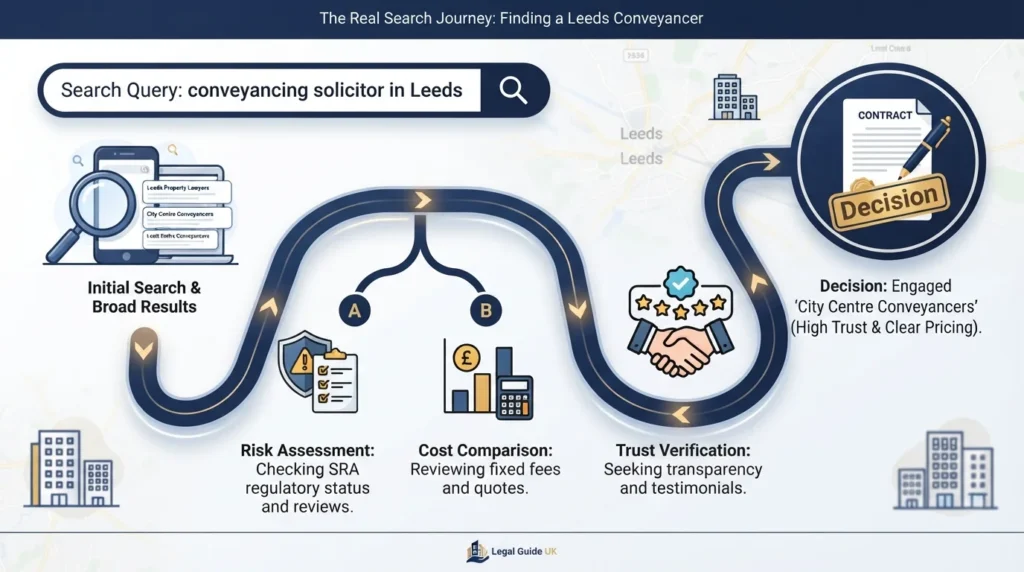
Start with the real search journey
Someone searching for “conveyancing solicitor in Leeds” is not looking for a lecture on property law. They are weighing risk, urgency and cost. A useful page should answer those concerns quickly, then give them enough confidence to enquire.
The same applies to searches for probate solicitors, immigration advice, employment tribunal representation and debt recovery. Search terms vary, but the decision process is familiar.
A strong page normally makes four things clear near the top:
- The legal service and the type of client you help
- The area you serve, where local representation matters
- The likely pricing approach, whether fixed fee, hourly rate or a range
- The next sensible step, such as a call, a quote request or a document review
Avoid vague opening copy such as “trusted legal excellence for all your needs.” It says very little. A prospective client needs to see whether you handle their issue, whether you are accessible, and whether the cost is likely to be within reach.
For a regional firm, local relevance should be earned rather than sprayed across every page. Mention your offices, the courts or tribunals you regularly work with, and practical geographical limits where they affect the service. A firm serving Manchester and Greater Manchester should explain that reality clearly. It should not claim relevance to every UK town merely because a keyword tool suggests volume.
Make transparency part of the page
The most common mistake is treating the SRA information as an awkward legal block at the bottom of a page. It may technically exist, but it is easy to miss and does nothing to help a nervous visitor decide what to do.
Instead, build your service page around the questions clients already have.
A residential conveyancing page, for example, can introduce the service, explain who it suits, show a clear cost illustration or pricing range, identify likely disbursements, set out the key stages, and explain what may fall outside the quoted scope. Then add information about the person or team handling the work and a clear enquiry route.
That structure is good for people. It also gives search engines a clearer understanding of the page’s purpose.
The pricing and service information requirements apply to a specified range of services. These include residential conveyancing, uncontested probate, motoring offences handled in the magistrates’ court, employment tribunal cases for unfair or wrongful dismissal, debt recovery up to £100,000, immigration matters excluding asylum, and licensing applications for business premises. If you promote any of these services, the relevant details must be straightforward to locate from that service.
Two further requirements are easy to overlook. Firms with a website must display the SRA clickable digital badge, and the complaints procedure, including how to escalate to the Legal Ombudsman, must be published. A well built service page makes both easy to find without cluttering the layout.
| Page section | What the visitor needs | What it supports |
|---|---|---|
| Service introduction | Confirmation that you handle their legal matter | Search relevance and clearer intent |
| Price information | Total, range or charging basis | SRA transparency and enquiry quality |
| Included and excluded work | Scope before they contact you | Fewer unsuitable leads |
| Disbursements and VAT | A more realistic cost picture | Trust and clearer expectations |
| Key stages and timescales | A sense of what happens next | Better decision making |
| Team credentials | Who will carry out or supervise the work | Credibility and compliance |
| Clear call to action | A low friction next step | More qualified enquiries |
Do not bury important pricing details in a downloadable PDF if the surrounding service page says little. A PDF can be useful for a full fee schedule, but the key information should still be easy to locate from the relevant webpage.
What a good pricing section looks like
Most firms know what the rules require. The harder part is presenting it so that a buyer can understand it in under a minute. A residential purchase page is a good example because the cost picture has several moving parts.
Start with your legal fee and state clearly whether it is a fixed fee or a range, and whether VAT is included. Then list the likely disbursements separately, such as local authority searches, the Land Registry fee and any bank transfer charge, and explain that some of these vary by property or area.
Tax is where many pages go wrong. A purchase in England attracts Stamp Duty Land Tax, while a purchase in Wales attracts Land Transaction Tax, which is collected by the Welsh Revenue Authority. If your firm acts on both sides of the border, say so and explain which applies.
Finish with what the quote does not cover. Leasehold matters, new build purchases and unregistered land often involve extra work. Stating that upfront prevents awkward conversations later and shows the reader you understand their situation.
SEO content that does not overpromise
Legal SEO can become risky when marketing language runs ahead of what a firm can reasonably support. “Guaranteed outcome”, “fastest divorce” or “best immigration lawyer” are obvious examples. Even softer claims can create problems if they imply a certainty that the facts do not justify.
Keep claims specific and verifiable.
Say that your firm handles first time buyer conveyancing in Birmingham. Say that your employment team advises employees and employers on unfair dismissal claims. Explain the experience of the solicitor supervising the matter. These are useful, grounded statements.
What often gets missed is that transparent content can improve lead quality. A page that explains that a debt recovery service only covers business debts up to a stated value, or that an immigration quote excludes a particular type of appeal work, filters out enquiries that would otherwise waste time for both sides.
There is a trade off, of course. Publishing prices may make competitors’ research easier. Yet hiding every pricing signal can make prospective clients assume the worst. For many routine services, clarity is usually more persuasive than mystery.
Show who is behind the advice
Legal content affects people’s money, homes and livelihoods, so it sits firmly in the category Google treats with extra scrutiny. Anonymous articles published under a generic “Admin” account do little to build confidence with readers or search engines.
Name the solicitor who wrote or reviewed each guide, link to their profile page, and show their role and areas of practice. Add a “last reviewed” date to guides that deal with fees, deadlines or procedure, and actually revisit them when the rules change.
Your SRA number and registered office details should appear in the site footer. Prospective clients can check your firm on the Solicitors Register, and consistent details across your website, Google Business Profile and directories help search engines connect the right information to your firm.
Build authority beyond one page
A single polished service page will not carry an entire law firm SEO strategy. It needs support from genuinely useful related content.
For example, a conveyancing practice could publish pages explaining the difference between legal fees and disbursements, what happens after an offer is accepted, and common causes of delays. A family law firm might answer practical questions around mediation, financial disclosure and the early stages of divorce.
The point is not to publish dozens of near identical articles chasing slightly different keyword variations. Google’s guidance is clear that content should be created primarily to help people, not simply to manipulate rankings.
Each article should have a job. It might answer a question that clients repeatedly ask, explain an unfamiliar process, or help someone decide whether they need legal advice now. If it cannot do one of those things, it probably does not need publishing.
Local SEO matters too. Keep your Google Business Profile accurate, use the same office details across trusted directories, and ensure each office page reflects a real location and service capability. Avoid adding keywords to your business name on the profile, as this breaches Google’s guidelines and can lead to suspension. Do not create thin town pages for places where you have no office, no established service area and no meaningful reason to rank.
A clear SEO contract UK can also help firms understand ownership, notice periods and responsibilities before they appoint an SEO provider.
Reviews, links and trust signals
Client reviews can help a law firm stand out in local search results, but they should never be selectively edited into something misleading. Ask for feedback consistently, avoid incentivised reviews, and respond professionally where appropriate. Since April 2025, the Digital Markets, Competition and Consumers Act 2024 has made fake reviews and concealed incentivised reviews a banned practice in the UK. When replying, remember that confirming someone was a client can itself breach confidentiality, so keep responses general.
External links should be earned through credible legal commentary, professional memberships, local business relationships and useful resources. Buying low quality links, placing articles on irrelevant sites, or building artificial networks is particularly short sighted for a regulated business. Rankings may rise briefly, but the reputational cost is not worth it.
Technical basics still matter. A secure site, fast mobile pages, accessible forms, clear navigation and correct indexation are not glamorous, but they determine whether strong content can be discovered and used. Structured data such as LegalService or Organization markup can help search engines understand your offices and services, though it supports clarity rather than guaranteeing rankings.
If your firm needs a clearer plan, our UK SEO consultant service can review your current service pages, local visibility and content priorities. We can help identify what is missing without turning your site into a generic legal marketing template.
Frequently asked questions
Can law firms use SEO under SRA rules?
Yes. Law firms can use SEO, provided their marketing is accurate, not misleading and consistent with their professional obligations. Online marketing must also meet the CAP Code, which the ASA enforces. The safest approach is to make pages genuinely useful, clearly identify the service offered, and avoid unsupported promises about outcomes, speed or superiority.
Does an SRA regulated law firm have to show prices online?
It depends on the service. Firms that advertise specific services—such as residential conveyancing, uncontested probate, employment tribunal claims, or debt recovery up to £100,000—must publish clear information about prices and what the service includes. This information should be clearly signposted and easy for prospective clients to find.
What should an SRA compliant service page include?
A suitable page should explain the service, price or charging basis, likely disbursements, VAT treatment, included and excluded work, key stages, likely timescales, and the qualifications or experience of those carrying out or supervising the work. It should also be easy to locate from the main website.
Should every legal service have its own SEO page?
Usually, yes, where the services are meaningfully different. A probate page, a conveyancing page and an employment tribunal page serve different search needs and require different information. Do not split pages merely to target minor keyword variations where the service and answer are effectively identical.
How long does SEO take for a UK law firm?
Most firms should expect gradual progress rather than instant rankings. The timeline depends on local competition, existing website quality, technical issues, reputation and the depth of useful content already available. A realistic early focus is better visibility, stronger pages and more relevant enquiries.
Can transparent prices improve law firm enquiries?
Yes, because they help prospective clients decide whether your service fits their needs before contacting you. Clear prices or sensible ranges may reduce unsuitable enquiries, but they can also increase trust among people who would otherwise leave because they cannot estimate the likely cost.
A UK SEO consultant can review your service pages, local visibility and content priorities.
Good legal SEO is not about squeezing a law firm into a marketing formula. It is about making the firm easier to find, easier to understand and easier to trust. Start with the services clients most often search for, make the required information genuinely easy to use, then build useful supporting content around the real questions your team hears every week.

Be the first to leave a comment below.