
AI Citation Rate UK: What the Published Data Shows
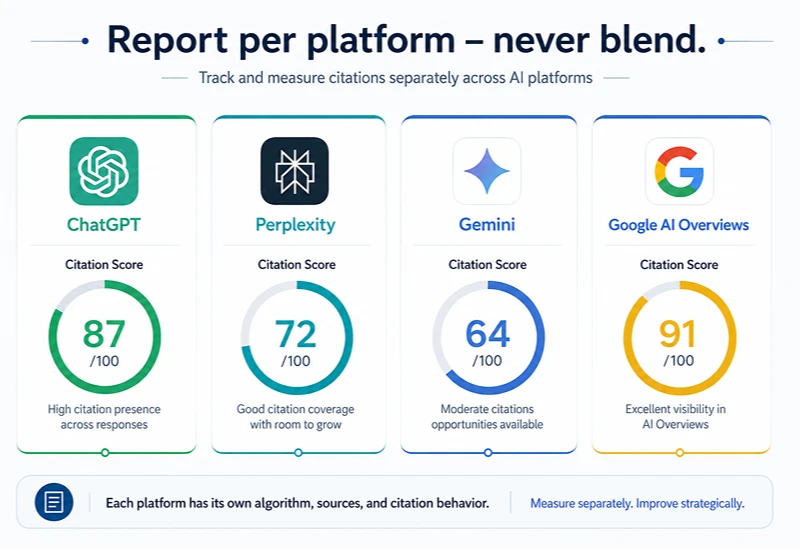
AI citation rate measurement in the UK means using a fixed set of buyer-intent prompts. Run these prompts through ChatGPT, Perplexity, Gemini, and Google AI Overviews. You then record what share of answers name your domain. Report it per platform, never as one blended score. The published research shows why: the platforms barely agree on who to cite.
That last point is the whole argument, so let’s start there.
The platforms overlap far less than anyone assumes
A cross platform audit covering 680 million citations found that only 11% of domains were cited by both ChatGPT and Perplexity. Read that again. Nine in ten cited domains appear on one platform and not the other.
A single blended visibility score averages across systems that fundamentally disagree. If your number is 30%, that could be 55% on Perplexity and 5% on ChatGPT. Those are different problems needing different work, and the average hides both.
Here’s why they diverge, platform by platform.
| Platform | How it retrieves | What it favours |
|---|---|---|
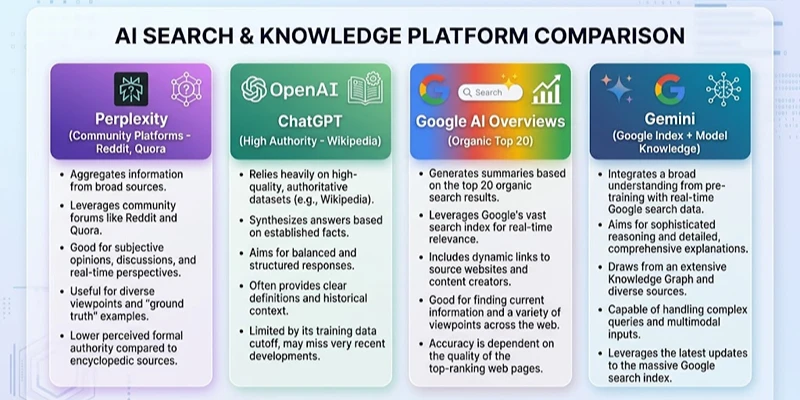
| Perplexity | Searches on every query and cites systematically | Community platforms are heavily represented, with 46.7% of its top cited sources coming from places like Reddit, Quora and niche forums |
| ChatGPT | Leans on training data first, activating web search on request or when it detects it needs recent information | High authority content, with Wikipedia frequently favoured when it does cite |
| Google AI Overviews | Draws from the existing organic index | Roughly 97% of cited sources come from the organic top 20, so classic SEO remains decisive here |
| Gemini | Google index plus model knowledge | Overlaps with AI Overviews but produces its own source set per query |
The practical read: AI Overviews is an organic ranking problem. Perplexity is a presence problem, and your absence from UK forums and community sites may matter more than your on page work. ChatGPT is an authority problem, which is the slowest of the three to move.
The UK context that shapes how urgent this is
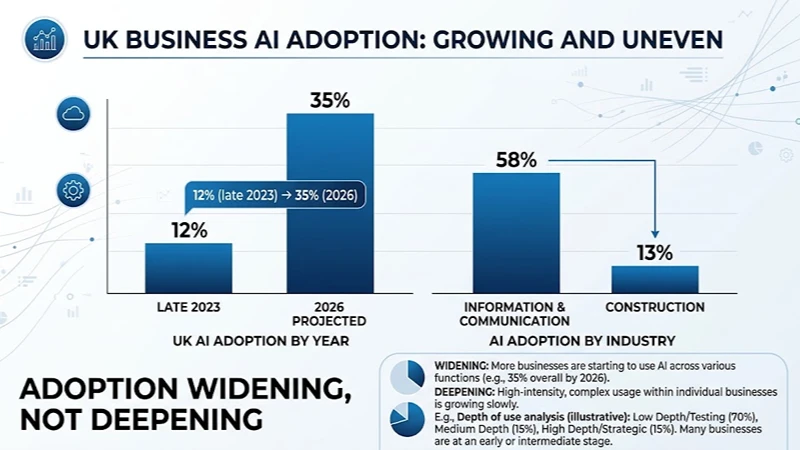
The Office for National Statistics reports that self reported AI use among UK businesses with ten or more employees has risen from around 12% to around 35% since late 2023, and large language models were the most widely used AI technology among those businesses in June 2026, at 18%.
But adoption is nowhere near uniform. Over half of businesses in information and communication report using AI, at 58%, compared with 13% in construction.
That gap should change your priorities. If you sell software to tech companies, your buyers are already inside these tools and AI visibility is a live revenue channel. If you sell to construction firms, it’s a three year bet, and your budget is probably better spent on local search this year.
There’s also a caution on the adoption story itself. The average number of AI technologies used per adopting business has risen only modestly, from around 1.4 to around 1.6 since late 2023. Adoption is widening rather than deepening.
The protocol, if you want to measure your own
Six rules produce numbers you can compare month to month.
| Step | Rule | Why |
|---|---|---|
| Prompt set | 30 to 50 non branded, commercial intent prompts per vertical | Branded prompts test recall, not discovery, and inflate every figure they touch |
| Sourcing | Pull from Search Console queries and recorded sales calls | Buyers phrase questions to models differently to how they type searches |
| Platforms | Run and report each separately | The 11% overlap figure makes blending indefensible |
| Repetition | Three runs per prompt, 24 hours apart | Answers rotate between identical queries |
| Recording | Log the full response, not just yes or no | A mention and a linked citation are different outcomes |
| Denominator | State it publicly | Changing the denominator changes the score, so it belongs in the report |
Start manual. One practitioner view worth taking seriously is to buy tracking software only once the manual panel has already changed a decision, since teams that start with software tend to admire dashboards rather than use them.
Where the debate is genuine
Industry by industry citation share benchmarks do not credibly exist yet, and precise figures quoted by vendors should be treated with suspicion. Anyone telling you the average UK dental practice has a 14% ChatGPT citation rate is guessing.
There’s also real disagreement about whether AI traffic is worth chasing at current volumes. Semrush measured a 4.4 times conversion advantage over classic organic traffic, and Ahrefs found 0.5% of traffic from AI search driving 12.1% of signups. High quality, tiny volume. Whether that maths works depends entirely on your margins.
FAQ
What is AI citation rate?
The percentage of prompts in a defined set for which an AI platform names or links your brand. Track 100 prompts, appear in 40 answers, and your citation rate is 40% for that set. It’s meaningless without the prompt set and the platform attached, because both change the answer.
How do you measure AI search visibility?
Define your prompts, pick your platforms, run each prompt multiple times, log the full responses, and record mentions, citations and competitor appearances separately. Repeat on a fixed cadence with the prompt set unchanged. Comparability comes from stability, so resist the urge to keep tweaking the questions.
How many prompts should you track?
Thirty to fifty per vertical is the working consensus for a manual panel. Ten well chosen commercial prompts you actually maintain beat two hundred you run once and abandon. Weight them toward bottom of funnel questions, the ones a buyer asks when they’re close to choosing.
Can you track ChatGPT and Perplexity citations together?
You can run them in the same exercise, but they must stay separate measurement surfaces. With only 11% of cited domains overlapping between the two, a combined figure describes no real situation. Roll up to one number for a board slide if you must, but never work from it.
Are there industry benchmarks for AI citation share?
Not credibly. The field is too young, methodologies vary too widely, and most published benchmarks come from vendors with a dashboard to sell. Your own baseline is the only benchmark worth having. Measure yourself in month one, then measure the change.
Does AI search traffic convert better than organic?
Published measurements say yes, substantially, with one analysis finding LLM referred visitors converting at roughly twice the rate of other sources on around a third fewer sessions. The volume is small. The quality is high. Whether that trade is worth your budget depends on your average order value.
How do you track AI referral traffic in GA4?
ChatGPT referrals arrive tagged with utm_source=chatgpt.com and show in your GA4 referral report. Bing Webmaster Tools has also added an AI Performance dashboard tracking citation frequency and page level citation activity, which makes it the first major engine with native AI visibility reporting.
What to do next
Open Google Search Console and export your top 50 non branded queries. Rewrite them as questions a buyer would type into a chat box. That’s your prompt panel.
Run it through ChatGPT, Perplexity, Gemini and Google AI Overviews. Three runs each, spread over three days. Log every response in a spreadsheet with columns for cited, mentioned, competitor cited, and source domain.
Submit your sitemap to Bing Webmaster Tools if you haven’t, since both ChatGPT browsing and Perplexity draw on that index. Then check the AI Performance dashboard while you’re in there.
Set the same panel to run monthly. Citations shift more slowly than rankings, so weekly checking tells you nothing except that you’re anxious.

Be the first to leave a comment below.