
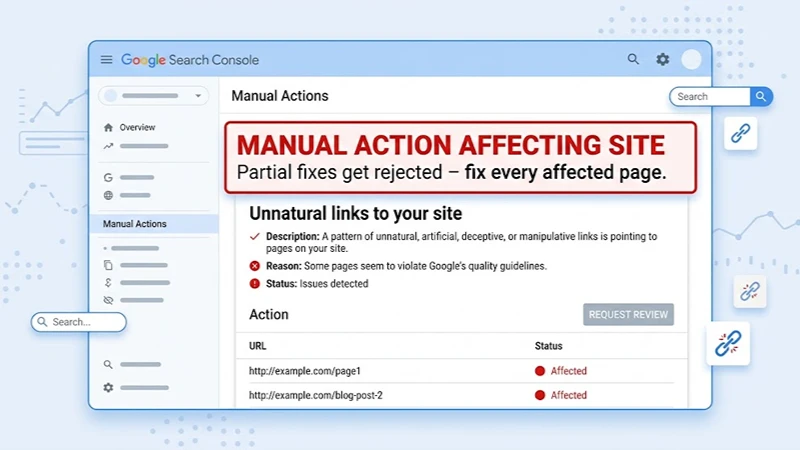
To remove a Google manual action, open the Manual Actions report in Search Console. Fix the violation on each affected page. Then submit a reconsideration request. Document what you found, what you changed, and the result. Reviews typically take days or weeks. Partial fixes get rejected.
That last sentence is where most sites lose months. Google is explicit that fixing the issue on only some pages will not earn you a partial return to search results. Half a clean up reads to a reviewer as no clean up.
The evidence a reviewer actually wants, by action type
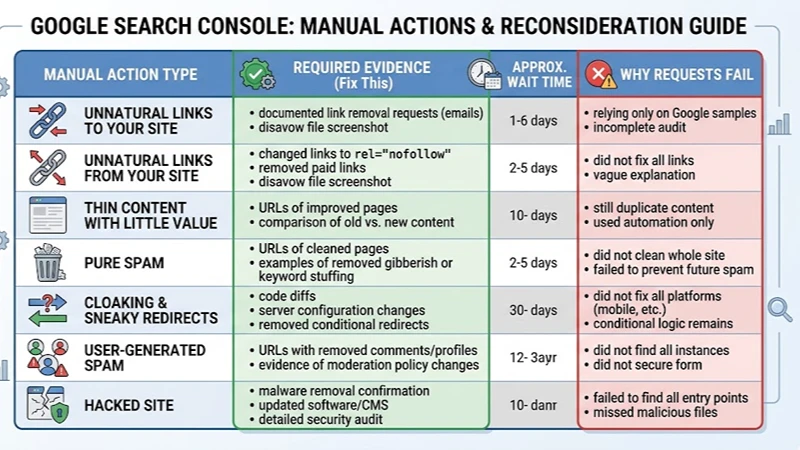
| Manual action | What Google needs to see | Realistic wait | Why requests usually fail |
|---|---|---|---|
| Unnatural links to your site | Proof of genuine removal attempts first, then a disavow file for the rest | Longest of all types | Disavowing everything with no outreach evidence |
| Thin content with little or no added value | Examples of what you removed and what you replaced it with | Days to weeks | Rewriting thin pages instead of deleting them |
| Site reputation abuse | The third party section removed, noindexed, or moved off the domain | Days to weeks | Moving it to a subfolder or subdomain |
| User generated spam | Spam removed plus a prevention measure in place | Days | Cleaning current spam, leaving the hole open |
| Major spam problems | Evidence of a genuine change in how the site operates | Weeks | Cosmetic edits on an unchanged business model |
| Cloaking and sneaky redirects | URL Inspection output showing Googlebot and users now match | Days | Missing a conditional redirect in a plugin |
| Structured data issue | Non compliant markup corrected or stripped out | Days | Fixing templates but not old published pages |
Google confirms that most reconsideration reviews take several days or weeks, and link related requests often take longer.
Why the link penalty behaves differently
Everything else on that table is a content or code problem you control. Backlinks aren’t. Google asks you to contact the owners of the offending sites and ask for removal or a nofollow attribute before disavowing what remains, and it warns that blindly adding every backlink to a disavow file is not treated as a good faith effort.
So keep receipts. Every outreach email, every reply, every domain you couldn’t reach. That log is the request. Without it you’re asking a stranger to take your word for it.
Budget realistically here too. Outreach across a few hundred referring domains is weeks of specialist time, not an afternoon. Expect two to four days just to export, audit and categorise the profile, then anywhere from three to ten days of outreach and chasing depending on how many site owners bother replying. ITJobsWatch lists the median UK day rate for an SEO consultant as £363. So, most link clean-ups cost between £2,000 and £6,000. That is before anyone has written a single word of the request. Profiles under fifty referring domains come in well below that. Anyone quoting £300 for a link penalty recovery is selling you a disavow file and nothing else.
The UK context nobody mentions
Site reputation abuse enforcement hit publishers with voucher and affiliate sections hard. The UK trade press followed the fallout closely. Press Gazette said enforcement came through manual action without warning. It also said the meaning of “third party” has widened to include freelancers. It also noted one case involving a publisher and a coupon provider. The publisher ended the third-party deal and brought everything in-house. It still received a manual penalty.
If you run a UK publisher, a casino or iGaming subfolder, or a leased content section on a strong .co.uk domain, that history matters. Removal restores the manual action status. It rarely restores the traffic.
Where recoveries usually go wrong
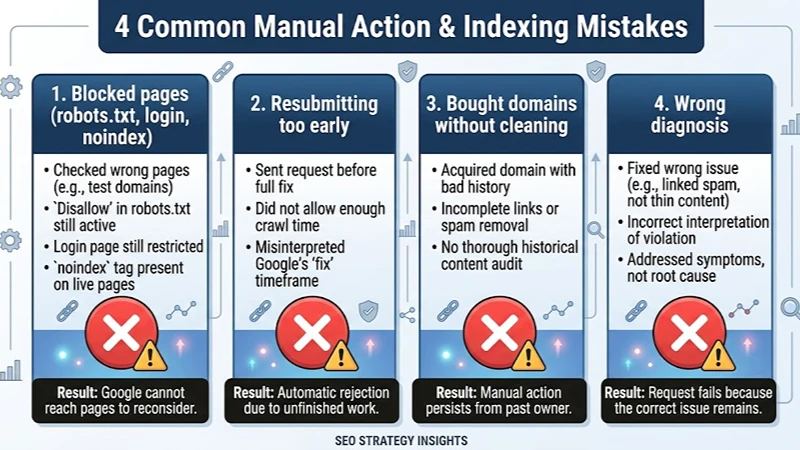
Blocked pages. Google needs to reach the fixed pages. Anything behind a login, a paywall, a robots.txt rule or a noindex tag can’t be verified. Check with the URL Inspection tool before you submit.
Resubmitting too early. Google asks you not to send another request while one is outstanding. Impatience reads as pressure and buys nothing.
Bought domains. If you acquired a site with existing violations, clean it and say so plainly. Google’s guidance is to fix the listed issues and mention the recent acquisition in the request.
Wrong diagnosis entirely. No notice in the Manual Actions report means no manual action. Traffic can fall for a dozen other reasons and a reconsideration request won’t touch any of them.
One genuine area of debate: some SEO tools suggest manual actions expire on their own after a set period. Google has never published anything confirming that, and I’d treat it as folklore rather than a plan.
Frequently asked questions
How do I know if I have a Google manual action?
Open the Manual Actions report in Search Console. A green tick means nothing has been issued. If something has, you’ll see the action type plus the URL patterns affected, and Google will also notify you in the message centre and by email. No notice means no manual action.
How long does a Google manual action last?
Until you fix the violation and Google approves a reconsideration request. There’s no published expiry. Sites have carried actions for months where the underlying issue was never properly addressed, and cleared them in under a fortnight where it was.
How long does a reconsideration request take?
Several days to several weeks in most cases, with link related requests running longer. You’ll get an email confirming receipt and another when the review completes. Don’t resubmit while a request is open.
What’s the difference between a manual action and an algorithmic penalty?
A manual action is a human decision, appears in Search Console, and can be appealed. An algorithmic drop is a ranking system doing its job. There’s no notice, no appeal and no reconsideration request. Google is clear that reconsideration is only for manual actions.
Can a manual action be removed without a reconsideration request?
No. Fixing the problem alone doesn’t clear it. A reviewer has to look again and revoke it, and the only route to that is Request Review inside the Manual Actions report.
What happens if my reconsideration request is rejected?
You can submit again. There’s no cap. But treat a rejection as information: something was missed, or the evidence wasn’t convincing. Go back through every affected URL pattern before you resubmit rather than rewriting the same request.
Do I need to disavow links to get a manual action lifted?
Only for link related actions, and only after real removal attempts. Disavow is the fallback for links you genuinely couldn’t get taken down, not the first move.
What to do next
Open the Manual Actions report and expand the panel to see which URL patterns are affected. Read the matching section of Google’s manual actions documentation for your specific action type, then read the relevant part of the spam policies so you’re fixing against the actual policy language rather than a summary of it.
For link actions, export from the Links report in Search Console rather than a third party tool, since that’s the dataset the reviewer sees. Run every fixed URL through URL Inspection before you submit.
If the action covers a third party section, Press Gazette’s analysis of the site reputation abuse policy and Hello Partner’s reporting on how UK publishers responded are worth reading before you decide whether to noindex, move or rebuild.
Limitations worth stating: review times vary and Google publishes no guaranteed turnaround. Nothing here guarantees a lifted action, and recovery of the manual action status is not the same as recovery of traffic.


Be the first to leave a comment below.