


In-Depth Guide
The Complete Guide to Recruitment Marketing
Our team has written a comprehensive guide covering technical specs, best practices, and the exact approaches we use on every project.
A recruitment website carries a strange kind of pressure most other business sites never face. It has to convince a hiring manager the agency understands their sector deeply, while simultaneously convincing a candidate that this is worth applying through rather than just uploading their CV to a generic job board.
We’ve built enough recruitment sites now to recognise the pattern almost immediately when reviewing a new client’s existing setup. Nine times out of ten, one audience has been prioritised at the expense of the other, usually without anyone realising it happened.
Recruitment Website Design: The Direct Answer
Here’s what UK recruitment agencies need to understand before rebuilding or optimising their site.
| Question | Answer |
|---|---|
| Who does a recruitment website need to serve? | Two distinct audiences, hiring clients and job seeking candidates, with different intentions |
| Should jobs and client services share one site? | Yes, but with clearly separated navigation rather than one confused structure |
| What matters most for candidate searches? | Job title and location specificity, since most candidates search for a specific role nearby |
| What matters most for client searches? | Genuine sector expertise and placement track record, not generic recruiter copy |
| Is local SEO important for recruitment? | Yes, particularly on the candidate side, where location heavily influences search behaviour |
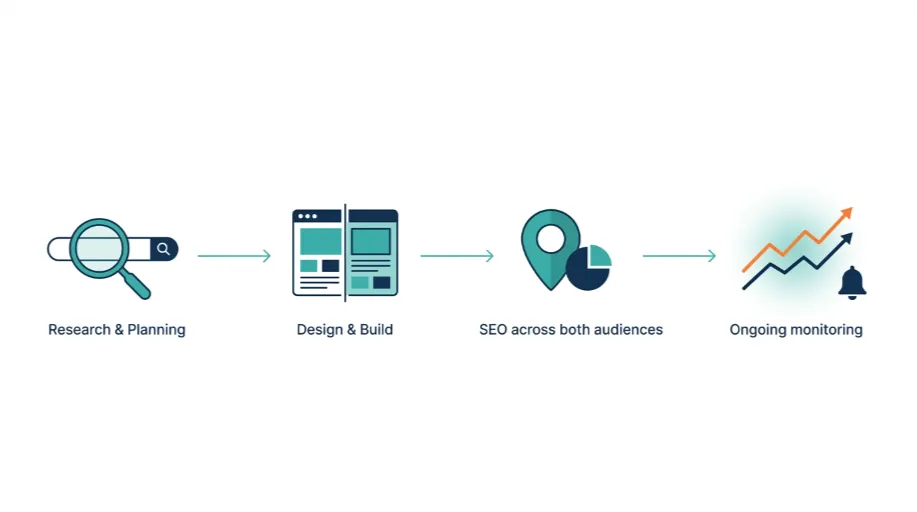
| How long does a proper rebuild typically take? | Around four weeks from research through to launch |
That split between client and candidate intent is really the whole challenge in one sentence. Most website builders default to treating a recruitment site like any other business site, and that assumption creates problems almost immediately.
Why One Site Serving Two Audiences Is Harder Than It Looks
In our testing across recruitment sector clients, the most common failure we see is a site that reads entirely like a job board, heavy on listings, light on anything that would convince a hiring manager to actually pick up the phone. The opposite failure happens too, with agencies burying their live vacancies behind confusing navigation because the site was built primarily to impress prospective clients.
We worked with a recruitment agency based in the Midlands whose previous site fell into exactly this trap. Client enquiries were reasonable, but candidate applications had dropped noticeably over the previous year, and nobody on the team could explain why. Reviewing the site properly, the job listings were buried three clicks deep behind a navigation structure built entirely around service pages aimed at employers. Restructuring the site with a genuinely separate, clear candidate pathway alongside the client focused content brought applications back within weeks, without losing any of the client side credibility that had been carefully built up.
What a Properly Built Recruitment Site Actually Needs
Getting this right means designing for two journeys at once, deliberately rather than accidentally.
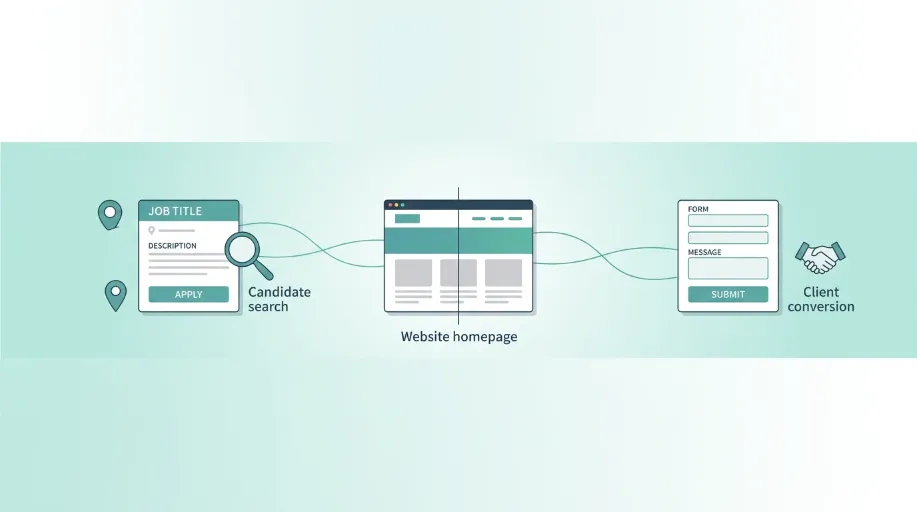
- Clear separated navigation so a candidate and a client each land on content built specifically for them, not a shared generic homepage trying to do both
- Sector and specialism pages that demonstrate genuine expertise, since a client wants a recruiter who understands their specific industry, not a generalist
- Job title and location pages structured around how candidates actually search, since vague listings rarely satisfy specific search intent
- Placement track record and testimonials presented clearly enough to build trust with a hiring manager making a genuinely important decision
- Fast, current job listings that feel live and maintained, since stale vacancies quietly damage credibility with both audiences at once
- Simple enquiry paths for clients, distinct from the candidate application process, so a business looking to instruct a recruiter doesn’t get lost in job seeker content
Miss the separation between these two journeys and a site ends up quietly underperforming for one audience while nobody notices exactly why.
Client Side Trust Works Differently Than Consumer Trust
A hiring manager instructing a recruitment agency is making a decision with real business consequences. A bad placement costs time, money and disruption. That’s a genuinely different kind of trust to build compared to a straightforward retail purchase, where the stakes and decision process look completely different. Our work with eCommerce Websites for Retail Businesses shows just how differently a purely transactional audience behaves compared to a client evaluating a service relationship, and recruitment sits firmly in the latter category, needing content built around credibility and expertise rather than simple product appeal.
Getting Both Sides Right at the Same Time
As long as the principle is understood, this need not feel too complicated. A recruitment website works when it treats client acquisition and candidate attraction as two connected but sufficiently separate journeys in their own right, each deserving proper attention rather than one being just the other’s afterthought.
When agencies achieve the right blend, they routinely benefit on both fronts, with stronger client briefs arriving through organic search and an ongoing stream of genuine candidate applications instead of relying solely on paid-for job board listings to fill the pipeline. That balance is what separates a recruitment website that works from one which quietly underperforms while nobody quite knows why.