


In-Depth Guide
The Complete Guide to B2B SEO
Our specialists have written a comprehensive guide covering strategy, best practices, and the exact approaches we use for our clients.
Most SEO agencies treat every website the same way. Publish blog posts, target keywords, watch the rankings climb, and wait for the traffic to convert. That approach works well enough for a shop selling trainers. It falls apart for a B2B software company where the buyer spends four months researching, brings in a procurement team, and reads three case studies before anyone books a call.
B2B buying decisions do not happen in a single visit. A finance director might read your comparison page in March, forward it to a colleague in April, and only request a demo in June. If your entire SEO strategy is built around one keyword and one landing page, you lost that visitor somewhere between March and June, because you never gave them what they needed at each stage of that decision.
Why Standard SEO Fails B2B Companies
Search volume tells you what people type into Google. It tells you nothing about whether that person can authorise a purchase order. A keyword with 300 searches a month looks appealing until you realise most of those searchers are competitors, students, or people three years away from any buying decision.
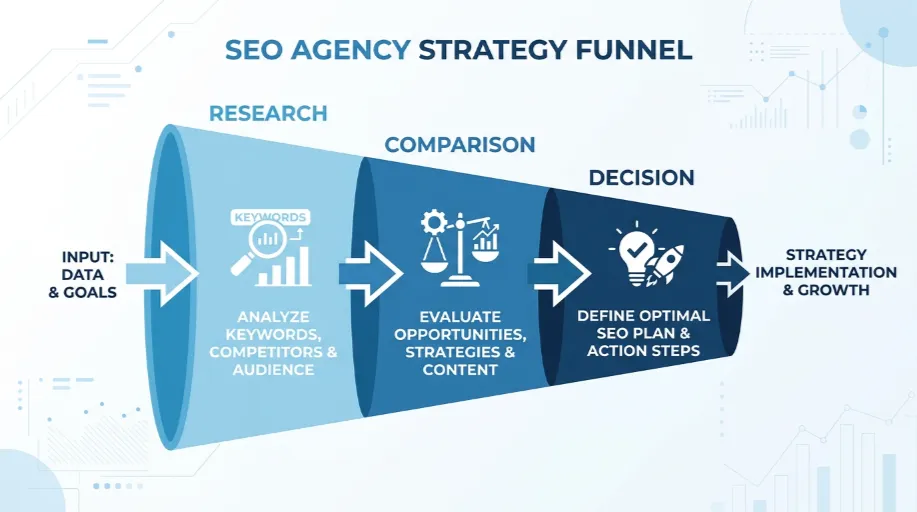
We map every page against a simple question: where is this reader in the buying process, and what do they need to see right now to move one step closer without picking up the phone? That framing changes everything about what gets written and what gets written first.
The Three Stages Every B2B Buyer Moves Through
| Buyer Stage | What They Are Doing | Content That Wins Them |
|---|---|---|
| Early Research | Realising they have a problem worth solving | Educational guides, industry benchmarks, problem-focused blog content |
| Active Comparison | Shortlisting two or three vendors | Comparison pages, alternative pages, detailed case studies |
| Final Decision | Building a business case for their team or board | Pricing pages, ROI data, procurement-friendly documentation |
Most B2B websites we audit have plenty of content for that first stage and almost nothing for the second and third. That gap is usually where deals stall.
Bottom of Funnel Content Is Where B2B SEO Actually Pays
Ranking for informational keywords has its place. It rarely generates revenue on its own. The pages that actually close deals sit much further down the funnel, and they are also the pages most agencies never build.
An effective B2B SEO strategy needs to include:
- Comparison pages covering the vendors your prospects are evaluating alongside you
- Alternative pages for people actively searching for a replacement for a competitor’s tool
- Case studies structured around the specific objections your sales team hears every week
- Content that helps a champion justify the investment to a decision maker
- Pages covering security, compliance, and implementation timelines that procurement will ask about
This comes down to a properly structured content strategy that ties every asset to a funnel stage. A blog treated as a separate marketing channel, disconnected from how buyers actually move through a decision, will keep generating traffic that never reaches sales.
Getting Marketing and Sales to Agree on What a Good Lead Looks Like
Ask a marketing team what counts as a qualified lead and you get one answer. Ask the sales team the same question and you often get a different one. That disconnect is one of the most common reasons B2B SEO gets written off as ineffective, and in most cases it comes from a reporting gap rather than a performance one.
Our reporting centres on marketing qualified leads and pipeline value, not rank position. That means tracking which organic pages a prospect visited before requesting a demo, how long that typically takes, and which content types appear most often in closed-won deals. When marketing and sales are looking at the same numbers, they stop arguing about credit and start agreeing on what to build next.
Technical SEO for Complex B2B and SaaS Sites
B2B websites are usually large, often built by an engineering team rather than a marketing team, and frequently structured in ways that block crawlers from reaching important content. That causes real problems. Resource centres load slowly. Gated whitepapers are invisible to Google. Internal links follow the sitemap rather than the buyer journey, so a visitor reading an early-stage guide has no obvious route through to a comparison page.
Fixing this properly means auditing crawl paths and indexing across both gated and ungated content, resolving the Core Web Vitals issues that content-heavy pages tend to accumulate, and rebuilding internal linking around funnel stage rather than category. For software firms, designers and engineers are often involved in wider site architecture decisions, which is where SaaS-focused web design and SEO need to be planned together rather than handled by separate teams working from different briefs.
What This Looks Like in Practice
We worked through exactly this problem with a UK manufacturing client whose organic traffic had grown steadily for two years without any noticeable increase in qualified enquiries. The content existed. The buyer journey mapping did not. Once we rebuilt their site around research, comparison, and decision stage content, and tied reporting back to actual sales conversations, the picture changed considerably. You can read the full breakdown in our manufacturing SEO case study, including what specifically moved the needle and what took longer than expected.
That timeline point matters. A six to eighteen month sales cycle means a B2B SEO strategy needs patience built into it from day one. Early wins usually show up as an increase in the right kind of enquiry, not a sudden jump in overall traffic. Anyone promising fast results for a genuinely long B2B sales cycle either does not understand the buying process or is measuring the wrong thing entirely.
Getting this right means treating your website less like a brochure and more like a second sales team, one that works through every stage of a decision even when nobody is watching it happen in real time.