

In-Depth Guide
The Complete Guide to Industrial Marketing
Our team has written a comprehensive guide covering technical specs, best practices, and the exact approaches we use on every project.
A buyer sourcing a bracket, a housing or a batch of turned parts does not browse for pleasure. They arrive with a drawing, a deadline and a shortlist, and your website has about a minute to prove you belong on it. Most sites fail that test, and the reason is rarely the quality of the work behind them.
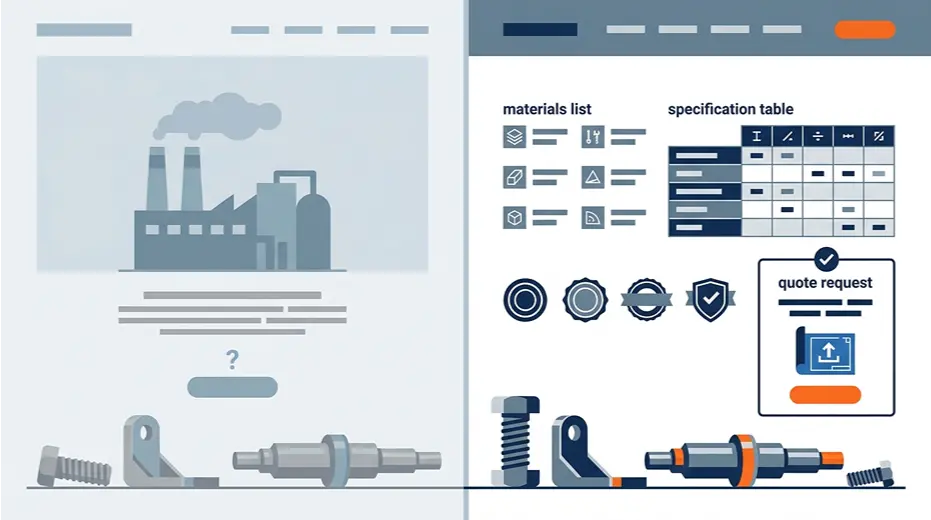
Much marketing for manufacturing companies focuses on appearance, a polished homepage and a line about heritage. Buyers want proof instead. That is where a specialist B2B SEO approach differs from general marketing, because it starts from the buyer’s checklist rather than the supplier’s story.
What a Procurement Engineer Checks in the First Minute
Think about the questions running through a buyer’s head. Can this firm make the part, in the right material, at the right volume, with the right paperwork behind it? The table below shows where they look for each answer and where websites usually let them down.
| What they check | Where they look | What often goes wrong |
|---|---|---|
| Process and material | Capability page | Described in vague marketing language |
| Tolerances and capacity | Specification section | Missing, or locked inside a PDF |
| Certifications | Footer or about page | Logo shown with no scope or certificate detail |
| Lead times | Quote form or FAQ | Never mentioned, so the buyer assumes the worst |
| Proof of similar work | Case studies | Generic photos with no part, material or result |
Try running your own site through that table. If a stranger cannot answer every row within a minute, an enquiry has probably been lost without leaving a trace in your inbox.
Capability Pages Should Read Like a Datasheet
A pattern we see again and again on industrial sites is a single services page that lists welding, cutting, machining and finishing in one breathless sentence. It sounds capable. It tells an engineer nothing. They cannot tell whether you handle stainless or aluminium, prototype runs or ten thousand units, or whether your equipment suits their part at all.
Separate pages for each process, material and sector fix this. Each one can state what you make, the materials you work with, typical tolerances and the batch sizes you prefer. It also gives search engines a clear, specific page to show when someone types a precise request, which is how many industrial buyers search.
Certifications Deserve More Than a Logo in the Footer
Supplier approval is a box ticking exercise for many procurement teams, and your website is where they tick the boxes before they ever call. ISO 9001, ISO 14001, ISO 45001 and Cyber Essentials, along with sector standards such as AS9100 for aerospace or IATF 16949 for automotive, where they apply to you, mean far more when the scope and issuing body are shown alongside the badge.
Gather your quality, environmental and safety policies in one findable place too. A buyer who has to email you for basic documents will often email your competitor instead, simply because their documents were already online. If your finished products need UKCA or CE marking, say which they carry, as many buyers will look for it.
Make the Quote Request Painless
The quote form is where interest becomes revenue, and it is also where many sites lose people. Buyers with a drawing in hand want to send it straight away, not describe it in a text box and wait to be asked for the file.
- Offer a secure upload for drawings and specification files, so nothing has to be emailed separately
- Limit the required fields to material, quantity and delivery date, and make everything else optional
Add an automatic confirmation message so the buyer knows the request arrived. A short, honest line about your usual response time sets expectations and reduces chasing calls.
How Buyers Search for a Supplier
Industrial searches are specific. Someone looks for CNC machining of stainless steel for food equipment, or sheet metal fabrication near a particular region, rather than anything as broad as engineering services. Your pages need to match that precision, and they need to load quickly while doing it. Pages heavy with machinery photography, large datasheets and embedded video can slow a site down and make it harder for search engines to crawl. When rankings stall, a technical SEO review of speed, crawling and indexing often finds the cause faster than rewriting more copy.
Long Sales Cycles Mean Several Readers
An industrial purchase rarely rests on one person. An engineer checks the specification, a quality manager checks the certificates, a buyer compares prices and someone in finance wants to know you are stable. Each of them may visit your site separately over several weeks, often on different devices.
Good content serves all of them without forcing any of them to hunt. Engineers find detail on capability pages, quality staff find accreditations, and the commercial side finds clear information about minimum orders, lead times and how to start a conversation.
Case Studies That Name the Part, the Material and the Result
A case study that says you helped a customer improve efficiency means very little. One that names the part type, the material, the batch size and what changed for the customer gives a buyer something to compare against their own requirement. Where a customer will not allow a name, describe the sector and the problem instead. Detail builds trust even when the client stays anonymous.
Setting Realistic Expectations
Search volumes in industrial niches are modest, and individual process searches are smaller still. That is not a weakness. Each enquiry can be worth a great deal, and the people searching usually know exactly what they need.
Rankings take months to build rather than weeks, so judge progress on quote requests and their quality, not on traffic alone. A smaller number of well matched enquiries beats a large number of irrelevant visits every time.
Where to Start Before You Spend Anything
If your site already exists, begin by learning what it is currently doing. An SEO audit shows which pages buyers reach, where they leave and what stops search engines trusting your content, so your first pound goes to the biggest gap rather than a guess.
From there, the work is practical rather than mysterious. Publish what buyers need to know, show your credentials plainly, and make it easy to send a drawing. Manufacturers who do that tend to find the right enquiries arrive on their own.