

In-Depth Guide
The Complete Guide to Amazon Marketplace SEO
Our team has written a comprehensive guide covering technical specs, best practices, and the exact approaches we use on every project.
A listing can sit on page one of Amazon search results and still lose money. It sounds contradictory until you understand how Amazon decides what to show. More importantly, it decides what to keep showing after someone clicks.
We’ve had more than one seller tell us their Google SEO agency handled their Amazon listings too, as a sort of add-on service. It rarely goes well. Amazon isn’t Google wearing a different hat. It’s a genuinely different search engine with its own logic, and treating it like an afterthought shows up quickly in both ranking and revenue.
Amazon SEO Fundamentals
Here’s what UK sellers need to understand before optimising a single listing.
| Question | Answer |
|---|---|
| What ranks products on Amazon? | The A9 algorithm, weighing relevance alongside conversion rate and sales velocity |
| Does PPC affect organic ranking? | Yes. Sales generated through PPC genuinely feed back into organic position over time |
| What decides the Buy Box? | Pricing, fulfilment method and seller performance metrics, not keywords |
| Is Google SEO experience enough? | Not on its own. Amazon rewards conversion signals Google simply doesn’t weigh the same way |
| Do backend search terms matter? | Yes. They capture additional relevant search traffic invisible to the shopper |
| Is Brand Registry required? | No, though it unlocks A+ content that meaningfully improves conversion |
Notice how many of these answers involve conversion rather than pure relevance. That’s the biggest difference between Amazon SEO and ranking a webpage on Google, and it’s where most agencies without dedicated marketplace experience get caught out.
Why Amazon Punishes Listings That Look Fine
In our testing with UK sellers, we often find listings with good keyword coverage that still rank poorly. This happens because they do not convert after someone clicks through. Amazon notices this. A listing that gets clicks but doesn’t sell tells the algorithm something is wrong, and ranking drops accordingly, regardless of how well the title and bullets are written.
We worked with a home fragrance brand based in the South East whose listings had solid keyword coverage, but they kept losing the Buy Box to a competitor selling an almost identical product. Their organic ranking looked fine on paper. Their actual visible sales told a different story because losing the Buy Box meant most traffic never saw their listing as the default buying option. Fixing their fulfilment method and adjusting their pricing strategy recovered the Buy Box within a couple of weeks, and their genuine visibility improved immediately. Their keywords had not changed at all. The thing actually controlling most of their sales simply had nothing to do with search terms in the first place.
That’s the lesson worth sitting with. Amazon SEO that focuses only on keywords solves, at best, half the problem.
What Amazon SEO Actually Requires
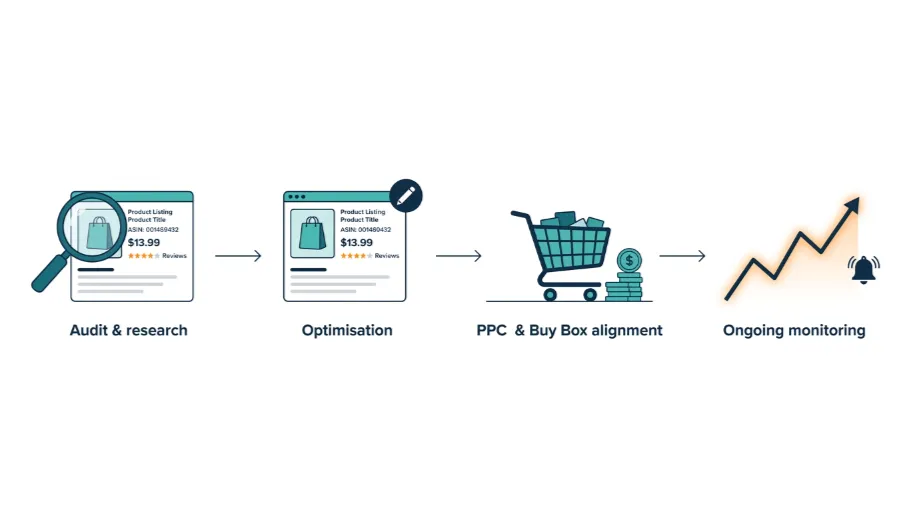
Getting a listing to perform properly on Amazon means working across several connected areas at once.
- Backend search terms filled with genuinely relevant keywords the shopper never sees, but the algorithm reads
- Titles and bullet points structured to satisfy both search relevance and the questions a real buyer is actually asking before they purchase
- A+ content built out properly for Brand Registry holders, since well-designed content measurably improves conversion rate on eligible listings
- PPC strategy aligned with organic goals, since advertising-driven sales genuinely influence long-term ranking position rather than sitting separately
- Buy Box factors reviewed regularly, covering pricing, fulfilment choice and seller performance metrics that have nothing to do with keyword strategy
- Ongoing monitoring, since competitor activity and algorithm behaviour shift constantly, meaning a listing optimised once can quietly slip months later
Miss the conversion side of this and even the most carefully researched keywords won’t hold a ranking position for long.
Where Google and Amazon Visibility Actually Meet
Many sellers run both an ecommerce site for Google search and an Amazon storefront. Treating them as separate strategies often means missed chances to link them. Product research for one can reveal useful insight for the other. This is especially true for what buyers search for and which objections come up often.
If your product visibility strategy spans Google and Amazon, our eCommerce SEO service covers Google properly. The two work best when run together. They should not compete for the same budget.
When the Website Behind Your Amazon Store Needs Attention Too
Some sellers use Amazon purely as a marketplace channel. Others run it alongside a proper ecommerce site, often built on Shopify, where Amazon becomes one sales channel among several rather than the entire business.
If your site needs building or improving to support that wider strategy, our Shopify Development service handles it properly, making sure your owned ecommerce presence is as strong as your marketplace listings, rather than leaving all your visibility eggs in Amazon’s basket.
Genuine Marketplace Experience, Not a Side Service
It’s worth being direct. Many agencies offering Amazon SEO apply Google SEO logic to a platform that doesn’t work in the same way, and it shows in results that plateau quickly or never quite match what a dedicated specialist achieves.
Our Amazon work is led by someone with seven years’ experience specifically within Seller Central, not a generalist adding Amazon to a service list because clients kept asking. You can see who is actually handling your account on our Meet the Team page, which matters far more on a platform this specific than it does with more generic marketing work.
Getting Past Keywords Into What Actually Moves Revenue
Ranking position on Amazon is a means to an end, not the end itself. A listing that ranks reasonably well and converts strongly will consistently outperform one that ranks perfectly and converts poorly, because Amazon’s own algorithm is watching that exact trade-off constantly and adjusting visibility accordingly.
Getting this right means treating relevance, conversion, Buy Box performance, and PPC as one connected system. It should not be four separate jobs, split between people who do not talk. Most missed revenue sits there. It is not just from a few missing keywords. It comes from gaps between parts that were never joined up properly.