

For UK legal, financial, and medical websites, E-E-A-T involves showing genuine Experience, Expertise, Authoritativeness, and Trustworthiness. This is typically evidenced through clearly named, suitably qualified authors, relevant regulator credentials (such as the SRA, FCA or GMC), citations from authoritative sources like GOV.UK and the NHS, and content that is fair, clear and not misleading. Google applies higher standards to “Your Money or Your Life” (YMYL) pages. This is because wrong advice can harm a reader’s money, health, or legal rights. If you are also reviewing your site’s foundations as part of this work, our web design services can help ensure the technical and UX elements support your E-E-A-T strategy.
Why E-E-A-T matters more in regulated UK industries
Google’s Search Quality Rater Guidelines call some content YMYL. This content can affect people’s money, health, safety, or legal matters. In practice, this means Google’s ranking systems, and the human quality raters who help Google evaluate them, look harder at who created the content, whether they have verifiable credentials, and whether the information is accurate and consistent with expert consensus. For UK regulated sectors, that usually means official regulatory and clinical guidance.
Google described its March 2026 core update (27 March to 8 April) as a regular update and issued no new E-E-A-T guidance alongside it. However, many post-update analyses reported that original content showing first-hand involvement and real expertise held up better than generic explainers anyone could write. Google’s own guidance still describes Trust as the most important part of E-E-A-T, with Experience, Expertise and Authoritativeness supporting it. For a law firm in England and Wales, that means solicitor-authored practice area pages with specific procedural knowledge. For financial advisers, it means original analysis tied to FCA rules, not rehashed investment definitions. For private clinics, it means clinician-written treatment content with GMC (or other professional register) numbers and citations to NICE or NHS guidance.

What each regulator expects from website content
Each regulator has its own marketing rules, and they sit alongside Google’s quality expectations rather than replacing them. Legal regulation also differs across the UK: the SRA covers solicitors in England and Wales, while Scotland and Northern Ireland have their own law societies and rules.
Financial services and FCA financial promotions
Under FCA rules, a financial promotion is a communication that invites or induces someone to engage in financial activity, and much of the marketing content on an FCA-authorised firm’s website will fall into that category. Promotions must be fair, clear and not misleading, with risks presented alongside benefits. For retail customers, the Consumer Duty adds an expectation that information supports genuine consumer understanding.
Key requirements include stating your regulatory status and Firm Reference Number (FRN), using plain language over jargon, and giving risk warnings and disclosures enough prominence, close to the claims they qualify rather than hidden in footers. Linking to your entry on the FCA Register is good practice that lets readers verify you in one click. Content that could lead someone to make a significant financial decision, such as mortgages, investments, pensions or tax guidance, needs particularly strong E-E-A-T signals.
Legal services and SRA compliant website content
In England and Wales, solicitors can market freely provided content is accurate, not misleading and evidenced. The SRA Transparency Rules require every SRA-authorised firm to publish its complaints procedure. This includes how and when a client can complain to the Legal Ombudsman and the SRA. Firms that advertise certain services, including residential conveyancing, probate, motoring offences, employment tribunal claims, debt recovery, immigration and business premises licensing, must also publish pricing information, key stages, timescales, and the experience and qualifications of the people doing the work.
What is often overlooked is the SRA digital badge. Every authorised firm must display its SRA number and a clickable badge prominently on its website.
Success-rate claims are not outright banned, but any publicity must be accurate and not misleading. The SRA has specifically warned against statements that misrepresent the likelihood of success. A headline such as “we win 95% of cases” is therefore risky unless you can fully evidence it and provide clear context.
Genuine reviews are allowed if you have the client’s consent and do not edit them in a way that changes their meaning. Fake reviews have been prohibited under UK consumer law since April 2025.
Healthcare and medical content YMYL
Medical content falls squarely under YMYL because it can affect readers’ health and safety. Every clinical article should be authored or reviewed by a named clinician with their GMC, GDC, NMC, GPhC or other relevant register number visible.
References should link to NHS, NICE or peer-reviewed sources, and pages need both a published date and a last medically reviewed date. The ASA’s CAP Code Section 12 governs claims about medicines, medical devices, and treatments. The MHRA’s Blue Guide sets out rules for advertising medicines. It bans promoting prescription-only medicines to the public. That ban catches many clinic pages for treatments such as weight-loss injections. Clinics should also show their registration with the relevant care regulator: the CQC in England, Healthcare Improvement Scotland, Healthcare Inspectorate Wales or the RQIA in Northern Ireland. Overstating what your practice can treat creates YMYL quality red flags.
Building E-E-A-T signals that actually work in 2026
Named authors with verifiable credentials
Real author authority means named experts with genuine, relevant credentials and dedicated author pages that set out who they are and why they are qualified. Include structured data marking up the author with sameAs links to their real professional profiles, such as LinkedIn, Companies House, or regulatory registers.
Anonymous YMYL content, or content credited to an expert who did not actually write or review it, undermines trust. For healthcare that means GMC, NMC or other register details on author bios. For legal it means SRA numbers and named solicitor profiles linked to practice areas. For finance it means the firm’s FRN and, where relevant, the adviser’s entry on the FCA Register.
First-hand experience over commodity content
Experience asks whether the content creator has first-hand, personal involvement with the topic. Content that demonstrates the firm has done the thing outperforms generic explainers.
In practice, the most common mistake is publishing broad “what is a mortgage” articles that any content mill could produce. What ranks now is original analysis, practitioner insight, and specific details that show you have actually handled these matters.
Citations to authoritative UK sources
Link to credible sources like GOV.UK and the FCA for finance, NHS or NICE for health, and the SRA or Law Society for legal matters. Citing authoritative references signals accuracy and helps readers verify claims.
This does not mean linking to competitors. It means referencing the actual regulatory guidance or clinical consensus that underpins your advice.
Transparency and maintenance
Clear contact details, complaints processes, regulatory status and the date content was last reviewed all matter. Disclaimers should sit near claims rather than buried in footers.
Outdated clinical or regulatory content is a specific YMYL quality failure. If guidance changes, your pages need updating with new review dates.
A practical E-E-A-T checklist for regulated UK websites
| Signal | What it looks like | Common gaps |
|---|---|---|
| Experience | First-hand analysis, original data, practitioner insight in content | Commodity explainers with no specific detail or real-world nuance |
| Expertise | Named authors with real credentials, dedicated author pages, author schema with sameAs to professional profiles | Anonymous content, missing author bios, no regulator numbers visible |
| Authoritativeness | Consistent firm name and details across site, Google Business Profile, Companies House, regulator registers, earned press mentions | Inconsistent NAP data, missing regulator badges, no external recognition |
| Trust and validation | Visible regulatory status, FCA Register link, SRA badge or CQC rating, genuine reviews within regulator and consumer law rules, clear disclosures near claims | Hidden disclaimers, misleading or fake testimonials, missing regulator links |
| Transparency | Clear contact details, complaints process, regulatory status, published and last-reviewed dates | No review dates, buried complaints info, vague regulatory status |
This table combines regulatory requirements (FCA financial promotions rules, SRA Transparency Rules and healthcare advertising rules) with Google’s published quality guidance. Not every row is a legal requirement, but each one is a trust signal readers and search engines look for.
Content gaps competitors miss and how to do better
Most existing guides on E-E-A-T and YMYL SEO in the UK cover the basics but skip practical nuance. Three gaps stand out.
First, many articles mention FCA or SRA compliance generally but do not explain where disclosures should sit on the page. Put them right next to the claim they qualify. A mortgage page, for example, must carry the FCA’s prescribed warning that your home may be repossessed if you do not keep up your mortgage repayments, and an investment page should make clear near any return figures that capital is at risk.
Second, healthcare SEO content often says “cite NHS” without specifying which sources count as authoritative for different purposes. Use NICE guidelines for clinical pathways, NHS.uk for patient information, and MHRA guidance for claims about medicines.
Third, legal content frequently omits the SRA digital badge or treats it as optional. It is mandatory for SRA-authorised firms, so make it a visible checklist item: the badge and SRA number should sit in a prominent, consistent place, such as the homepage or a site-wide header or footer, so visitors can find them easily.
How this applies to your SEO strategy
For UK regulated sectors, E-E-A-T is not a box-ticking exercise. It is about building a trust layer that satisfies both Google’s quality guidelines and your regulator’s marketing rules.
Lead with the primary term in your title and H1, use a clear heading hierarchy that reflects how a reader thinks through the topic, and build internal links from educational content into related service pages. Route high-risk content through proper compliance review before publishing.
If you are working on SRA-compliant website content or SEO for FCA-regulated financial promotions, start by auditing author pages, regulator badges, review dates and disclosure placement. Those fundamentals matter more than clever keyword variations.
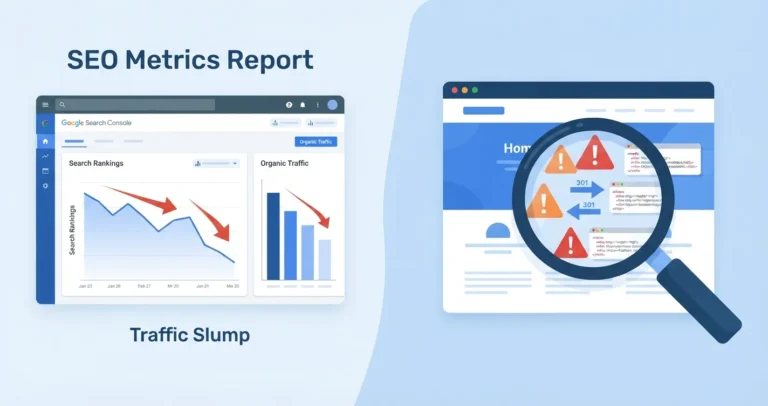
At our UK-based SEO service, we specialise in building E-E-A-T architectures for legal, financial and medical clients that satisfy both search quality standards and regulator expectations. If you need help auditing your current content against these signals, get in touch for a no-obligation review. For firms that have seen visibility drop after recent algorithm changes, our analysis of traffic dropped after Google update outlines the specific E-E-A-T and YMYL signals to prioritise in your recovery plan.

FAQ
What is E-E-A-T in SEO for UK regulated industries?
E-E-A-T stands for Experience, Expertise, Authoritativeness and Trustworthiness, the quality framework Google uses to evaluate content. For UK legal, financial, and medical sites, it means demonstrating real credentials, first-hand knowledge, and compliance with regulator rules such as FCA, SRA, and GMC standards.
Does E-E-A-T directly affect Google rankings?
E-E-A-T is not a single ranking factor with its own score. Instead, Google uses a mix of signals to identify content that demonstrates good experience, expertise, authoritativeness, and trustworthiness, such as content accuracy, author credibility, and links from reputable sites. Pages that demonstrate strong E-E-A-T tend to perform better, especially for YMYL topics.
What counts as YMYL content in the UK?
YMYL covers content that could affect readers’ financial security, health and safety, or legal position. In the UK, this includes mortgages, investments, pensions, tax advice, medical treatments, legal services, insurance, and civic information like voting or government services.
Do I need named authors on all regulated content?
For YMYL pages, yes, in practice. Google strongly encourages clear authorship information, such as bylines linking to author pages, and its quality raters are asked to check who is responsible for YMYL content. Anonymous finance, legal, or medical content is a weak trust signal, and clinical content in particular should name a qualified author or reviewer.
How often should I update E-E-A-T content?
Whenever underlying guidance changes, and as a sensible minimum, review core service pages at least once a year. Outdated clinical, regulatory or financial content is a specific YMYL quality failure. Publish both a published date and a last-reviewed date on each page.
Can I use AI to help write regulated content?
You can use AI tools for drafting, but the accuracy duty is yours. Verify everything against authoritative sources before publishing, ensure named qualified humans review and take responsibility, and route high-risk content through proper compliance review.
If you want a broader view of how these principles fit into a full SEO programme, see our SEO services. They cover E-E-A-T audits, YMYL content strategy, and regulator-aligned optimisation for UK firms.


Be the first to leave a comment below.