

In-Depth Guide
The Complete Guide to SEO Services
Our specialists have written a comprehensive guide covering strategy, best practices, and the exact approaches we use for our clients.
Launching on Shopify takes an afternoon. Ranking takes rather longer. That gap catches out a lot of UK store owners, who expect search traffic to arrive once the theme is live and the products are uploaded.
It rarely does, and the reason isn’t mysterious. Shopify handles the plumbing well, but thousands of other stores use the same themes, the same apps and often the same supplier descriptions. To Google, many of them look alike. Standing out is the real job, and it’s where we spend our time.
What Shopify Handles For You, And What It Doesn’t
Shopify gives you a sound base. You get SSL, an automatic sitemap, canonical tags and mobile friendly themes from day one. What it can’t do is think for you.
| Area | What Shopify Does | What Still Needs Attention |
|---|---|---|
| Security and mobile | SSL and responsive themes included | Speed on real phones |
| Sitemap and canonicals | Generated automatically | Tag, vendor and filter pages |
| Collection pages | A page exists for every collection | Useful copy and clear structure |
| Product pages | A template and editable fields | Original descriptions and accurate schema |
Look at the right hand column and you’ll see where most stores lose ground.
Collection Pages Bring In The Broad Searches
Think about how people shop. They search for a general need first, such as running shoes or scented candles, then narrow things down. Collection pages catch those broad searches, and for most stores they earn far more organic revenue than individual products do.
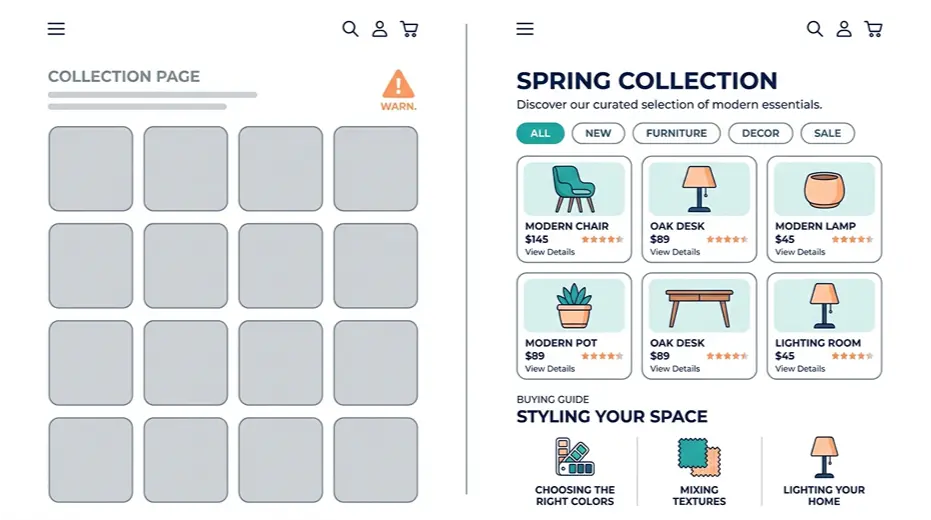
Yet the typical collection page has a single sentence of text above a grid of products. Google has very little to work with, and so does the shopper. A strong collection page usually includes several things.
- A short opening paragraph explaining what the range covers and who it suits
- Clear headings for the main ways people choose, such as size, use or budget
- Links to closely related collections and popular products
- Helpful buying advice placed below the products, so it never pushes them down the page
- A title and description written for a real search, not filled in by a default template
We start with your five or ten highest earning collections. Fixing those first tends to pay back faster than spreading effort across the whole catalogue.
Thin Pages Sneak In Through Tags And Filters
Shopify lets a product appear under several collection paths, and it adds a canonical tag pointing to the main product URL. That handles most duplication neatly. Many themes still link to the collection path version internally though, which sends Google a mixed signal. We fix that in the theme so every internal link points at the main product URL.
Tag pages, vendor pages and filtered views are a different story. Left alone, they can produce dozens of thin pages with almost nothing on them. Some deserve to rank, because a search for waterproof walking boots might match a filtered page. Most don’t. We decide which ones earn a place, then use canonicals, noindex rules or careful robots.txt changes to handle the rest. A wrong rule can block pages you want crawled, so we test every change before it goes live.
Apps Are Usually Why Mobile Speed Suffers
Ask a store owner why their site feels slow and they’ll often blame Shopify itself. In our audits the cause is usually the app stack. A review widget here, a popup there, an upsell tool nobody remembers installing.
Each one loads its own scripts, and mobile speed slips a little more every month. We go through every app and ask whether it earns its place. Unused apps get removed, and leftover code gets cleaned out, because uninstalling an app doesn’t always delete what it added to your theme. Where a theme needs deeper changes, our Shopify development services team can build the feature properly instead of stacking another app on top.
Product Data Should Match What Shoppers See
Structured data tells Google your price, availability and review scores. It only helps when it’s accurate. We’ve seen products sell out for weeks while the markup still said in stock, which sends shoppers to a dead end and wastes the click.
We check your markup against live store data, then test it in Google’s Rich Results Test before and after each change. If you use Google Merchant Center, your product feed should match the page as well. Mismatched prices are one of the quickest ways to get products disapproved.
Moving To Shopify Needs A Plan
Migrations are where rankings often vanish. URLs change, titles get rewritten and old pages disappear with no redirect. Before launch, we map every old URL to its new home and keep the copy that already performs. That way months of hard won visibility don’t drop away in a weekend.
What Realistic Progress Looks Like
We won’t promise overnight jumps, because nobody honest can. Technical and schema fixes can show movement within a few weeks. Content led gains on competitive collection terms usually take three to six months, depending on your competition and how much needs improving at the start.
What you can expect is a clear order of work, plain reporting tied to organic revenue, and a store that’s easier for shoppers and search engines to understand with every month we work together.