

In-Depth Guide
The Complete Guide to Off-Page SEO
Our specialists have written a comprehensive guide covering strategy, best practices, and the exact approaches we use for our clients.
Your On-Page SEO Is Strong. So Why Are You Still Stuck on Page Two?
This is one of the most common frustrations in SEO, and the answer is usually the same. On-page optimisation matters enormously. Getting your page titles right, your content structured properly, your technical foundations solid and your internal linking coherent are all necessary for ranking well. For competitive search terms, though, they are not enough on their own.
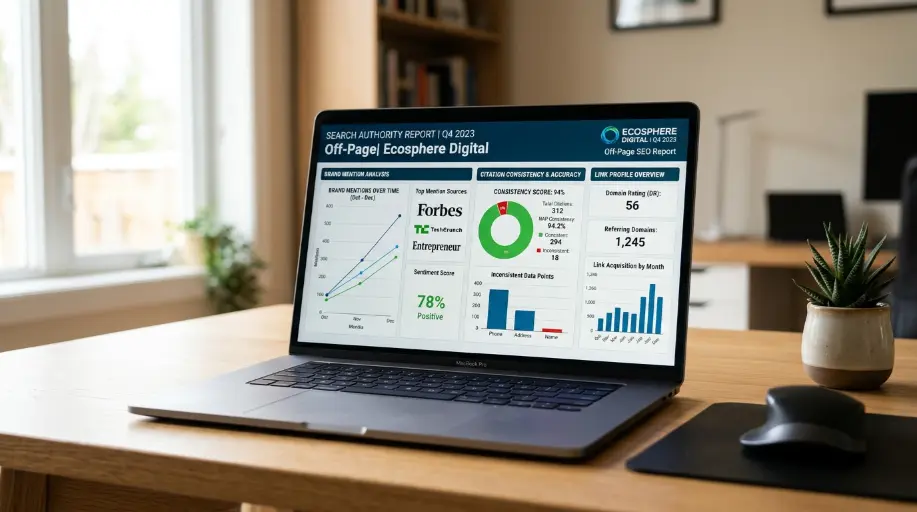
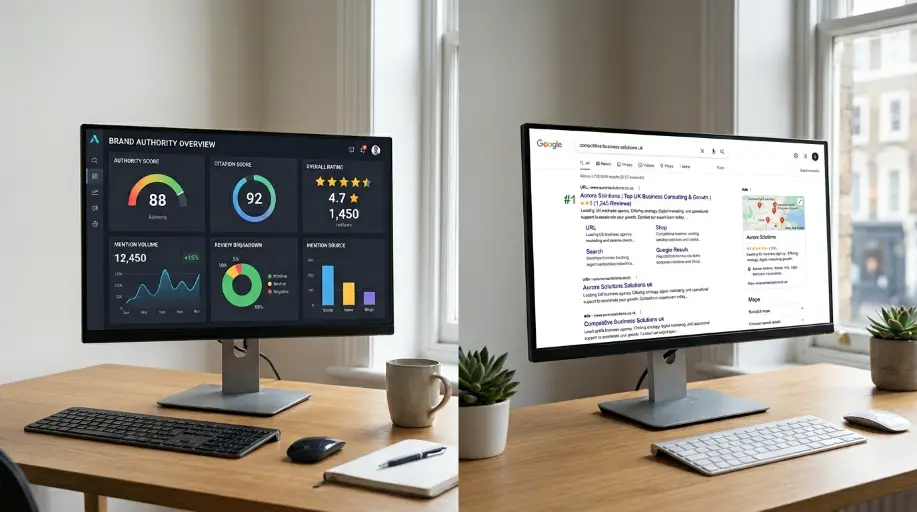
Google does not rank pages in isolation. It ranks them in the context of everything it knows about the domain they sit on and the brand behind it, and most of that comes from outside your website. The mentions, the citations, the reviews, the coverage. Those signals tell Google how much weight to give your content compared with everyone else competing for the same searches.
Webranko builds that authority for UK businesses. We cover the full range of signals that influence rankings, from local citation consistency and review strength to digital PR and brand mentions, so your on-page work finally has the foundation it needs to compete for the terms that matter to you.
What Off-Page SEO Actually Covers
Off-page SEO and link building often get used as if they mean the same thing. They don’t. Link building is one part of off-page work, and modern off-page SEO covers a much wider range of signals than links alone.
Brand Mentions and Digital PR
Every time your brand is mentioned on a credible, relevant website, Google registers it as a signal of your brand’s existence, relevance, and authority in your space. Links from those mentions pass authority straight to your domain, and even unlinked mentions help Google understand how prominent your brand is compared with competitors.
Our digital PR work builds these signals through targeted outreach to relevant UK publications, industry websites and sector platforms. We identify the sources that carry the most weight for your keyword targets and build a programme of activity that earns coverage month after month. We don’t blast out press releases and hope something sticks. Every pitch is aimed at the kind of coverage that moves rankings in your sector.
Local Citations and Directory Listings
For any business with a local or regional presence, citations are a foundational off-page signal. Google uses the consistency and volume of your business name, address and phone number across directories and platforms as a signal of legitimacy and local relevance. Businesses with accurate, consistent citations across relevant directories tend to outperform those with sparse or messy listings in local search.
The trouble is that most citation profiles have grown on their own over the years and are full of inconsistencies. Old addresses, wrong phone numbers, name variations, duplicate listings. Each one sends a mixed signal to Google and weakens the authority your citations should be building.
Our local citation management starts with a full audit of your existing profile. We correct inconsistencies, claim and optimise existing listings and build new citations across the directories and platforms that matter for your sector and location. Then we keep them accurate, because citations are not a one off fix.
Review Signals and Reputation
Reviews are among the most significant off-page signals for local businesses. The number of reviews you have, your average rating across platforms and how recent those reviews are all feed into Google’s local rankings. A business with 200 recent five star reviews will usually outrank an equivalent business with 30 reviews and a 3.8 average, all else being equal.
Beyond rankings, reviews shape how prospects see you the moment they find you in search. A strong review profile with thoughtful responses to both praise and criticism says more about your professionalism than any amount of website copy.
We set up review request processes that bring in a steady flow of reviews, manage responses across every platform that matters to you, and handle negative reviews carefully to protect both your reputation and your rankings. Every review we help generate comes from a real customer, with no incentives attached, in line with Google’s review policies and the UK’s rules on fake and incentivised reviews.
Why Off-Page Authority Is the Hardest Gap to Close Quickly
When you’re stuck below a competitor with similar or even weaker on-page SEO, the reason is usually simple. They have been building off-page authority for longer. Their citation profile is more established, they have picked up more brand mentions, their review count is higher, and their domain carries more of the trust signals Google has been measuring for years.
The good news is that the gap can be closed. The harder truth is that it takes steady effort over a long period. Off-page authority does not respond well to short bursts of activity followed by months of silence. It builds through regular work and compounds over time, which is exactly why businesses that stick with it end up with authority their competitors struggle to catch.
What About Toxic Links?
Low quality links pointing at a domain worry a lot of business owners, and most of the time they don’t need to. Google ignores the random spammy links every site picks up over time. The links that cause problems are those a business, or a previous agency, built on purpose. They may come from paid placements, link networks, or old link-building practices. These practices no longer meet Google’s guidelines.
Our authority audit separates the two. Where a past campaign has left a pattern of manipulative links, or there is a manual action in Search Console, we clean it up and manage the disavow file properly. Where there isn’t, we tell you so and spend the time building authority instead.
Off-Page SEO as Part of a Complete Strategy
Off-page SEO works best alongside strong on-page optimisation and solid technical foundations. Building authority on a site with serious on-page or technical problems is like building on unstable ground. The authority you earn has less effect than it should, because other issues are limiting what the domain can rank for.
We offer off-page SEO as a standalone service for businesses whose on-page foundations are already in good shape, and as part of a complete SEO engagement covering every layer together. When we take on a new off-page client, we always check the on-page and technical position first. If there are serious problems there, we’ll tell you plainly, because fixing them makes everything we do off-page work harder for you.
On-page content, technical health and off-page authority all support each other. Get all three right and the combined effect is far greater than any one could produce alone.
What Consistent Off-Page Work Produces Over Time
Businesses that invest in off-page SEO steadily for twelve to twenty four months end up in a very different competitive position from those that don’t. Their citation profiles are clean and growing. Their review counts are high and their ratings strong. Their brands turn up regularly in relevant publications and industry sources. And their domains carry real authority, so every new page they publish ranks more easily.
That’s what our off-page SEO builds for UK businesses. Quick wins tend to vanish with the next algorithm update. A solid authority profile keeps compounding and gets harder for competitors to match every month.
Let’s Look at Your Off-Page Authority Profile
If your rankings have stalled despite solid on-page work, the answer is very likely in your off-page authority profile. Knowing exactly where you stand against the competitors above you is the starting point for closing that gap.
We work with businesses across the UK on off-page SEO. We’ll give you a straight assessment of your current authority profile, where the gaps are against your competitors, and what a realistic off-page programme looks like for your situation. Then we’ll have an honest conversation about your rankings and what it will take to move them.