

Skip to content
SEO Services

Shopify SEO Agency UK: Stores That Get Found And Keep Selling

Shopify makes it easy to launch a store, and that is exactly why so many UK stores look identical to search engines. Same theme structure, same supplier descriptions, same thin collection pages. Ranking takes more than a tidy install. We work inside Shopify properly, fixing collection page content, product descriptions, structured data, filtered URLs and app bloat, so your store earns visibility for the products you actually sell. Our approach sits alongside broader ecommerce SEO and technical SEO, but every fix is made with Shopify's own limits and tools in mind.
No lock-in contracts UK-based specialists Core Web Vitals certified
Web Ranko team working on SEO Services
Built around how Shopify actually works

The Foundation

Why Shopify stores stall in search, and what usually causes it

Shopify handles a lot of the technical basics for you. You get SSL, an automatic sitemap, canonical tags and mobile friendly themes from day one. What it cannot do is write your collection copy, choose your keywords or decide which pages deserve to rank. Most stores we audit have a sound technical base and then lose ground on the things nobody owns. Collection pages carry one line of text. Product pages reuse the supplier description. Tag pages and filters create thin URLs no one has checked. Each issue looks small on its own, and together they hold a store back.

The second pattern is the app stack. Every review widget, popup and upsell tool adds scripts, and mobile speed suffers quietly over the months. We start by working out where your organic revenue really comes from, usually a handful of collections and a long tail of products, then fix those first. That means proper keyword research mapped to collections, rewritten copy, product schema that matches live prices and stock, and a theme and app review focused on speed. Effort goes where it earns the most return.

Stores with strong products but collection pages that never reach page one
Product pages using the same supplier description as competing retailers
Tag, vendor and filter pages creating thin or duplicate URLs
Stores slowed down by apps, heavy themes and oversized images
Businesses moving to Shopify who need rankings protected through the migration
Web Ranko SEO Services specialist at work

Common issues we fix

Collection pages with thin or missing descriptive content High
Product descriptions copied from suppliers or manufacturers High
Tag pages and filter URLs left unchecked High
Product schema missing, incomplete or out of sync with live data High
Slow mobile speed caused by apps, sliders and large images High
Old URLs left without proper redirects after a restructure High
Out of stock and discontinued products handled inconsistently High
Product feed and Merchant Center data not matching page content High

What's Included

What's Included in SEO Services

A comprehensive, senior-led service — not a checklist handed to a junior. Here's exactly what you get.

Full Shopify Store Audit

We review your collections, products, navigation, theme and apps together, so you see exactly which issues are costing you rankings and in what order to fix them.

  • Collection and product page review against current search intent
  • Tag, vendor and filter URL check for thin or duplicate pages
  • Theme and app impact on page speed reviewed
  • Priority list built around your highest revenue collections

Collection and Product Content

We rewrite thin collection copy and duplicated product descriptions around how UK shoppers actually search, giving Google a real reason to rank your pages over near identical competitors.

  • Collection content written around genuine buying intent
  • Product descriptions rewritten where supplier copy is duplicated
  • Internal links added between related collections and products
  • Titles and meta descriptions rewritten at scale with clear templates

Product Schema and Structured Data

We check the structured data your theme outputs and improve it where needed, so price, availability and reviews are accurate and eligible for rich results. Our schema markup work is tested before and after every change.

  • Product schema checked against live price and stock data
  • Validated in Google's Rich Results Test before and after changes
  • Review and rating markup set up where reviews genuinely exist
  • Breadcrumb and organisation markup reviewed

Technical SEO and Site Speed

We fix the technical issues that quietly hold Shopify stores back, from app bloat and oversized images to redirect chains and crawl waste, including careful robots.txt changes where they help.

  • Core Web Vitals reviewed on collection and product templates
  • Unused apps and scripts identified and removed or deferred
  • Redirects, canonicals and robots.txt rules reviewed
  • Sitemap checked against your live product range

Keyword Mapping and Store Structure

We map keywords to collections and products so every page has a clear job, then adjust your navigation and collection structure to match how customers search and browse.

  • Keyword research across collections, brands and long tail products
  • One clear target per page, with no pages competing against each other
  • Collection hierarchy and menus reviewed for depth and clarity
  • New collection opportunities identified from search demand

Ongoing Shopify SEO Support

Catalogues change constantly, with new products, seasonal ranges and discontinued lines. We check your store regularly so growth and housekeeping do not quietly undo rankings you have already earned.

  • Regular review of impressions, clicks and indexing reports
  • New products and collections checked for SEO consistency
  • Discontinued and out of stock pages managed with a clear rule
  • Simple monthly summary tied to organic revenue

Why It Matters

Why UK Retailers Choose Webranko for Shopify SEO

Generic ecommerce advice only gets a Shopify store so far. We work with the platform's own tools and limits, and we focus on the collections and products that actually drive your revenue, rather than spreading effort thinly across every page in the catalogue.

Web Ranko SEO team collaborating
Get a free SEO Services audit

Built Around Shopify, Not Generic Ecommerce

We work with Liquid themes, collection structures and the app stack properly, instead of giving advice written for a different platform.

Content That Sells as Well as Ranks

Collection and product copy is written to help shoppers decide, which supports both rankings and conversion.

Revenue Led Priorities

We start with the collections and products that bring in money, so early effort pays back quickly.

Speed Without Losing Features

We remove what is slowing your store down without stripping out the tools your business relies on, and our own developers make the theme changes so nothing waits on a third party.

Support That Keeps Pace With Your Range

We keep checking as your catalogue changes, so new lines and retired products never create hidden problems.

How We Work

How Webranko Handles Shopify SEO

A clear process that starts with what is already earning revenue, then fixes the issues holding your best pages back.

Web Ranko technical SEO team collaborating
Senior-only team. No junior handoffs.
Days 1 to 3

Store and Revenue Audit

We review your collections, products, theme, apps and search data, and identify where your organic revenue comes from today.

Week 1 to 2

Keyword Mapping and Structure

Keywords are mapped to collections and products, and any overlapping or missing pages are identified.

Week 2 to 4

Content and Schema Build

Collection content, product descriptions, titles and structured data are written and implemented, starting with your highest value pages.

Week 3 to 5

Technical and Speed Fixes

Apps, scripts, images, redirects and crawl rules are corrected, then tested on real collection and product templates.

Ongoing

Monitoring and Reporting

Performance is tracked against organic revenue, with regular checks as your catalogue and the platform change.

Real Results

Why Our Shopify Audits Go Deeper

5 Stage process from audit to ongoing monitoring
3-6 Months for content led gains on competitive collections
4.9 Rated Excellent Verified Google Reviews Scan to Review

Our Shopify store had plenty of products, but organic traffic wasn’t translating into sales. Webranko fixed the technical SEO issues, improved our collection-page structure and helped us target the right commercial keywords. We started seeing consistent growth in organic traffic and search-driven orders within a few months.

Sophie Grant Founder, a UK Shopify store

In-Depth Guide

The Complete Guide to SEO Services

Our specialists have written a comprehensive guide covering strategy, best practices, and the exact approaches we use for our clients.

Launching on Shopify takes an afternoon. Ranking takes rather longer. That gap catches out a lot of UK store owners, who expect search traffic to arrive once the theme is live and the products are uploaded.

It rarely does, and the reason isn’t mysterious. Shopify handles the plumbing well, but thousands of other stores use the same themes, the same apps and often the same supplier descriptions. To Google, many of them look alike. Standing out is the real job, and it’s where we spend our time.

What Shopify Handles For You, And What It Doesn’t

Shopify gives you a sound base. You get SSL, an automatic sitemap, canonical tags and mobile friendly themes from day one. What it can’t do is think for you.

Area What Shopify Does What Still Needs Attention
Security and mobile SSL and responsive themes included Speed on real phones
Sitemap and canonicals Generated automatically Tag, vendor and filter pages
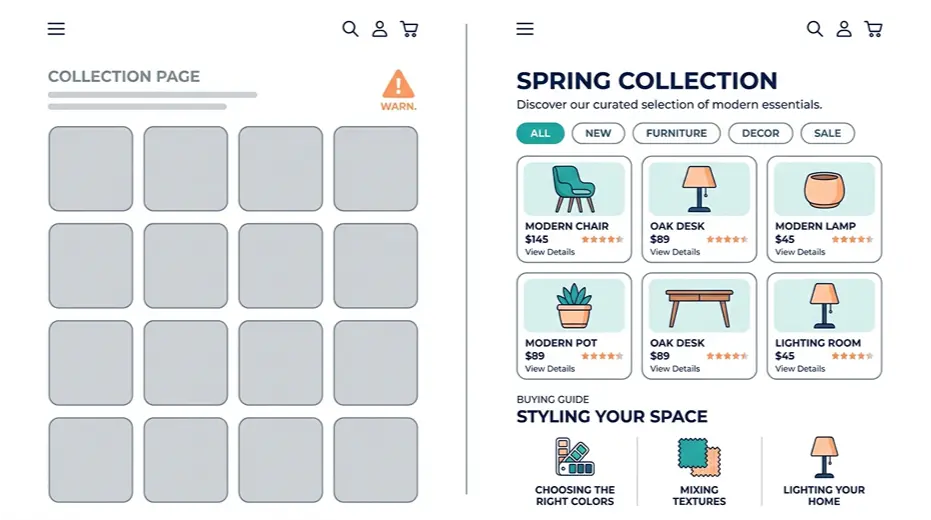
Collection pages A page exists for every collection Useful copy and clear structure
Product pages A template and editable fields Original descriptions and accurate schema

Look at the right hand column and you’ll see where most stores lose ground.

Collection Pages Bring In The Broad Searches

Think about how people shop. They search for a general need first, such as running shoes or scented candles, then narrow things down. Collection pages catch those broad searches, and for most stores they earn far more organic revenue than individual products do.

Yet the typical collection page has a single sentence of text above a grid of products. Google has very little to work with, and so does the shopper. A strong collection page usually includes several things.

  • A short opening paragraph explaining what the range covers and who it suits
  • Clear headings for the main ways people choose, such as size, use or budget
  • Links to closely related collections and popular products
  • Helpful buying advice placed below the products, so it never pushes them down the page
  • A title and description written for a real search, not filled in by a default template

We start with your five or ten highest earning collections. Fixing those first tends to pay back faster than spreading effort across the whole catalogue.

Thin Pages Sneak In Through Tags And Filters

Shopify lets a product appear under several collection paths, and it adds a canonical tag pointing to the main product URL. That handles most duplication neatly. Many themes still link to the collection path version internally though, which sends Google a mixed signal. We fix that in the theme so every internal link points at the main product URL.

Tag pages, vendor pages and filtered views are a different story. Left alone, they can produce dozens of thin pages with almost nothing on them. Some deserve to rank, because a search for waterproof walking boots might match a filtered page. Most don’t. We decide which ones earn a place, then use canonicals, noindex rules or careful robots.txt changes to handle the rest. A wrong rule can block pages you want crawled, so we test every change before it goes live.

Apps Are Usually Why Mobile Speed Suffers

Ask a store owner why their site feels slow and they’ll often blame Shopify itself. In our audits the cause is usually the app stack. A review widget here, a popup there, an upsell tool nobody remembers installing.

Each one loads its own scripts, and mobile speed slips a little more every month. We go through every app and ask whether it earns its place. Unused apps get removed, and leftover code gets cleaned out, because uninstalling an app doesn’t always delete what it added to your theme. Where a theme needs deeper changes, our Shopify development services team can build the feature properly instead of stacking another app on top.

Product Data Should Match What Shoppers See

Structured data tells Google your price, availability and review scores. It only helps when it’s accurate. We’ve seen products sell out for weeks while the markup still said in stock, which sends shoppers to a dead end and wastes the click.

We check your markup against live store data, then test it in Google’s Rich Results Test before and after each change. If you use Google Merchant Center, your product feed should match the page as well. Mismatched prices are one of the quickest ways to get products disapproved.

Moving To Shopify Needs A Plan

Migrations are where rankings often vanish. URLs change, titles get rewritten and old pages disappear with no redirect. Before launch, we map every old URL to its new home and keep the copy that already performs. That way months of hard won visibility don’t drop away in a weekend.

What Realistic Progress Looks Like

We won’t promise overnight jumps, because nobody honest can. Technical and schema fixes can show movement within a few weeks. Content led gains on competitive collection terms usually take three to six months, depending on your competition and how much needs improving at the start.

What you can expect is a clear order of work, plain reporting tied to organic revenue, and a store that’s easier for shoppers and search engines to understand with every month we work together.

FAQ

SEO Services questions, answered honestly

Questions UK retailers ask us most before starting a Shopify SEO project.

Ask us anything
Is Shopify good for SEO?

Yes. Shopify handles many technical basics automatically, including SSL, sitemaps, canonical tags and mobile friendly themes. Rankings still depend on keyword targeting, collection page content, product descriptions and site speed, which are the areas most stores neglect and where focused SEO work makes the biggest difference.

Why does Shopify create duplicate URLs?

Shopify lets products appear under collection paths as well as the main product URL. It adds canonical tags pointing to the main version, which handles most duplication. Tag pages, vendor pages and filter parameters still need checking, because they can create thin or near identical pages.

Can I edit robots.txt on Shopify?

Yes. Shopify supports a robots.txt.liquid template in the theme, so you can add rules or block specific paths. It needs care, since a wrong rule can stop important pages being crawled. We review any changes against your collections, filters and search pages first.

Do Shopify apps slow my store down?

Often, yes. Many apps load their own scripts on every page, even where they are not needed. Reviewing which apps earn their place, removing unused ones and deferring the rest usually improves mobile speed without changing your design or losing features that matter.

How long does Shopify SEO take to show results?

Technical and schema fixes can show movement within a few weeks. Content led gains on competitive collection terms usually take three to six months, depending on your competition, catalogue size and how much needs improving at the start. Ongoing monitoring helps protect those gains as your range changes.

How much does Shopify SEO cost

It depends on how many collections and products need work, how many apps are installed, and whether you need a one off fix or ongoing support as your range changes. A store with a few dozen products is a different job to one running thousands of SKUs across many collections. Projects start from £399, and we quote a fixed price after the free store audit, so you know the number before committing.

Start today

Stop Letting a Good Store Sit Behind Weaker Competitors

Every month your collections stay thin and your product data stays unchecked is revenue a better configured competitor is picking up instead. Let's see what your store is missing.

What's in your free audit

Delivered in 48 hours by a senior specialist.

Full review of your collections, products, apps and theme
Product schema and structured data check against live store data
Priority list built around your highest revenue collections
No lock in contract, support scales with the size of your catalogue