


In-Depth Guide
The Complete Guide to SEO Services
Our specialists have written a comprehensive guide covering strategy, best practices, and the exact approaches we use for our clients.
Ask a fifteen year old how they searched for a restaurant last weekend and there’s a decent chance they’ll say TikTok before Google. That shift has happened quietly, and most UK businesses still haven’t noticed it’s changed how they need to think about visibility on the platform entirely.
TikTok isn’t just a place to chase views anymore. It’s become a genuine search engine for a huge slice of younger UK audiences, who type queries into that search bar the same way older users type into Google. Post trend driven content with zero thought for keywords and you might rack up views for a day. You won’t show up when someone actually searches for what you offer three weeks later.
Why Views and Search Visibility Are Two Different Things
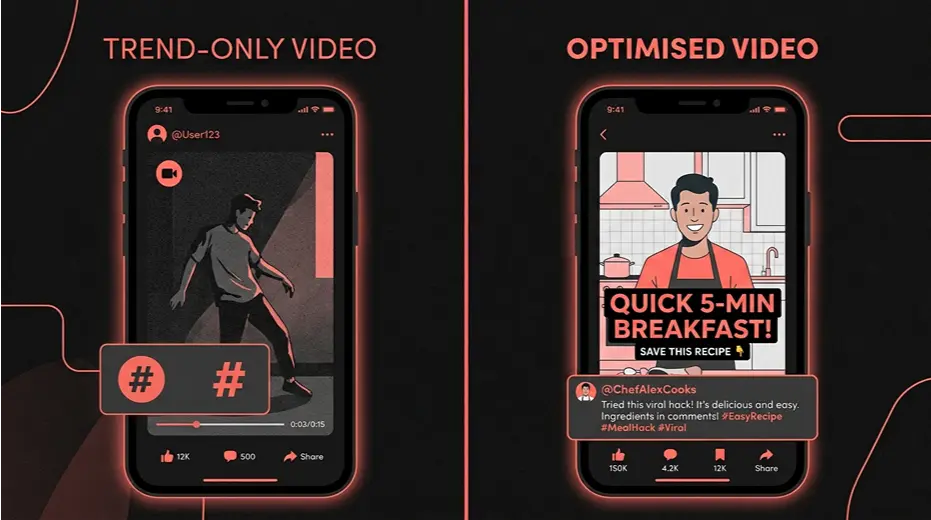
Here’s the distinction most businesses miss completely. The For You feed rewards watch time, shares and how well a video performs against the algorithm’s short term interest signals. TikTok search works differently. It reads captions, on screen text, spoken keywords in the audio, and hashtags to work out relevance, applying much the same logic behind how a page earns its ranking on Google, then weighs completion rate and engagement to decide where that content sits once relevance is established.
A video can perform brilliantly in the feed and still be completely invisible to search. No keywords in the caption. Nothing spoken that TikTok can pick up as relevant. No on screen text reinforcing what the video is actually about. That video gets its moment, then disappears, while a properly structured video keeps quietly surfacing in search for months afterwards.
Feed Performance Versus Search Visibility
| Element | Optimised for Feed Only | Optimised for Search Too |
|---|---|---|
| Caption | Trending hashtags, no keywords | Built around a real search phrase |
| On screen text | Minimal or decorative | Reinforces spoken and written keywords |
| Spoken content | Not considered searchable | Treated as genuine keyword content |
| Content lifespan | Fades within days | Keeps surfacing for months |
Most accounts we audit are optimised entirely for that left column, chasing trends without ever building the search layer underneath.
Spoken Words Matter More Than Most Businesses Realise
This is the part that genuinely surprises clients. TikTok can read what’s said out loud in a video, not just what’s typed in the caption. That means the actual words spoken in your content carry search weight, which changes how a video script should be planned from the start.
Saying your service name and location clearly within the first few seconds, rather than leaving it to a caption nobody reads properly, gives TikTok far more to work with when deciding what your video is actually about. Combine that with on screen text repeating the same core phrase, and a single video can end up covering several distinct search angles rather than relying on one hashtag doing all the work.
Trend Chasing Alone Leaves Long Term Visibility on the Table
Trends bring reach. They rarely bring lasting search visibility, because a trending sound has a shelf life measured in days, not months. Building a content strategy purely around whatever’s trending this week means starting from zero again every single week.
The stronger approach treats TikTok the same way a proper content strategy treats a website, organising videos around core topics your actual audience searches for, then layering trend participation on top rather than letting trends define the entire account. Fewer, better structured videos built around genuine search intent tend to outperform a constant stream of reactive trend content once you look past the first week of views.
Product Businesses Have a Genuine Opportunity Here
TikTok Shop and product tagging have opened up real commercial search behaviour on the platform, and ecommerce businesses that get this right tend to see it pay off quickly. A video with properly tagged products and a clear spoken description of what’s being sold gives TikTok’s search far more to work with than a purely aesthetic clip.
This overlaps directly with wider ecommerce SEO work too. Product pages built with clear structured descriptions give TikTok Shop integrations more accurate data to pull from, and keeping product naming and keywords consistent between your website and your TikTok catalogue avoids the kind of mismatch that quietly confuses search relevance on both platforms.
Getting the underlying keyword targeting right matters just as much here as it does on Pinterest or Google. TikTok search phrasing tends to be more conversational and question based than typed search elsewhere, and building content around that specific behaviour, rather than reusing keywords lifted straight from a keyword research spreadsheet built for Google, is usually where the real search visibility comes from.
Seasonal Timing Still Applies, Just on a Faster Clock
Unlike Pinterest, where seasonal search can build months in advance, TikTok’s seasonal window tends to move faster, often building in the weeks rather than months before a major UK shopping period or event. Publish seasonal content the day an event starts and you’ve likely missed the window where search interest was actually climbing.
Planning content two to four weeks ahead of key dates, rather than reacting on the day, gives videos enough runway to start surfacing in search before demand peaks rather than after it’s already passed.
What Changes Once the Search Layer Gets Built Properly
None of this asks a business to abandon what already works on TikTok. It asks for captions and on screen text built around real search phrasing, spoken content planned with keywords in mind from the first few seconds, product tagging set up properly where relevant, and a content strategy that treats search topics as seriously as trend participation.
We see accounts every month with strong view counts and almost no search visibility to show for it. The content wasn’t weak. The search layer underneath it simply never existed. Build that layer properly, and videos that would have disappeared after a single trend cycle start quietly surfacing for anyone actively searching for exactly what that business offers, weeks or months after the original post.