


In-Depth Guide
The Complete Guide to Education Marketing
Our team has written a comprehensive guide covering technical specs, best practices, and the exact approaches we use on every project.
Ask any training provider what their biggest frustration is, and you’ll hear some version of the same thing. Applications trickle in slowly for weeks, then suddenly flood in during the final few days before a deadline, by which point half the available places have already gone to whoever happened to search and find them first.
We’ve worked with enough colleges and training providers now to understand why this happens. It’s rarely about the quality of the course. It’s almost always about when the website actually became visible in search results relative to when people were searching for it.
Education Sector SEO: The Direct Answer
Here’s what UK training providers need to understand before building or optimising a course website.
| Question | Answer |
|---|---|
| Why does timing matter so much in this sector? | Course pages need to rank before enrolment closes, since visibility afterwards has little value |
| Should every course have a separate page? | Yes, generic listings rarely satisfy specific searches for named qualifications |
| What builds trust fastest with prospective students? | Clear accreditation and awarding body recognition, shown prominently |
| Does location affect course search behaviour? | Yes, for in-person delivery, many searches include a specific town or region |
| Are funded course searches different? | Yes, they use specific terminology that needs reflecting accurately in content |
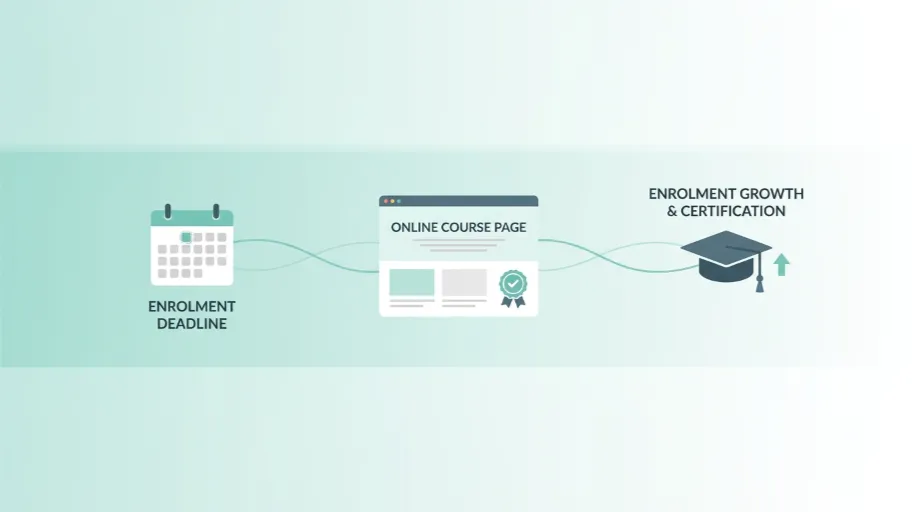
| How far ahead should SEO work start? | Several weeks before the enrolment window opens, not once it’s already live |
That last row matters more than most providers realise. Search rankings don’t improve overnight, so content optimised the week enrolment opens is usually too late to make a meaningful difference to that particular cohort.
Why Enrolment Timing Changes the Whole Approach
In our testing across education sector clients, the pattern shows up consistently. A course page published or updated right as enrolment opens takes weeks to gain any real search visibility, by which point a meaningful share of the available places have often already filled through other channels, referrals, funding body listings, or word of mouth.
We worked with a skills academy in the East Midlands. Their enrolment pattern followed this shape term after term. It was a slow trickle, then a last-minute scramble.
We reviewed their search visibility in detail. Their course pages were not ranking for relevant terms early enough. They only ranked well after each enrolment window had opened. This meant organic search traffic arrived too late. It did not help fill the cohort in a steady way.
We rebuilt the content and improved the timing. We started optimisation work several weeks before the next term opened. This changed their enrolment curve in a clear way. Applications arrived earlier, not all in a final rush.
What Course Pages Actually Need to Get Right
Getting this right takes more than publishing a course description and hoping it ranks eventually.
- Course-specific pages built around one qualification each, since a shared generic listing rarely satisfies a search for a named course
- Accreditation shown clearly, since prospective students and their employers check awarding body recognition before committing time and money
- Funding and eligibility explained plainly, avoiding jargon that confuses someone trying to work out whether a course is genuinely free or funded for them
- Genuine outcomes and progression routes, answering what actually happens after completing the course, not just what the course covers
- Content timed ahead of enrolment, published and optimised with enough lead time to actually rank before the window that matters
- Simple application paths, since a confusing enquiry process loses interested prospective students regardless of how well the course page ranks
Miss the timing piece specifically, and even a well-written course page ends up ranking for the wrong term entirely, arriving just in time to be useful for the next cohort instead of the current one.
Building Genuine Local Visibility for In-Person Courses
Plenty of courses are delivered in person at a specific site. This makes location a real factor in how prospective students search. Someone looking for a course nearby behaves quite differently. This differs from someone searching for content they would complete entirely online.
Our local SEO work covers exactly this kind of location-driven visibility, making sure a provider actually appears for searches from prospective students within reach of where a course is genuinely delivered, rather than losing that visibility to competitors covering the same region with a stronger local search presence.
Making Sure Each Course Page Actually Satisfies the Search
Beyond location and timing, the content itself needs to genuinely answer what someone is looking for before they apply, covering entry requirements, what the course actually involves, and where it leads afterwards. A vague overview rarely works as well as a page built around the real questions a prospective student asks. Our on-page SEO team handles exactly this, structuring and optimising course content properly so it satisfies genuine search intent rather than reading like a brochure copied from a prospectus.
Finding Out Where the Real Gaps Are
A lot of providers we speak to know something isn’t working without being entirely sure what. Enrolment numbers feel inconsistent, a competing provider always seems to rank above them for the same courses, or a website redesign a few years back never delivered the improvement that was promised.
That’s precisely what a proper technical review uncovers. A full SEO audit reviews a site step by step. It checks crawl errors and page speed. It also checks if course content is well structured. It checks if content timing matches search intent and your enrolment calendar. This shows what is holding visibility back before fixes start.
What This Means Going Forward
Enrolment cycles repeat every term, which means the timing problem never solves itself permanently. A provider that gets ahead of one deadline still needs the same discipline applied to the next one and the one after that.
The providers that see real benefit are almost always the ones that stopped treating their website like a brochure. They no longer see it as something you set up once and forget. Instead, they treat it as something that needs planning on real calendar dates. That change, more than any single design tweak, usually breaks the pattern. It stops the last-minute scramble for applications each term.