
In-Depth Guide
The Complete Guide to Web Development
Our team has written a comprehensive guide covering technical specs, best practices, and the exact approaches we use on every project.
Some businesses reach a point where WordPress and off the shelf plugins simply can’t do what’s needed anymore. A booking system with genuinely complex logic, a customer portal tied into internal stock data, a SaaS product that needs to scale to thousands of users. That’s a different job entirely, and it’s one most web agencies quietly avoid because it requires actual software engineering, not template customisation.
We work with UK businesses at exactly that point, building applications from the ground up rather than stretching a CMS beyond what it was ever designed to do.
What Counts as a Custom Web Application
A custom web application is one that is built from the ground up for a business process rather than being put together using pre-existing plugins or a theme. Conceive of internal dashboards, booking and scheduling platforms, customer portals with login access, or full SaaS products sold to other businesses. Everything from user authentication to your website’s database structure will be tailored to your exact requirements from day one.
When a Custom Build Actually Makes Sense
Not every project needs this level of engineering, and we’ll say so honestly during scoping rather than upselling unnecessary work.
- Your process involves complex logic that no existing plugin handles properly
- You need to scale to a large number of concurrent users
- Sensitive data requires custom authentication and permission structures
- You’re building a product to sell, not just a website to inform
A client came to us last year trying to force a multi vendor marketplace onto WooCommerce. It technically worked, barely, but every new vendor feature meant fighting against plugin conflicts. Six months into a custom rebuild, that friction disappeared entirely because the platform was designed for exactly what the business needed rather than adapted from something else.
Custom Application vs WordPress or WooCommerce: Choosing the Right Path
| Factor | Custom Web Application | WordPress or WooCommerce |
|---|---|---|
| Best suited to | Complex logic, SaaS, internal tools | Content sites, standard ecommerce |
| Development timeline | Longer, built from scratch | Faster, built on existing framework |
| Long-term flexibility | Fully bespoke, no plugin limits | Limited by plugin and theme constraints |
| Typical cost | Higher upfront investment | Lower upfront investment |
| Scaling large user bases | Built for it from the architecture stage | Can struggle without significant optimisation |
If your project fits comfortably within what a well-built WordPress site or WooCommerce store can handle, that’s genuinely the better route, both on cost and time to launch. Our WordPress Development Agency and WooCommerce development agency teams handle that end of things. Custom development is for the projects that have already outgrown that approach or were never going to fit it in the first place.
The Technical Foundations We Build On
API Development
Most custom applications need to talk to other systems, payment providers, CRMs, third party data sources. We build APIs designed around exactly what your application needs to send and receive, rather than forcing data through a generic integration that half fits.
Database Architecture
Get this wrong early and every feature added afterwards becomes harder to build. We plan database structure around how the application will actually be used at scale, not just what looks tidy during initial development.
User Authentication Systems
Login, permissions, and access control get built specifically around your user types, whether that’s a simple customer login or a multi tier system with different permission levels for staff, admins, and clients.
Cloud Hosting for Web Apps
A custom application needs infrastructure that can scale with it. We set up cloud hosting appropriate to expected load, with room to grow rather than needing a full rebuild the moment traffic increases.
What Development Actually Looks Like
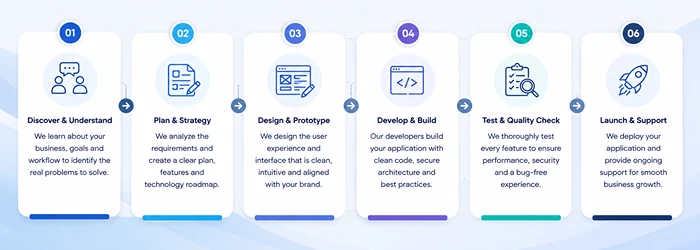
Custom builds move in stages, and skipping any of them tends to cause expensive problems later.
- Requirements mapping, understanding the actual business process before writing a line of code
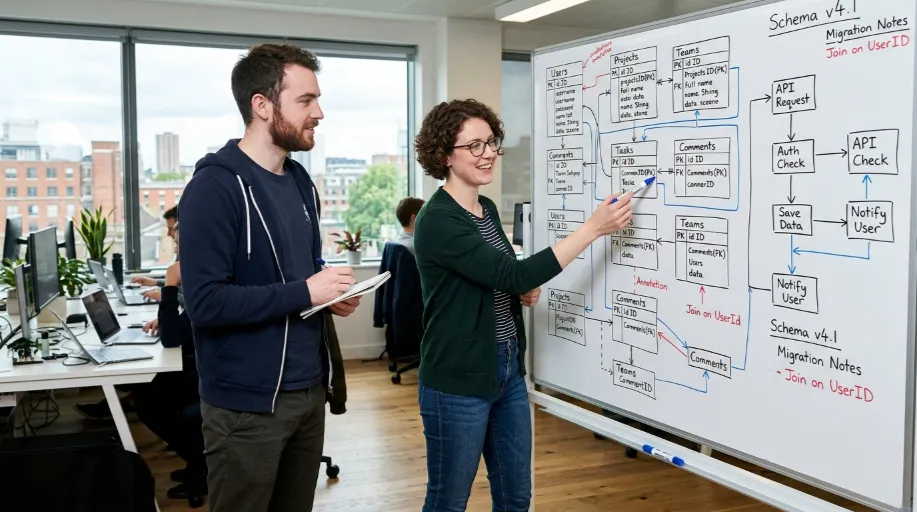
- Technical architecture planning, database structure, API needs, hosting requirements
- Development in phases, with working versions to review rather than one long build with no visibility
- Testing under realistic load, not just functional testing on a handful of test accounts
- Launch and ongoing support as the application and its user base grow
Try Our Build Complexity Estimator
We’re building a brief interactive tool where you can fill in a few questions about your expected features, user numbers and integrations. It would provide a rough sense of whether your project lends itself to the standard WordPress approach or really requires custom development, along with an estimate of scope. The initial call barrage doesn’t happen. Business owners start off with a realistic measure of their marketing, before any consultation.
Cost and Timeline Honesty
Custom web application development costs more upfront than a WordPress build, and takes longer. There’s no getting around that, and any agency telling you otherwise is either underscoping the project or planning to cut corners on testing. What you’re paying for is software built specifically around your business, with no plugin conflicts, no licence renewals for features you don’t fully control, and genuine capacity to scale as the business grows.
For businesses weighing this decision, the honest starting point is usually working out whether the complexity is real or assumed. Plenty of projects that sound like they need custom development actually fit comfortably within what Webranko can already deliver through WordPress and WooCommerce, at a fraction of the cost and timeline.