


In-Depth Guide
The Complete Guide to SEO Services
Our specialists have written a comprehensive guide covering strategy, best practices, and the exact approaches we use for our clients.
Why Most UK Content Marketing Produces Very Little
Publishing content is not a content strategy. That distinction sounds obvious, but it is the reason most UK businesses with active blogs, regularly updated service pages and well-written articles still cannot rank for the terms that would actually move their revenue.
Content without architecture is just noise in an already crowded search landscape. If you are looking for a content strategy agency UK businesses can rely on to build genuine organic authority rather than just fill a content calendar, the difference comes down to one thing. Whether the agency understands how Google actually evaluates topical depth in 2026 and builds your content around that understanding rather than around publishing frequency and word counts.
Webranko builds content strategies that start with architecture. The topics, the relationships between them, the gaps in your current coverage and the internal structure that turns individual pieces into a compounding authority system. Everything else follows from that. And that is the foundation of advanced Answer Engine Optimization services that deliver lasting visibility.
What a Proper SEO Content Strategy Actually Involves
The Difference Between Content and Content Architecture
There is a meaningful difference between having content and having a content architecture. Most UK businesses have the former without realising they are missing the latter.
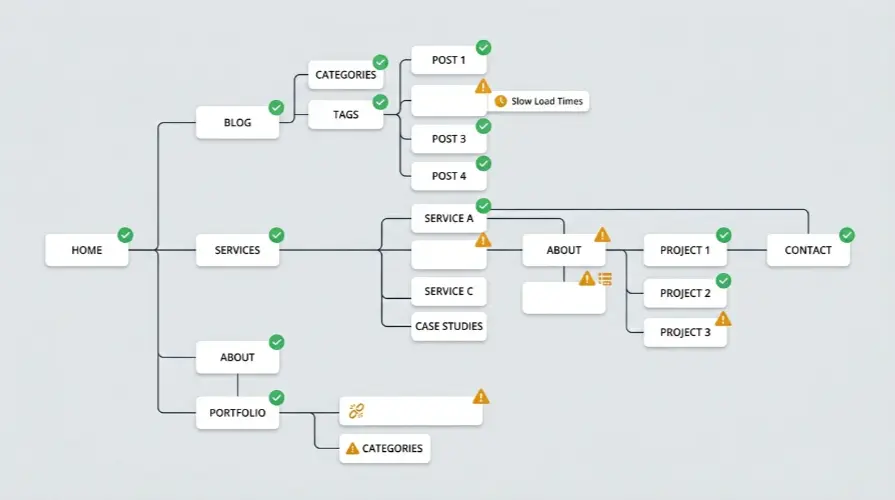
A content architecture is a deliberate structure that assigns every topic your audience searches for to a specific page type with a specific role in your overall organic authority system. Pillar pages cover broad head terms comprehensively. Cluster content covers every related subtopic in depth. The internal linking between them signals to Google that your site is not just one page about a subject but the most complete resource on it. That signal is what produces topical authority, and topical authority is what produces competitive national rankings in 2026.
Without that architecture you can publish fifty blog posts on related topics and rank for none of them at scale because Google sees disconnected individual pages rather than a coherent subject matter authority.
What Topical Authority Means in Practice
Topical authority is the concept that Google evaluates not just individual pages but whether a site covers a subject area comprehensively enough to be considered a genuinely authoritative resource. A site with one well-written article on a topic will consistently lose to a site that covers every angle of that topic in depth across a structured network of connected pages.
Building topical authority requires identifying the full range of questions, concerns and search terms your target audience uses across every stage of their decision-making process and then producing content that addresses each of them clearly, with every piece connected to the others through a deliberate internal linking structure.
SEO success for charity organizations comes down to getting the fundamentals right. Done properly this creates a compounding effect. Each new cluster piece strengthens the pillar page it connects to. Each improvement to your internal linking passes more authority to the pages that need it. The more comprehensively you cover a topic, the harder your positions become to displace.
Content Gap Analysis — Finding What Your Site Is Missing
Why Gap Analysis Comes Before Strategy
Most content strategies are built around what the business wants to publish rather than what the audience is searching for and what competitors are already covering. The result is a content plan that feels productive but generates very little organic movement because it does not address the specific gaps in your market’s search coverage.
A proper content gap analysis starts from the keyword data. We map every relevant search term in your market, identify which ones your site currently has coverage for, which ones competitors are ranking for that you are not and which ones nobody in your market is covering well. That third category is where the fastest organic gains come from because you are competing for positions that are genuinely available rather than trying to displace well-established pages on their best terms.
Competitor Content Benchmarking
Understanding what your competitors are ranking for is as important as understanding what your own site is missing. A content gap analysis at Webranko includes a structured competitor benchmarking exercise that maps the specific topics, page types and content depths your main organic competitors have that your site does not.
This is not about copying competitor content. It is about identifying the coverage floor your market has established and making sure your strategy builds beyond it rather than just matching it. The sites that dominate organic search in a given market are almost always the ones whose content architecture is more comprehensive than every competitor’s, not just slightly better optimised on individual pages.
The Pillar and Cluster Framework
How Pillar Pages Work
A pillar page is a comprehensive piece of content that covers a broad topic area in enough depth to serve as the authoritative resource on that subject for your site. It targets a high-volume head term and is structured to answer the full range of questions a reader might have on the topic while making it clear that deeper coverage exists across the cluster content connected to it.
The pillar page does not try to answer every question exhaustively. It answers them sufficiently and signals through its internal linking structure that more detailed treatment of each subtopic is available on the relevant cluster pages. That structure is what tells Google the pillar page is backed by genuine topical depth rather than just being a long article.
How Cluster Content Supports Pillar Authority
Cluster content pages are the individual subtopic pieces that surround a pillar page. Each one covers a specific aspect of the broader topic in genuine depth, targets a more specific keyword and links back to the pillar page it belongs to. The relationship is bidirectional because the pillar page also links to each cluster piece.
This bidirectional linking structure creates a topic cluster that Google can recognise as a coherent subject matter system. The pillar page accumulates authority from every cluster piece connected to it. Each cluster piece benefits from the domain-level authority the pillar page holds. The system compounds in a way that individual unconnected pages simply cannot replicate.
Internal Linking as an Authority Distribution System
Internal linking is one of the most undervalued elements of a content strategy and one of the most consistently mismanaged on UK business sites. Most sites link content organically as new pieces are published without any deliberate plan for where authority should flow and why.
A properly designed internal linking strategy treats every link as a deliberate authority signal. High equity pages link to the commercial pages that need authority. Cluster content links to the pillar pages that anchor the topic. Supporting content links to the primary conversion pages in the most relevant context. None of this happens naturally without a plan behind it.
Webranko designs internal linking architecture as a core component of every content strategy because no amount of well-written content can realize its full organic potential without the authority-distribution structure that connects it.
What Our Content Strategy Services Include
| Service Component | What It Delivers |
|---|---|
| Content and SEO audit | Baseline assessment of existing content against keyword opportunities |
| Content gap analysis | Identification of topics competitors rank for that your site does not cover |
| Keyword architecture | Full topic map with intent classification and page type assignment |
| Pillar and cluster planning | Comprehensive content structure with internal linking design |
| Content calendar | Strategic publishing plan mapped to topical architecture |
| Content production | Brief-led content created to exact topical authority specifications |
| Internal linking strategy | Authority distribution plan across all content and commercial pages |
| Monthly reporting | Ranking, traffic and commercial performance tracking |
Your competitors are building topical authority right now across every keyword cluster in your market. Every month without a structured content strategy is a month that the gap widens. Webranko works with UK businesses that are ready to close it systematically, starting with a strategy that is built around how organic search actually works rather than how often you can publish.