


Skip to content
Website Redesign

Website Redesign Agency That Protects Your Rankings and Rebuilds for Growth

Most UK businesses lose hard-earned Google rankings when they redesign their website because the agency they hired didn't treat SEO migration as a core deliverable. We rebuild existing websites with a structured SEO-safe migration process, Core Web Vitals compliance built in, GDPR-compliant data handling throughout, and conversion rate improvements from day one. Whether you need a visual refresh, a full website overhaul, or a complete CMS switch redesign, we protect what you've already built while giving your site the foundation it needs for the next five years.

Fixed-price quotes UK-based developers 90+ PageSpeed guaranteed
Website Redesign Agency UK: Rebuild Your Existing Site Without Losing What You’ve Already Earned — Web Ranko
UK Website Redesign Specialists

Website Redesign Services UK

What Is Website Redesign and Why Does Getting It Wrong Cost You More Than the Project Itself?

Website redesign is the process of rebuilding or significantly updating an existing website to improve its performance, visual presentation, user experience, or platform capability, while preserving the search equity, indexed URLs, and ranking signals the current site has accumulated over time. That last part is the piece most agencies skip, and it is where businesses across the UK lose years of organic visibility in the days immediately after A new site launches. A website redesign done without a structured SEO migration plan is one of the fastest ways to hand your Google rankings to competitors who have been watching and waiting. Done properly, by a specialist website redesign agency with a documented migration process built into every project, a redesign improves rankings, increases conversion rate, and builds the technical foundation your business needs for sustained organic growth.

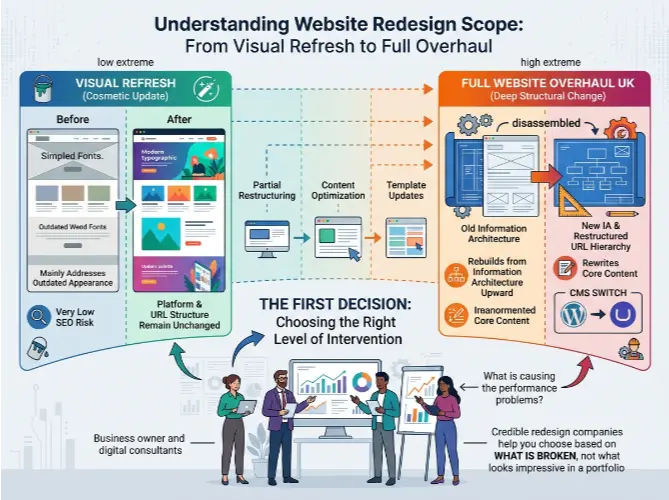
The scope of a website redesign varies considerably depending on what is actually causing the performance problems on the current site. A visual refresh updates the design and layout without touching the URL structure or platform, carrying very low SEO risk and suiting businesses whose main The problem is an outdated appearance. A full website overhaul UK project rebuilds from the information architecture upward, restructures the URL hierarchy, rewrites core content, and frequently involves a CMS switch redesign to a more capable platform. Between those two extremes sits a range of project types, and choosing the right level of intervention is the first decision any credible website redesign company will help you make before Any brief is written or quote produced. The right choice depends on what is broken, not on what looks most impressive in a portfolio.

Full SEO audit of the existing site completed before any design work begins
Every indexed URL documented and mapped to a 301 redirect or new equivalent page
Information architecture defined and approved before visual design starts
Core Web Vitals compliance treated as a hard build requirement, not a post-launch review
Mobile-first development throughout with full functionality from 390px screen width
GDPR-compliant form handling built to UK Data Protection Act 2018 requirements
Schema markup reimplemented across all new page templates as standard
WCAG AA accessibility compliance reviewed and confirmed before launch
Staging environment provided for full client review and sign-off before go-live
Post-launch monitoring for minimum 30 days covering crawl errors, rankings, and conversions
Analytics and Search Console reconfigured for new URL structure before launch day
Content audit carried out to determine what migrates, consolidates, redirects, or retires
Website Redesign Agency UK: Rebuild Your Existing Site Without Losing What You’ve Already Earned specialist

Common issues we fix

New site launches with hundreds of old URLs returning 404 errors and no redirects High
URL structure changed without a documented redirect mapping plan in place High
Core Web Vitals scores worse on new site than on the old one High
Schema markup not reimplemented on new page templates after launch Med
Analytics goals broken because tracking was not reconfigured for new URLs High
Old and new URLs both indexed simultaneously causing duplicate content issues High
GDPR compliance not reviewed during rebuild, legacy forms carried across unchanged High
Mobile layout functional but slow on 4G, harming Quality Score on paid campaigns Med
Internal linking structure broken because it still points to old URL patterns Med
Content migrated blindly from old site, bringing thin and underperforming pages across Med
Redirect chains created instead of direct 301s, diluting passed link equity Med
Search Console property not updated and old property abandoned without monitoring High

What's Included

Everything in our Website Redesign Agency UK: Rebuild Your Existing Site Without Losing What You’ve Already Earned service

A senior developer owns your project from first line to launch. Here is exactly what you get.

Discovery, Audit and Strategy

Every website redesign project begins with a thorough audit of your existing site. We document every indexed URL and measure Core Web Vitals baseline performance, review your current rankings and backlink profile, and audit your analytics data to understand which pages and traffic sources matter most commercially. The audit findings shape the entire project brief and determine the correct scope of work before any design or development resource is committed.

  • Full technical SEO audit of existing site
  • Core Web Vitals baseline measurement on mobile and desktop
  • Complete indexed URL inventory and ranking page identification
  • Backlink profile review for high-equity URLs
  • Analytics and conversion data review
  • Stakeholder brief covering commercial goals and audience
  • Content inventory across all existing pages
  • Competitor gap analysis for organic and conversion opportunities

Information Architecture and Redirect Mapping

The new site structure is defined and approved before a single design element is placed. We build the URL architecture with SEO continuity as the primary constraint, produce a complete 301 redirect map covering every indexed URL, and define the internal linking strategy for the new site. This document becomes the foundation of the entire project and is tested twice before the new site goes live.

  • New URL structure designed for SEO continuity
  • Complete 301 redirect map, every URL documented
  • Navigation structure and internal linking strategy
  • Content gap analysis and page-level decisions
  • Sitemap draft for client approval
  • Redirect map tested in staging before launch
  • Redirect chains identified and resolved to direct 301s
  • Canonical tag strategy defined for new templates

UX Design and Mobile-First Visual Design

Design follows the approved information architecture and the signed-off wireframes, not a template library. We design mobile-first throughout because more than half of UK web traffic now arrives on a mobile device. Every design decision is evaluated against conversion rate optimisation principles, WCAG AA accessibility standards, and the specific audience the site needs to serve commercially.

  • Mobile-first wireframes for all key page templates
  • Visual design for homepage and all primary templates
  • UX design review covering conversion flow and form usability
  • WCAG AA accessibility compliance review
  • Conversion rate optimisation principles applied throughout
  • Client sign-off on full designs before development begins
  • Responsive breakpoints defined and documented
  • Typography, colour, and spacing system documented for handover

Technical Development and SEO Build

The development phase builds the approved designs with technical SEO and Core Web Vitals compliance as hard requirements. We do not use page builder templates that load unnecessary scripts or bloat load times. Schema markup, semantic HTML structure, SSL-secured form endpoints, and GDPR-compliant consent handling are all implemented and verified before the The staging environment is presented for client review.

  • Mobile-first responsive development
  • Core Web Vitals compliance verified before staging sign-off
  • Schema markup implemented across all relevant templates
  • GDPR-compliant form development aligned with UK DPA 2018
  • SSL/TLS security on all data collection endpoints
  • Semantic HTML structure throughout
  • Page speed optimisation built into the development process
  • Staging environment deployed for full client review

SEO Migration and Analytics Setup

Before the new site goes live, every SEO migration element is verified independently. The redirect map is tested link by link. Analytics goal tracking is reconfigured for the new URL structure and tested end to end. end. Search Console is updated with the new sitemap. The pre-launch crawl of the staging environment is completed and all issues resolved. Nothing is launched with outstanding items on the migration checklist.

  • Redirect map fully tested in staging environment
  • GA4 conversion events reconfigured and verified
  • Google Search Console property updated before launch
  • New XML sitemap generated, tested, and submitted
  • Robots.txt reviewed and configured for new structure
  • Pre-launch full site crawl with all issues resolved
  • Schema markup validation confirmed
  • Cross-browser and cross-device testing completed

Launch Management and Post-Launch Monitoring

Launch day is a managed process with a defined checklist, not a button press followed by silence. We monitor Search Console crawl errors daily for the first 30 days after launch, track organic ranking changes across all previously ranking keywords, verify that Core Web Vitals field data is accumulating correctly, and confirm that conversion tracking is reporting accurately across all traffic sources.

  • Managed go-live with defined pre-launch checklist
  • Search Console crawl error monitoring for 30 days
  • Organic ranking tracking across previously ranking keywords
  • Conversion rate tracking against pre-launch baseline
  • Core Web Vitals field data monitoring post-launch
  • Analytics data integrity confirmation post-launch
  • Redirect performance monitoring for chains or errors
  • Post-launch issues resolved within agreed response times

Why It Matters

Why a Properly Managed Website Redesign Pays Back More Than It Costs

The commercial argument for investing in professional website redesign services comes down to three things: the cost of the traffic you're currently losing to poor performance, the cost of the leads your existing site isn't converting, and the cost of what happens to your rankings if The redesign is managed badly. A well-planned website redesign UK project addresses all three simultaneously and builds a platform that compounds value over time rather than one that requires another rebuild in two years.

Web Ranko development team
Get a free website redesign audit

Rankings Protected Through Every Stage of the Migration

A documented redirect mapping plan built before development begins and tested twice before launch, meaning the organic visibility your existing site has accumulated is preserved, and is transferred to the new site. Most ranking losses after redesigns are caused entirely by missing or broken redirects, not by the redesign itself. Fix the process and the risk drops to near zero.

Core Web Vitals Improvements That Directly Affect Rankings

Older UK websites consistently fail all three Core Web Vitals thresholds. A mobile-first rebuild with page speed optimisation built in from the development stage, not reviewed as a post-launch afterthought, regularly moves PageSpeed mobile scores from the twenties to the eighties. The organic ranking improvements that follow within 60 to 90 days are measurable and documented.

Higher Conversion Rate from the First Day the New Site Is Live

A redesign guided by conversion rate optimisation principles from the wireframe stage, not applied as a surface-level visual refresh, produces pages that convert better from launch. Information hierarchy, form usability, call to action placement, and trust signal positioning are all informed by what the analytics data on the existing site tells us is working and what isn't.

GDPR Compliance That Removes Legal Risk and Builds Trust

A website overhaul is the right moment to audit all data collection touchpoint and bring it into full compliance with GDPR and the UK Data Protection Act 2018. Proper consent language, compliant privacy policies, and secure data handling are built into every project as standard. Beyond the legal obligation, transparent data handling is a visible trust signal to UK visitors that converts better anyway.

Mobile Performance That Matches Where Your Traffic Actually Comes From

In most UK business sectors in 2026, more than half of all Web traffic arrives on a mobile device. A mobile-first website redesign service ensures that proportion of your audience experiences a fast, functional, properly structured page rather than a desktop layout squeezed onto a small screen. Mobile conversion rate improvement is consistently one of the largest measurable gains from a professional redesign.

A Platform You Can Actually Manage Without Developer Dependency

The inability to update content without hiring a developer is one of the most common frustrations that drives businesses toward a website redesign in the first place. A properly structured CMS on a maintained platform, with a sensible editorial workflow and trained content editors, removes that dependency and allows your team to keep The site is current without external support for every minor change.

How We Work

How Our Website Redesign Process Works from First Conversation to Post-Launch

The difference between a website redesign that strengthens a business and one that causes months of firefighting and ranking losses is almost entirely in the process. Every stage below is non-negotiable. We do not skip the audit to get to design faster. We do not launch without clearing the pre-launch checklist. And we do not consider the project complete until 30 days of post-launch monitoring has passed without unresolved issues. Here is exactly what working with a website redesign agency that takes SEO migration seriously looks like from start to finish.

Web Ranko development team at work
Senior developers. Fixed-price. No surprises.
Week 1 to 2

Discovery, SEO Audit and Technical Baseline

Before any brief is written or design tool opened, we carry out a full technical audit of your existing site. We crawl every index. URL and document its current ranking, inbound link profile, and traffic contribution. We measure Core Web Vitals baseline scores on both mobile and desktop, review your Google Analytics data to identify highest-value pages and conversion paths, and carry out a content inventory covering every existing page. The audit findings are presented to you as a clear document that defines what the new site must preserve, what it must fix, and what the realistic scope of work looks like for your specific project.

Week 2 to 3

Information Architecture and Redirect Mapping

The new site architecture is built from the audit findings and defined before any visual design begins. We propose the new URL structure with SEO continuity as the primary constraint, produce the complete 301 redirect map covering every indexed URL on the current site, define the navigation structure and internal linking strategy, and carry out a content audit that determines what migrates, what consolidates, and what retires. The architecture document and redirect map are presented for client approval before any designer begins work. This stage is the foundation of the entire SEO for the website redesign and migration process.

Week 3 to 5

Wireframes and Visual Design

Design begins from the approved information architecture, not from a template or a visual brief. Mobile-first wireframes are produced for every key page template and reviewed for conversion flow, form usability, and accessibility before the visual design stage begins. Visual design is developed across the homepage and all primary templates, with a WCAG AA accessibility review carried out before any of it goes to development. Full client sign-off on designs is a gate before development starts. Nothing moves forward without it.

Week 5 to 9

Technical Development and SEO Build

The build phase works from the signed-off designs and the approved redirect map simultaneously. Core Web Vitals compliance is a hard build requirement, measured on staging before any review is requested. Schema markup is implemented across all relevant page types. GDPR-compliant form handling is built to UK Data Protection Act 2018 requirements. SSL is active on all data collection endpoints. Analytics and conversion tracking are reconfigured for the new URL structure during the build, not after launch. The staging environment is deployed and presented for full client review and user acceptance testing before any Pre-launch work begins.

Week 9 to 10

Pre-Launch Audit and Full Migration Testing

Nothing goes live without clearing every item on the pre-launch checklist. The redirect map is tested link by link with broken chains or redirect loops permitted. A full crawl of the staging environment is run and all issues are resolved. Core Web Vitals scores are verified on both mobile and desktop. GA4 conversion events are tested end to end. The GDPR consent flow is tested on every form. WCAG Accessibility compliance is confirmed. Cross-browser and cross-device Testing is completed and signed off. Search Console is updated with the new sitemap. Only when every item is clear does the project move to launch.

Week 10

Managed Launch Day

Launch day follows a defined sequence, not a single button press. The DNS change, redirect activation, Search Console notification, and analytics verification all happen in a coordinated order. A post-launch crawl is run within the first 24 hours to catch any issues that appear under real traffic conditions that the staging environment did not expose. Any issues found are treated as priority items resolved the same day.

Weeks 10 to 14

Post-Launch Monitoring and Performance Review

The project does not close at go-live. We monitor search. Console crawl errors daily for the first 30 days, track organic ranking changes across all previously ranking keywords, verify that Core Web Vitals field data is accumulating as expected, and compare conversion rate on key pages against the pre-launch baseline. Any ranking movements outside expected ranges are investigated and addressed within the monitoring period. A formal performance review is delivered at the 30th. day mark covering all tracked metrics against pre-launch benchmarks.

Real Results

How Our Website Redesign Process Works from First Conversation to Post-Launch

0 Indexed URLs Lost with Our Redirect Mapping Process
87+ Average PageSpeed Mobile Score at Launch vs Industry Average of 51
30 Days of Post-Launch Monitoring Included on Every Project
60-90 Days to Measurable Ranking Improvement After Launch
Sarah Connolly

We had been putting off a website redesign for two years because we were genuinely afraid of losing our Google rankings. The previous agency we spoke to couldn't even explain what a redirect map was. Webranko audited our existing site before quoting, built a full migration plan, and launched the new site without losing a single page's position. Six months Later, our organic traffic is up 62 percent and enquiry volume has more than doubled. The process gave us confidence we hadn't had with any agency before.

Sarah Connolly Operations Director, Meridian Legal Services — Edinburgh

In-Depth Guide

Everything you need to know about Website Redesign Agency UK: Rebuild Your Existing Site Without Losing What You’ve Already Earned

Our team has written a comprehensive guide covering technical specs, best practices, and the exact approaches we use on every project.

What is Website Redesign, and What Does It Involve for UK Businesses?

Website redesign is the process of rebuilding or significantly updating an existing website to improve performance, user experience, visual presentation, or platform capability. For UK businesses, a professional website redesign service covers information architecture planning, SEO migration with full redirect mapping, mobile-first development, Core Web Vitals optimisation, GDPR-compliant form handling under the UK Data Protection Act 2018, and conversion rate improvements. The scope ranges from a visual refresh of an existing platform to a full CMS migration and structural rebuild. The critical distinction from building a new site is that a redesign must preserve all existing search equity, indexed URLs, and ranking signals accumulated by the current domain.

There’s a particular kind of frustration that comes from owning a website you know isn’t performing. The traffic is there, some of it. But visitors don’t convert. The design belongs to a different era. Your team cringes when they share the URL with a prospective client. You know it needs to change.

You also know what happened last time someone sorted the website. It took twice as long, cost more than the quote, and the Google rankings never fully recovered.

That last part is what every UK business owner thinking about a website redesign is actually worried about. It’s the part most agencies don’t address honestly.

Done without proper SEO migration planning, a website redesign can destroy years of accumulated search visibility within days of launch. Done properly by a specialist website redesign company with a structured migration process, it improves your rankings, increases your conversion rate, and builds a platform that works far harder than the one it replaced. At Webranko, we’ve seen both outcomes. Our entire website redesign process is built around guaranteeing the second one.


What Website Redesign Actually Means

Defining the Scope Before Any Work Begins

Not every project that carries the label “website redesign” involves the same scope of work. The right level of intervention depends entirely on what’s actually causing the performance problems on the current site, and choosing incorrectly has consequences both for your budget and for your search visibility continuity.

Understanding the difference before you brief any website redesign agency is essential.

Website Refresh vs Full Website Redesign vs CMS Migration

Project Type What Changes SEO Risk Level Typical UK Cost Typical Timeline
Visual refresh Design and layout only, same URLs and CMS Low £1,500 to £4,000 4 to 6 weeks
Partial redesign Key templates redesigned, structure mostly unchanged Low to medium £3,000 to £7,000 6 to 10 weeks
Full website redesign Structure, content, design, and URL architecture rebuilt Medium to high £5,000 to £20,000 10 to 18 weeks
CMS switch redesign Full rebuild on new platform with full content migration High £8,000 to £25,000 12 to 22 weeks
E-commerce redesign Product catalogue, checkout, and platform migration High £10,000 to £35,000 14 to 26 weeks
Headless CMS rebuild Decoupled architecture with API integration throughout Very high £15,000 to £50,000+ 16 to 32 weeks

The Three Core Questions to Answer Before Briefing Anyone

Before you speak to a single website redesign company, get clear on these three things:

What specific problem is the current site failing to solve, whether that’s conversion rate, search visibility, load speed, or content management difficulty? Has the brand or service positioning changed significantly since the current site was built? Is the current CMS platform capable of supporting what the new site needs to do, or is the platform itself part of the problem?

The answers determine whether you need a refresh, a redesign, or a full migration. They also tell you which type of agency to look for, because a studio that excels at visual redesigns is not the same as a website redesign company experienced in managing complex SEO migrations. Webranko handles both ends of that spectrum, and we’re direct about which one a project actually needs.


Why Your Existing Site Is Costing You Business Right Now

The Gradual Erosion That’s Hard to Spot in Real Time

An outdated website rarely fails dramatically. It erodes performance slowly, in ways that don’t always appear obviously in weekly traffic reports until the cumulative damage is genuinely difficult to reverse. The business in Leeds that ranked on page one for its primary service terms three years ago and now sits on page three. The e-commerce operation in Birmingham whose mobile conversion rate has been declining for eighteen months. The consultancy in Bristol whose inquiry volume dropped 30 percent without any obvious change in traffic quality.

These aren’t random declines. They’re predictable consequences of a site that hasn’t kept pace with how Google now evaluates page quality and how UK visitors expect websites to behave in 2026.

Core Web Vitals: Why Older Sites Consistently Fail

Google’s Core Web Vitals framework measures real-world page experience across three dimensions. Sites built before 2021 regularly fail all three, not because they were poorly built at the time, but because the technical standards have moved significantly since then.

Core Web Vital What It Measures Passing Threshold Common Fail Cause on Older Sites
Largest Contentful Paint (LCP) How fast the main content loads Under 2.5 seconds Unoptimised images, render-blocking scripts
Cumulative Layout Shift (CLS) Visual stability during page load Under 0.1 Late-loading fonts, ads, dynamic content
Interaction to Next Paint (INP) Page responsiveness to user input Under 200ms Heavy JavaScript, poor main thread management

A poor Core Web Vitals score affects organic rankings directly. Webranko’s website redesign UK clients consistently see measurable ranking improvements within 60 to 90 days of launching a Core Web Vitals-compliant rebuild, even when the content itself hasn’t changed.

Mobile-First Indexing and Structurally Outdated Sites

Google has operated mobile-first indexing since 2020, meaning the mobile version of a site is what Google primarily uses to assess and rank content. Sites built with a desktop-first approach, where the mobile version was an afterthought, carry a structural disadvantage that no amount of visual polish can fix.

Mobile-friendly website development isn’t only about layout fitting a small screen. It requires content parity between mobile and desktop versions, touch-optimised interaction design, sub-3-second load times on a 4G connection, and form usability that doesn’t require a stylus to complete.

Signs Your Site Is Overdue for Professional Website Redesign Services

Performance and technical signals: PageSpeed Insights mobile score below 50, Core Web Vitals failing in Google Search Console, bounce rate above 70 percent on primary landing pages, mobile conversion rate below half the desktop rate, SSL certificate outdated or missing, CMS so old that security updates are no longer available, crawl errors increasing month on month in Search Console, no schema markup implemented on any page template.

Business and commercial signals: conversion rate declining without a corresponding drop in traffic quality, sales team avoiding sharing the URL in client-facing situations, competitor sites visibly outclassing yours in every measurable dimension, content updates so technically difficult they’re regularly deferred, brand positioning has evolved but the site still reflects where you were four years ago, lead quality declining because the site no longer attracts the right audience.


SEO for Website Redesign and Migration: The Part Most Agencies Get Wrong

Why Redesigns Destroy Rankings and How to Prevent It

The single most common cause of post-redesign ranking loss is broken redirect mapping. When a website redesign changes the URL structure, which most full redesigns do, every old URL that no longer exists needs a permanent 301 redirect pointing to the most relevant equivalent page on the new site.

Without this, Google loses the link equity, crawl signals, and ranking history accumulated by those old URLs. Pages that ranked because of years of backlinks, content authority, and user behaviour data effectively restart from zero. Webranko has audited post-redesign sites in the UK where hundreds of previously indexed URLs were returning 404 errors with no redirects in place whatsoever. The traffic loss in those cases was immediate and in some instances permanent.

The Full Scope of SEO for Website Redesign and Migration

Professional SEO for website redesign and migration goes well beyond redirect mapping. Every element in the table below needs to be addressed before the new site goes live.

SEO Migration Component What It Involves When It Must Be Done
Full site crawl and URL inventory Every indexed URL documented before changes begin Before information architecture is finalised
Redirect mapping Every old URL mapped to its closest new equivalent Before development begins
Canonical tag review Canonical tags correctly implemented on new templates During development
Schema markup reimplementation All structured data rebuilt on new page templates During development
Internal linking audit Internal link structure mapped to new URL architecture During development
XML sitemap update New sitemap generated and tested before submission Pre-launch
Robots.txt review New configuration tested against staging crawl Pre-launch
Pre-launch staging crawl Full crawl of staging environment before go-live Pre-launch
Search Console property update New property verified, old property monitored On launch day
Analytics goal reconfiguration GA4 events and conversion tracking verified on new structure Before launch
Post-launch monitoring Daily crawl error monitoring for a minimum of 30 days Post-launch

What Happens Without Proper SEO Migration Planning

Risk Root Cause Business Consequence
Immediate ranking drops URL changes with no redirects Organic traffic loss within days of launch
Loss of link equity Backlinks pointing to 404 pages Competitors benefit from your lost authority
Crawl budget waste Orphaned pages and broken internal links Important pages indexed less frequently
Duplicate content penalties Old and new URLs both indexed simultaneously Keyword cannibalisation and ranking dilution
Rich result loss Schema markup not reimplemented Featured snippet and rich result eligibility disappear
Analytics data gaps Tracking not reconfigured for new URL structure Post-launch performance unmeasurable
Page speed regression The new design technically heavier than old site Core Web Vitals scores worsen after launch
GDPR compliance gap Forms not reviewed during rebuild Legal risk under UK DPA 2018

Webranko’s SEO Migration Process: How We Protect What You’ve Built

Before any design tool is opened, Webranko carries out a full SEO audit of the existing site. We crawl every indexed URL, identify which pages carry meaningful rankings and inbound links, and build a comprehensive redirect plan that is part of the project specification from day one. The redirect map is tested twice: once in staging and once immediately after launch. We don’t consider a website redesign project complete until 30 days of post-launch Search Console monitoring has passed without unresolved issues.


Website Redesign London: What UK Businesses in the Capital Need Specifically

Why Website Redesign Projects in London Carry Additional Considerations

For businesses operating in London and the wider South East, website redesign projects carry competitive pressures that businesses in other UK regions experience less acutely. London markets across professional services, financial services, property, legal, and e-commerce are among the most competitive in the country for organic search.

A website redesign London project that causes even a short-term ranking dip can hand established competitors an advantage that takes months to claw back. The technical precision required in the migration planning phase is proportionally higher when the existing site is ranking competitively in high-value London search terms.

What London Businesses Need from a Website Redesign Company

Technical requirements specific to competitive London markets: comprehensive pre-launch SEO audit covering all ranking pages and their associated backlink profiles, competitor gap analysis identifying content and structural improvements the redesign can capitalise on, local SEO signal preservation including Google Business Profile consistency and local schema markup, multi-location handling if the business serves both London and wider UK markets, load performance optimised for high mobile usage typical of London commuter audiences.

Commercial and trust requirements: case studies from comparable London businesses or sectors, not generic before-and-after screenshots, transparent pricing and project timeline documentation, named contacts and direct communication rather than account management layers, GDPR compliance built into every form and data collection touchpoint from day one.


Choosing the Right Website Redesign Agency or Company

What Separates Agencies That Protect Your SEO from Those That Don’t

There’s no shortage of studios and agencies in the UK that will take a website redesign brief. The ones that genuinely understand the SEO implications of what they’re doing are considerably rarer, and the difference becomes very apparent in the months after a new site launches.

Here’s what to look for when evaluating any website redesign agency or website redesign company before you commit.

Non-negotiable technical competence: they produce a documented redirect mapping plan before development begins, not after. They conduct a full pre-launch crawl of the staging environment and fix all issues found. They verify Core Web Vitals scores on staging before the new site goes live. They reimplement schema markup on all relevant new templates as a standard deliverable. They reconfigure Analytics and Search Console before launch, not as a post-launch task.

Process transparency: discovery and audit come before design, without exception. Information architecture is proposed and approved before any visual design begins. A staging environment is provided for full client review and sign-off before go-live. There is a defined go-live checklist covering both technical SEO and functional items.

UK-specific capability: GDPR and UK DPA 2018 compliance is standard, not an add-on. WCAG accessibility compliance is included in the deliverables. The agency has experience managing UK-specific hosting environments and domain configurations.

Questions Worth Asking Any Website Redesign Agency Before Signing

Question What a Credible Answer Looks Like
How do you approach redirect mapping? A documented URL-by-URL process created before development
Do you conduct a pre-launch SEO crawl? Yes, on staging, with a defined list of what they look for
How do you handle Core Web Vitals? A build requirement verified before launch, not a post-launch audit
Who manages the analytics migration? Named process with specific tracking events verified before go-live
What happens if rankings drop after launch? Defined monitoring period and response process
Is GDPR compliance included as standard? Yes, built in from the development stage
Do you provide a staging environment? Yes, with sign-off from the client before anything goes live
Can you share organic traffic data from previous redesign projects? They should be able to show before and after Search Console data

Red Flags That Should Stop the Conversation Immediately

They can’t explain what a 301 redirect is or why it matters to rankings. The portfolio shows finished pages with no discussion of performance outcomes. GDPR compliance, accessibility, and schema markup are quoted as additional services. No staging environment is mentioned in their process. The proposed timeline seems implausibly short for the scope described. They’ve never used Google Search Console to monitor a live migration. They recommend starting with a brand-new domain to avoid migration risk.


CMS Migration and Platform Switching Within a Redesign

When Redesigning Means Moving Platforms

Many website overhaul projects involve a platform change. Moving from a legacy bespoke system to WordPress, switching from WordPress to a headless CMS, migrating from Wix or Squarespace to a properly hosted custom build, or moving from Magento to WooCommerce for e-commerce. A CMS switch redesign adds a significant layer of complexity to an already involved project and demands additional technical rigour in the migration planning.

Common Platform Migration Scenarios Webranko Handles

Migration Path Typical Reason for Switching Key Technical Considerations
Bespoke legacy to WordPress Maintenance cost, poor content management Content migration, URL continuity, plugin architecture
WordPress to headless CMS Performance, flexibility, developer experience API integration, frontend rebuild, editorial workflow
Wix or Squarespace to WordPress SEO control, scalability, customisation Full redirect mapping, content export and clean reimport
Magento to WooCommerce Reduced operational cost, simpler management Product data migration, order history, payment gateway
WordPress to WordPress rebuild Theme architecture or plugin stack overhaul URL continuity, plugin audit, data integrity
Static HTML to CMS Updateability, content management capability Structure mapping, content entry, redirect handling

Content Audit: What Comes Across and What Doesn’t

A platform migration is also the right moment for a thorough content audit. Not everything on the old site deserves to come across to the new one. Pages with no organic traffic, no inbound links, and no active business purpose dilute crawl budget and add structural noise to the new site architecture.

Webranko categorises every existing page into one of four buckets:

Migrate: pages with meaningful traffic, rankings, or backlink equity that come across in full. Consolidate: multiple thin pages covering overlapping topics that are merged into one stronger page. Redirect: pages with no standalone value that redirect to the most relevant equivalent on the new site. Remove: pages with no traffic, no links, no rankings, and no business purpose that are simply retired.

The new site launches leaner, better structured, and with a content architecture that serves both search visibility and user experience from the first day it’s live.


Webranko’s Experience Delivering Website Redesign Services Across the UK

What We’ve Learned Across Real UK Projects

The knowledge in this content doesn’t come from theory. It comes from managing website redesign projects for UK businesses across sectors including professional services, e-commerce, construction, financial services, healthcare, and hospitality.

On redirect mapping: Webranko audited a post-redesign site for a professional services business in Manchester where 340 previously indexed URLs were returning 404 errors. The agency that built the new site had not produced a redirect plan. Within 14 days of implementing the full redirect map, Search Console showed crawl errors reducing by 90 percent. Organic impressions recovered to pre-launch levels within six weeks.

On Core Web Vitals: a legal services business in London had a PageSpeed mobile score of 23 before their redesign. The new build, developed mobile-first with image optimisation and deferred non-critical scripts, launched with a mobile score of 87. Rankings for primary commercial terms improved by an average of four positions within 90 days of launch.

On CMS platform migration: Webranko handled a full Magento to WooCommerce migration for an e-commerce business in Leeds with a product catalogue of 1,200 SKUs. Comprehensive redirect mapping, product data migration with clean URL restructuring, and a 30-day post-launch monitoring period resulted in zero measurable organic traffic loss across the first three months post-launch.

On GDPR compliance: during a redesign audit for a Birmingham-based SMB, we identified that the legacy contact form was storing submission data in the CMS database with no data retention policy, no consent checkbox, and no privacy policy link. The Webranko redesign included proper consent handling, a compliant privacy policy, and a data retention process aligned with UK DPA 2018 requirements. This isn’t just legal hygiene. It’s a trust signal that UK visitors notice.


Webranko’s Website Redesign Services: Full Scope and Process

Stage 1: Discovery and Audit

Before anyone opens a design application, we need to understand what the current site has built over time and what the new site needs to achieve commercially. This stage covers: a full technical SEO audit of the existing site covering all indexed URLs, ranking pages, backlink profile, and crawl errors. Core Web Vitals baseline measurement and performance benchmarking on both mobile and desktop. Content inventory and audit across all existing pages using traffic and ranking data. Analytics review identifying current traffic patterns, conversion paths, and highest-value pages. Stakeholder brief covering business goals, target audience, brand positioning, and commercial conversion priorities.

Stage 2: Information Architecture and Redirect Mapping

The new site architecture is defined and approved before any design work begins. Deliverables at this stage include: new URL structure designed with full SEO continuity from the existing site, complete 301 redirect map covering every indexed URL mapped to its new equivalent, navigation structure and internal linking strategy for the new site, content gap analysis identifying pages to create, consolidate, or retire, sitemap draft submitted for client approval before design begins.

Stage 3: Design

Design follows the approved information architecture, not the other way round. Key deliverables at this stage: mobile-first wireframes for all key page templates, visual design for homepage, primary service or product pages, and secondary templates, UX design review covering form usability, conversion flow, and accessibility, WCAG AA accessibility compliance review before any development begins, full client sign-off on designs before development starts.

Stage 4: Development

The build phase uses signed-off designs and the confirmed redirect map. Build requirements include: mobile-first responsive development throughout, Core Web Vitals compliance as a hard build requirement, schema markup implemented across all relevant page types, GDPR-compliant form development with UK DPA 2018-aligned consent handling, SSL/TLS security on all data collection endpoints, semantic HTML structure throughout, analytics and conversion tracking reconfigured for the new URL structure, staging environment deployed for full client review before any launch.

Stage 5: Pre-Launch Audit and Testing

Nothing goes live without clearing this checklist in full: full crawl of staging environment with all issues resolved before launch, redirect map tested across every URL with no broken chains or redirect loops, Core Web Vitals scores verified on both mobile and desktop, GA4 conversion tracking verified and tested, Search Console property updated and new sitemap submitted, form submission testing and GDPR consent flow end-to-end testing, WCAG accessibility audit cleared, cross-browser and cross-device testing completed and signed off.

Stage 6: Launch and Post-Launch Monitoring

Search Console crawl error monitoring for a minimum of 30 days post-launch. Organic ranking changes tracked across all previously ranking keywords. Core Web Vitals field data monitored as real traffic accumulates. Conversion rate on key pages tracked against pre-launch baseline. Analytics data integrity confirmed across all goal tracking.


What’s Included in Webranko’s Website Redesign Services

Deliverable Standard Redesign Full Redesign with SEO Migration
SEO audit of existing site Yes Yes, comprehensive
Content inventory and audit Basic Full with categorisation
Information architecture planning Yes Yes
301 redirect mapping Yes, documented Yes, fully tested
Mobile-first wireframes Key templates All templates
Visual design Yes Yes
WCAG AA accessibility compliance Yes Yes
Core Web Vitals optimisation Yes Yes
GDPR-compliant form development Yes Yes
Schema markup Basic Full implementation
Pre-launch SEO crawl Yes Yes
Analytics migration and reconfiguration Yes Yes
Post-launch monitoring (30 days) No Yes
Copywriting Optional Optional
CMS training 1 hour 2 hours
Maintenance retainer Optional Optional

Pricing and Timelines for UK Website Redesign Projects

Project Type Typical UK Cost Range Typical Timeline
Visual refresh, same CMS and URLs £1,500 to £4,000 4 to 6 weeks
Small business redesign, 5 to 15 pages £4,000 to £8,000 6 to 10 weeks
Mid-size business redesign, 15 to 50 pages £8,000 to £16,000 10 to 16 weeks
CMS switch redesign with full migration £10,000 to £22,000 12 to 20 weeks
E-commerce redesign with product migration £12,000 to £35,000 14 to 26 weeks
Headless CMS rebuild with API integration £18,000 to £55,000+ 18 to 34 weeks

Frequently Asked Questions

What is website redesign, and what does the process involve?

Website redesign is the process of rebuilding or significantly updating an existing site to improve performance, design, conversion rate, or platform capability while preserving accumulated search equity. A professional website redesign service like Webranko’s covers information architecture, SEO migration, mobile-first development, GDPR compliance, and conversion optimisation.

Can you redesign my existing website without losing my Google rankings?

Yes, with proper SEO for website redesign and migration planning in place. The critical elements are a documented 301 redirect map covering every indexed URL, a pre-launch crawl of the staging environment, Search Console monitoring for 30 days after launch, and schema markup reimplemented on all new templates. Ranking loss during redesigns is almost always caused by missing redirects, not the redesign itself. Webranko’s migration process is built specifically to prevent it.

How much do website redesign services cost in the UK?

Website redesign services range from around £1,500 for a visual refresh to £35,000 or more for a complex e-commerce redesign with CMS migration. A straightforward small business redesign with full SEO migration planning typically falls between £4,000 and £10,000. A scoped proposal from Webranko after a discovery session gives an accurate figure for your specific project.

What is the difference between a website refresh and a full website redesign?

A website refresh updates the visual presentation without changing URLs, platform, or content structure. A full website redesign rebuilds from the information architecture up, often switching CMS platforms and restructuring the URL hierarchy. The right choice depends on what’s actually causing the performance problem, not on budget alone.

Do Webranko’s website redesign services include GDPR compliance?

Yes, as standard. Every site Webranko rebuilds includes GDPR-compliant form handling aligned with UK Data Protection Act 2018 requirements, explicit consent language on all data collection forms, a linked privacy policy, and secure data routing. This is built in from the development stage rather than retrofitted after handover.

What does website redesign SEO involve, specifically?

Website redesign SEO covers the full technical migration process: URL inventory, redirect mapping, schema markup reimplementation, canonical tag review, internal linking restructure, sitemap update, robots.txt review, pre-launch staging crawl, Search Console reconfiguration, and post-launch monitoring. It’s the process of ensuring the new site inherits all the search equity the old site accumulated.

Should I use the same domain or start fresh for a redesign?

Always use the same domain for a redesign unless there’s an extremely specific strategic reason to change it. The existing domain carries years of accumulated authority, indexed pages, backlinks, and crawl history that a new domain starts without. A well-managed website redesign UK project, like the ones Webranko delivers, preserves and builds on all of that. Starting fresh means accepting twelve to eighteen months of lost organic visibility during recovery.

How long does a website redesign take for a UK business?

A visual refresh takes four to six weeks. A full redesign for a small to mid-size UK business typically runs ten to sixteen weeks from initial brief to launch. CMS migrations and e-commerce redesigns with product data migration take longer. The discovery and audit stage at the beginning is what determines an accurate timeline for your specific project. Get in touch with Webranko at webranko.co.uk to start with a scoped assessment.

FAQ

Website Redesign questions, answered honestly

The questions UK businesses ask most often before committing to a website redesign project, answered honestly and without jargon. These are the questions that matter because they're the ones that determine whether your A redesign strengthens your business or creates six months of damage control.

Ask us anything
What is website redesign and what does the full process involve?
Website redesign is the process of rebuilding or significantly updating an existing site to improve performance, design, conversion rate, or platform capability while preserving accumulated search equity. A professional website redesign service covers SEO audit, information architecture, redirect mapping, mobile-first development, Core Web Vitals optimization, GDPR-compliant data handling, and post-launch monitoring.
Can you redesign my existing website without losing my Google rankings?
Yes, with a documented SEO migration plan built before development begins. The critical elements are a complete 301 redirect map covering every indexed URL, a pre-launch staging crawl with all issues resolved, Search Console monitoring for 30 days after launch, and schema markup reimplemented on all new templates. Ranking loss after a redesign is almost always caused by missing redirects, not the redesign itself.
How much does a website redesign cost in the UK?
Website redesign services range from around £1,500 for a visual refresh to over £35,000 for a complex e-commerce redesign with full CMS migration. A straightforward small business redesign with proper SEO Migration planning typically falls between £4,000 and £10,000. A scoped proposal after a discovery session gives an accurate figure for your specific project scope.
What is the difference between a website refresh and a full website redesign?
A website refresh updates the visual design and layout without changing the underlying URL structure, platform, or content architecture. A full website redesign rebuilds from the information architecture up. often switching CMS platforms and restructuring the URL hierarchy. The right choice depends on what is actually causing the performance problem. not on budget alone.
What does SEO for website redesign and migration actually involve?
SEO for website redesign and migration covers the full technical process of preserving search equity during a rebuild. This includes complete URL inventory, 301 redirect mapping, schema markup reimplementation, canonical tag review, internal linking restructure, XML sitemap update, robots.txt review, pre-launch staging crawl, Search Console reconfiguration, and a minimum 30-day post-launch monitoring period.
Do website redesign services include GDPR compliance?
Yes, as standard on every project. Every site we rebuild includes GDPR-compliant form handling aligned with UK Data Protection Act 2018 requirements, explicit consent language on all data collection forms, a linked and compliant privacy policy, and secure data routing from form endpoints. Compliance is built in from the development stage, not retrofitted after handover.
Should I use the same domain or start fresh during a website redesign?
Always use the same domain unless there is a specific strategic reason for a domain change, and even then, a managed migration between domains requires exactly the same redirect process. Your existing domain carries years of accumulated authority, indexed pages, inbound links, and crawl history that a new domain starts without. A well-managed website The redesign UK project preserves and builds on all of that.
How long does a website redesign take for a UK business?
A visual refresh typically takes four to six weeks. A full redesign for a small- to mid-size UK business runs ten to sixteen weeks from the initial brief to launch. CMS switch redesigns and e-commerce Projects with product data migration take longer. The discovery and audit stage at the beginning is what determines an accurate timeline for a specific project, not an average.

Start today

Ready to Redesign Your Existing Website Without the Risk?

Every month you delay a website redesign, your outdated site is costing you leads your competitors are collecting. But a redesign done without a proper A migration plan can make things significantly worse before they get better. We start every project with a free audit of your existing site so you understand exactly what needs to change, what needs to be protected, and what A well-managed website redesign company would charge for your specific scope. No generic quotes. No surprises after the invoice.

What's in your free consultation

Delivered in 48 hours by a senior developer.

Free SEO audit of your existing site before any quote is produced
Complete 301 redirect mapping included on every redesign project
Core Web Vitals compliance verified on staging before launch day
Thirty days of post-launch monitoring included on every full redesign project