


In-Depth Guide
The Complete Guide to Website Speed Optimisation
Our team has written a comprehensive guide covering technical specs, best practices, and the exact approaches we use on every project.
What Does a Website Speed Optimisation Service Actually Do?
A professional website speed optimisation service audits your existing site using tools like GTmetrix and Lighthouse, then fixes the specific technical issues dragging down your load times and Core Web Vitals scores. This includes server-level work covering time-to-first-byte, hosting performance, and CDN configuration; front-end work covering image formats, render-blocking scripts, and layout stability; and CMS-level fixes for WordPress or WooCommerce environments. The result is measurable. Faster pages, better Google rankings, and more visitors who stay long enough to convert.
Slow Is Not Just Annoying. It Is Costing You Customers.
A visitor in Leeds does not wait. Neither does one in Edinburgh or Bristol. Research from Google has consistently shown that pages taking longer than three seconds to load see bounce rates climb sharply, and for mobile users in the UK, the threshold is even less forgiving.
Speed is a ranking signal. It has been confirmed as part of Google’s Page Experience update, and Core Web Vitals now form part of the direct ranking criteria. If your competitors have cleaner scores on Largest Contentful Paint and Cumulative Layout Shift, they have a structural advantage over you in the SERP, even with weaker content.
But the conversion impact is often bigger than the ranking impact. We worked with a Birmingham-based service business whose homepage was loading at 7.2 seconds on mobile. After fixing image delivery, resolving render-blocking JavaScript, and switching to a UK-based CDN node, load time dropped to 1.8 seconds. Enquiries from organic traffic increased 34% in the following 60 days. The site’s content hadn’t changed. The audience hadn’t changed. The speed had.
What Actually Slows a Site Down in 2026
People assume slow sites are caused by bad hosting. Hosting matters, and a poor server with a high time to first byte is often the first culprit we find, but it is rarely the whole story.
Here is what we typically find when we audit a UK SMB site.
Unoptimised images are almost universal. Hero images served at 2MB in JPEG format, when WebP at 180KB would render identically. There is no excuse for this in 2026, but it is still the most common issue on WordPress sites we see.
Render blocking resources. Third-party scripts like live chat widgets, analytics tags, and cookie consent banners load synchronously and hold the browser hostage before it renders anything visible. This kills LCP scores, which directly affects your Google PageSpeed score.
CLS issues. Layout shift happens when elements jump around as the page loads. Fonts swapping in, images without dimensions, and banners loading late. Google measures this as cumulative layout shift. It is fixable, but it requires knowing where to look.
Hosting performance. A shared hosting environment in the US, serving pages to users in Manchester, adds latency before a single asset even starts to download. UK hosting or a properly configured CDN with UK edge nodes makes a meaningful difference, especially for time to first byte.
WordPress-specific bloat. Themes loading 12 font variants. Plugins add their own CSS and JavaScript to every single page, regardless of context. WooCommerce cart fragments are firing AJAX requests on non-shop pages. These are the issues that don’t show up in basic audits but quietly damage your performance score.
Core Web Vitals Optimisation: What Each Metric Means for Your Business
Google measures three Core Web Vitals. You don’t need to memorise the technical definitions, but you do need to understand what each one costs you when it fails.
LCP, or Largest Contentful Paint, measures how quickly your main content loads. Fail this and users perceive your site as slow before they’ve even decided whether it’s relevant. Target: under 2.5 seconds.
CLS or Cumulative Layout Shift measures visual stability. A page that jumps around while loading feels broken. It’s one of the leading causes of accidental clicks and frustrated exits. Target: under 0.1.
INP or Interaction to Next Paint replaced FID in 2024 and measures how quickly the page responds when a user actually does something, like clicking a menu or submitting a form. For WooCommerce sites, particularly, this is where we see failures that never get caught because they’re not obvious on initial page load.
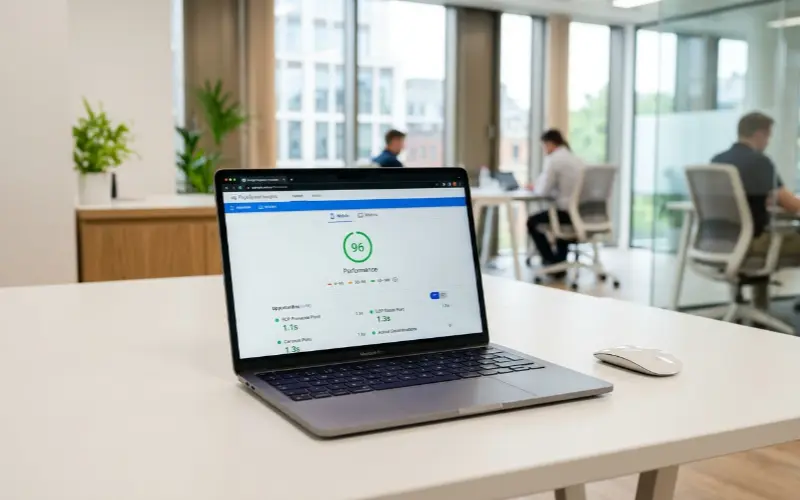
All three feed into your Google PageSpeed score. A score above 90 on mobile isn’t just a vanity metric. It’s a real indicator that your site isn’t giving Google a reason to rank you below a competitor.
What a WordPress Speed Optimisation Project Looks Like
WordPress speed optimisation is its own discipline. The flexibility that makes WordPress great, plugins, themes, and customisation, is also what creates performance debt over time.
Our process starts with a full technical audit. GTmetrix and PageSpeed Insights provide headline scores, but the real work is in the waterfall. Identifying which specific resources are causing the most damage and in what order they load. From there, we work through the stack systematically.
At the server level, that means checking your hosting provider’s UK response times, reviewing your PHP version, and configuring object caching correctly. At the WordPress level, it means auditing your active plugins, removing redundant CSS and JavaScript from pages that don’t need them, and fixing image delivery. WebP conversion, lazy loading, and correct srcset attributes all matter here.
If your theme is generating excessive database queries or loading Google Fonts via external requests instead of self-hosting them, we fix it. If your WooCommerce configuration is running cart fragment AJAX requests on the homepage, we fix that too.
The goal is a GTmetrix score of A (90 or above) and Core Web Vitals in the green. The actual load experience matches the numbers, not just the lab test.
Speed Optimisation Is Not a Rebuild
Worth saying clearly: this service is for your existing site. We are not redesigning it, changing your branding or moving you to a new CMS. If your site is fundamentally broken and needs a full rebuild, that is a different conversation. Our website redesign service handles that.
What we are doing here is surgical. You keep your site. You keep your content and your current Google rankings. You just get a version of it that loads substantially faster and scores better on the metrics that Google and your visitors actually care about.
Getting Started
The first step is understanding what is actually slowing your site down. A lot of agencies will sell you a speed fix before they’ve properly looked at your site. We don’t.
Send us your URL, and we’ll run an initial audit covering GTmetrix, PageSpeed Insights, and a manual review of your hosting performance and CMS configuration. From there, you get a clear picture of what